In 2003, Lakewood homeowners defeated a city plan to use eminent domain to clear their neighborhood for private retail development
In a significant victory for homeowners, Lakewood, Ohio residents successfully opposed a city plan to declare their neighborhood blighted and clear it for private retail development. This article explores their struggle against eminent domain abuse and its implications for homeowners nationwide.
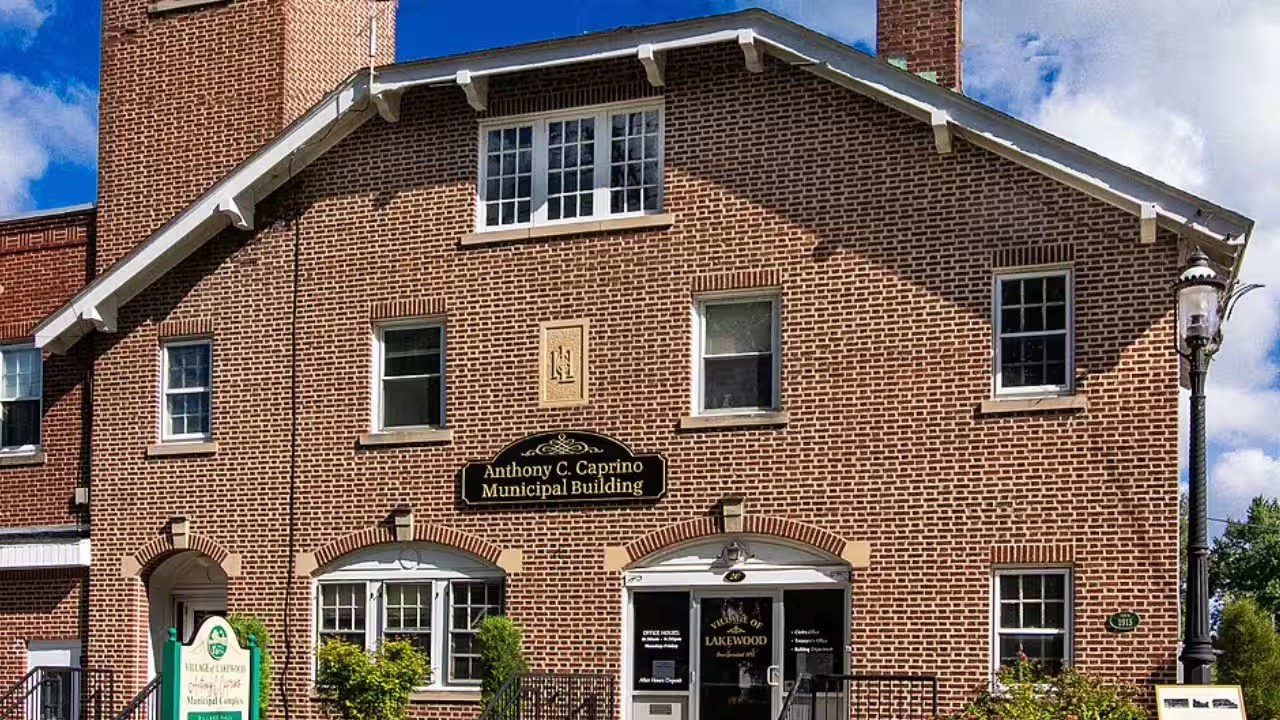
Lakewood, Ohio, a Lake Erie suburb of Cleveland, counted 50,942 residents in the 2020 census and has long called itself the City of Homes. It came as a jolt when its own leaders described a stretch of those homes as a problem to be removed. In 2003, a plan to clear one neighborhood for private retail and housing development landed on the ballot, and the result came down to a few dozen votes. The story is worth retelling because it shows how an ordinary neighborhood can end up labeled blighted, and how neighbors with a lawyer, a petition and persistence can undo that label. Here is how it unfolded, along with the national context that shaped it.Lakewood approves a development plan and blight finding for the West EndIn December 2002, the City of Lakewood adopted a community development plan for its West End and declared the area blighted under local law, as the Institute for Justice documented. The developers involved were Centerpoint Properties, Jeffrey R. Anderson Real Estate and Heartland Developers, and the institute later defended the property owners in their lawsuit. The plan provided for a shopping mall and upscale condominiums, and the institute describes the blight declaration as the tool that would let the city, under Mayor Madeline Cain, use eminent domain. The city's study of blight pointed to the area's high number of police and firefighter calls, as well as its functional and economic obsolescence. The institute disagrees with this characterization since there were neither major crimes nor fires in the area, which was similar to the rest of Lakewood. Because the area was attractive, the city leaned on a very broad definition: a home had characteristics of blight if it lacked a two-car garage, had fewer than two full bathrooms, or had fewer than three full bedrooms. Under that test, about 93 percent of Lakewood homes would qualify, the group reported in its March 2004 press release.Property owners sue the city and rally outside City HallOn May 19, 2003, 17 property owners filed a lawsuit against the City of Lakewood's blight designation in the Cuyahoga County Court of Common Pleas, with assistance from the Institute for Justice. They held a rally outside the City Hall that same day, prior to a meeting of the council where members were to vote on the deal with developers. Dana Berliner, the institute's senior attorney, spoke for the homeowners. She had also written Public Power, Private Gain, a nationwide report released earlier that year.In late June, Judge Kathleen Ann Sutula denied the city's motion to dismiss, and the institute made that decision public on July 1, 2003. Legal action was but one aspect of the strategy used to fight the law. Mark and Gilda Timieski, who did not live in the neighborhood facing condemnation but saw the threat to all of Lakewood, were among the residents who pushed to put the project to a vote, as the institute's Liberty & Law magazine reported.Lakewood voters reject the redevelopment plan by 39 votesIn the November 2003 election, voters rejected the redevelopment plan by a margin of 39 votes. The referendum, labeled Issue 47, asked residents to vote no on the city's agreement with the private developer for a shopping center and condominiums. The victory was partial. The city chose not to strip the area of its blight designation, leaving it vulnerable to condemnation should another developer come with a proposal.Voters pass Issue 10 and repeal the blight labelCitizens returned to the polls once again. Issue 10 passed by 8,278 votes to 4,831, more than 63 percent, as the institute reported the following day. According to one of the institute’s clients, homeowner JoAnn Saleet, it was the end of a tough period. The removal of the blighted designation took away the city’s stated path to acquiring the property for private use.Two Institute for Justice reports document a national patternLakewood was not an isolated case. The above-mentioned study covered 1998 through 2002 and counted more than 10,000 properties that governments had condemned or threatened to condemn for private development. The institute later called it its first-ever nationwide study in a 2005 press release, so that billing rests on the group's own description rather than an independent review. A second report by the same author, Opening the Floodgates: Eminent Domain Abuse in the Post-Kelo World, examined the year after the U.S. Supreme Court's Kelo v. City of New London decision, and the institute summarized it in a June 20, 2006 press release. Local governments pressed ahead with more than 117 projects in that single year, threatened more than 5,429 homes, businesses, churches and other properties with condemnation, and filed or authorized at least 354 condemnation actions. That made 5,783 properties in all, against 10,282 over the five years from 1998 to 2002.Ohio imposes a moratorium in 2005 and the Supreme Court rules on Norwood After Kelo, Ohio took action. Governor Bob Taft signed Senate Bill 167 on November 16, 2005, placing a 14-month moratorium on economic development takings of nonblighted property, as documented by the Ohio Legislature. The Ohio Supreme Court then ruled unanimously on July 26, 2006, in Norwood v. Horney, that the Ohio Constitution does not permit eminent domain used solely for economic development, as the institute's 2007 report card on Ohio described. That ruling came about two years and eight months after Lakewood voters first rejected the West End plan. Norwood was settled by judges, while Lakewood's fight was decided at the ballot box, where the West End property owners and their neighbors won twice.You use AI every day. Now get your AI Quotient. Take the AIQ test.
Topics in this story
Gathered from external sources. Rights to this text belong to whoever originally published it.