California removed invasive rabbits from Santa Barbara Island; its endangered native dudleya stopped declining, with 534 plants later counted
The eradication of invasive rabbits on Santa Barbara Island has led to a remarkable recovery of the endangered Dudleya plant, with numbers surging from extinction fears to record highs.
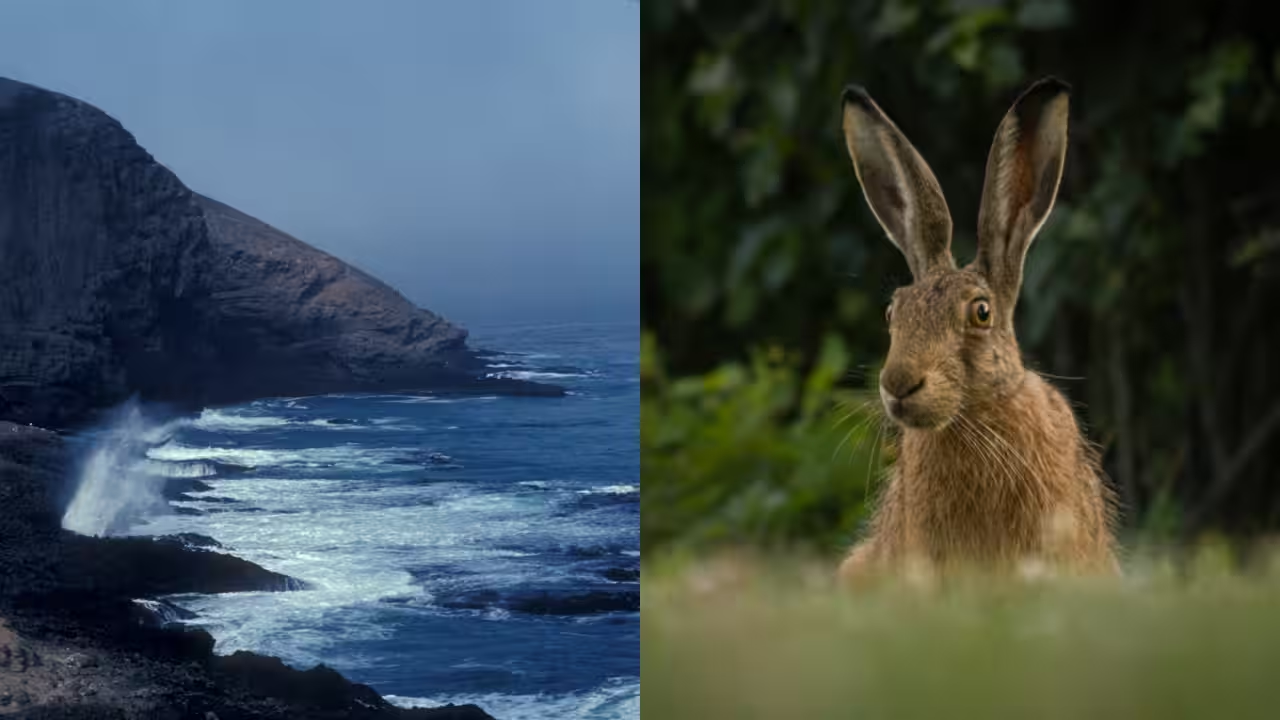
There are plants and creatures unique to the Channel Islands off the coast of southern California. Santa Barbara Island, about one square mile in area and home to plant species found only on the Channel Islands, illustrates the vulnerability of isolated island ecosystems. Over the course of more than a century, a large portion of its native vegetation was removed by goats, sheep, farms, and eventually rabbits.One fatality was the Santa Barbara Island liveforever, a succulent found nowhere else. Rabbits, often called hares in older accounts, chewed it so heavily that botanists feared in the early 1970s that it might be extinct. The National Park Service began removing an estimated 6,000 rabbits in 1954 and continued control efforts until the last rabbits were eliminated in 1981. The plant's decline subsequently stabilized, with 534 plants recorded around Signal Peak in 1984, 2,353 counted island-wide in 2020 and about 3,800 recorded in 2024. It remains classified as endangered.A plant on the vergeDudleya traskiae, the liveforever, has rosettes of thick, pale green leaves and produces yellow flowers from spring into early summer. It grows on steep rocky slopes and sea cliffs surrounding the rim of the island. Earlier grazing by goats and sheep, followed by introduced rabbits and hares, severely altered the island's native vegetation. In the next decades came hares and rabbits. In 1950, a biologist identified only two rabbits, but by 1953 he reported that native vegetation had been damaged almost to the extent caused by earlier sheep grazing.By April 1978, when the US Fish and Wildlife Service designated the plant as endangered, only two populations were known to exist. One showed three plants coming out from stubs eaten down by animals to ground level; the other was a few hundred plants on a sea cliff out of reach of the creatures. A later Fish and Wildlife Service assessment, citing a 1975 Smithsonian report, said the plant had not been collected since 1968 and was considered possibly extinct. The listing blamed hares, but further investigation revealed the animals were actually rabbits. Now that the grazing was finished, the question was, how many plants were left?The last rabbits left in 1981, and park workers inspected the island in 1982, 1983, and 1984, discovering eleven colonies. The cliffs at Signal Peak were the only place where more than 100 plants were found, and discoveries in 1984 increased the estimate for that region to 534, according to a Fish and Wildlife Service evaluation of the species. In a three-year study from 1985 to 1987, the plants in its sample plots were found to be virtually steady, while the overall number of rosettes increased by 22%.Subsequent estimates were low but promising, numbering 852 plants island-wide in 2004 and 928 in 2006. The assessment cautioned that such numbers depended on assumptions about the cliffs at Signal Peak, so a real increase from one year to the next couldn’t be shown. Recruitment has been a perennial issue. Deer mice eat the seeds; dryness kills the seedlings, and when park officials planted roughly 800 seedlings in 2005, just 15 per cent survived until January 2006. More recent surveys have recorded substantially higher numbers, although the assessment notes uncertainty caused by different survey methods and the difficulty of counting plants on steep terrain.Threats that remainA later Fish and Wildlife Service assessment reported that 2020 surveys counted 2,353 plants, the highest total recorded to date. Most, 1,683, were in one stand visible only in aerial photos, meaning those plants had probably been there for years and uncounted. The study found no obvious overall pattern, with some colonies expanding and others contracting or dying, and it maintained the listing as an endangered species.The rabbit problem has largely been resolved, but other pressures remain. Native deer mice devour seeds, seedlings and mature plants, and 506 young plants planted out near the island’s dwellings and campsite in July 2019 had all disappeared by 2020, likely eaten by mice. Brown pelicans can also damage rosettes and alter the soil in ways that favor grasses. The assessment also identified introduced annual grasses and iceplant, along with fire risk, as continuing pressures on the species. They increased their roosting on the island from around 2004 onwards. Introduced annual grasses and iceplants continue to dominate most of the area, boosting both competition and fire risk. Conservationists have already collected seed and grown hundreds of seedlings on an island nursery. The assessment calls for regular monitoring and protective cages for fresh plantings.The available evidence suggests the rabbit removal helped the plant recover, although it was not the only factor. The species persisted after the rabbits were eliminated, new colonies were identified and later surveys recorded substantially more plants than earlier counts. But regeneration on a small, devastated island is gradual, and the future of the plant rests on managing mice, pelicans, weeds and fire as carefully as the rabbits once were.You use AI every day. Now get your AI Quotient. Take the AIQ test.
Topics in this story
- Santa Barbara Island
- Dudleya traskiae
- endangered plants
- conservation efforts
- biodiversity conservation
- Santa Barbara Island endangered species
- California rabbits eradication
- dudleya traskiae conservation
- invasive species impact on native flora
- plant species recovery
- wildlife management in California
- habitat restoration efforts
Gathered from external sources. Rights to this text belong to whoever originally published it.