In 2004, Chicago covered a grim rail yard and parking lots with Millennium Park; now more than 20 million people visit its free public spaces each year
Discover how Chicago's Millennium Park transformed a grim rail yard into a thriving urban oasis, attracting millions with its public art, architecture, and free community events.
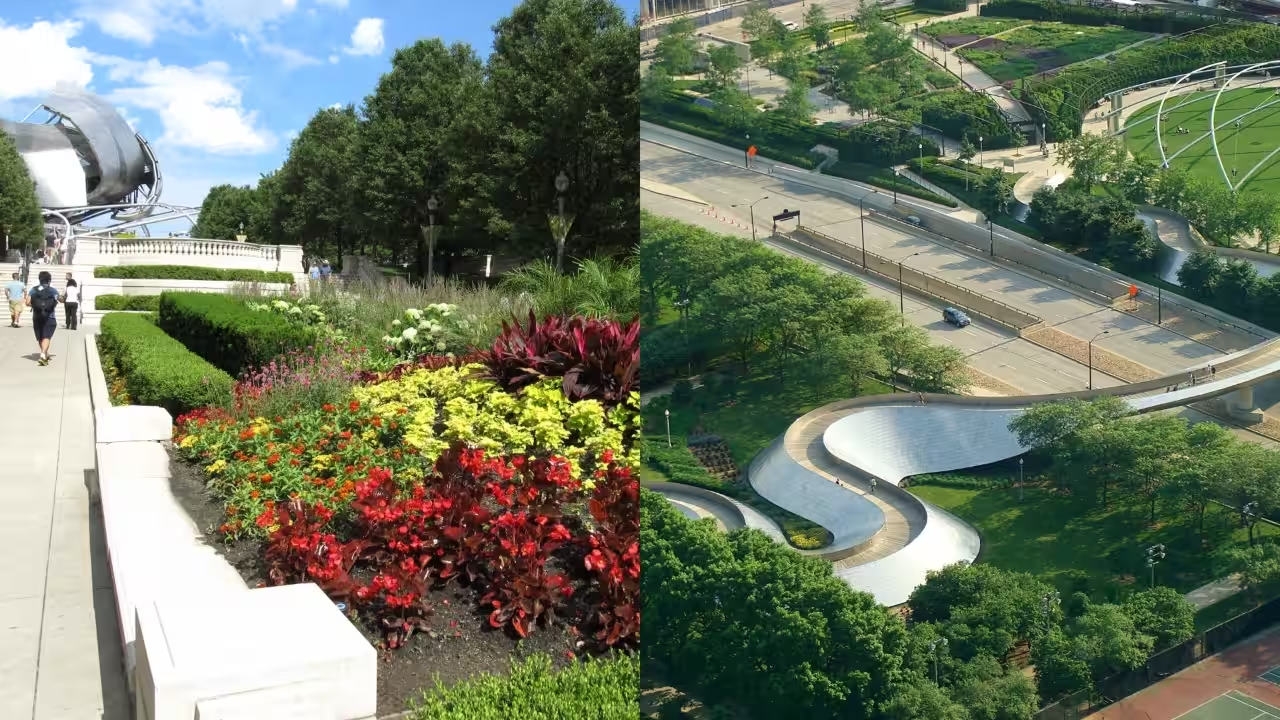
The area along the northern boundary of Chicago's Grant Park was unwelcoming for much of the 20th century. The location was largely overlooked by a city more concerned with its skyline than its ground-level areas, with commuter rail tracks cutting across it and rows of outdoor parking occupying what little space was left. As early as the 1970s, civic organizations proposed reclaiming the area for public use, but political will and financial resources never quite matched up. That goal didn't really take off until the last years of the 1990s, which paved the way for one of the most talked-about civic revolutions in recent American history.A park atop a garageMayor Richard M. Daley launched the project in 1998, and building began that year on a site that had long been controlled by the Illinois Central Railroad. The planners decided not to just clear the lines and parking lots but to construct a full new park over them with underground parking, an operational commuter rail line and a bus highway underneath. Today, the City of Chicago still refers to the location as one of the largest green roofs of its sort in the country, a fact that still surprises many first-time visitors who assume they are simply standing on solid ground. The park eventually opened in July 2004, four years behind its original schedule and well over budget, though few people walking through it today would guess at the years of wrangling that preceded its completion.Cloud Gate and a new type of public gathering spotBut the true attraction was what it had on top of it when the structural work was done. Burnished-steel sculpture soon became the park's unofficial symbol: Anish Kapoor's Cloud Gate, which locals call the Bean, its curved surface mirroring the cityscape for anybody who strolls below. Nearby, Jaume Plensa's Crown Fountain utilizes television screens and flowing water to give kids a place to play that also serves as public art, while Frank Gehry’s Jay Pritzker Pavilion introduced a dramatic, ribboned steel bandshell to what was once a stretch of railway sidings. Landscape architects have pointed to the park as a turning point in how public space is designed and funded. The American Society of Landscape Architects, in reviewing the project years later, noted that the park established a new template for how private and public money could combine to create civic space and how that space could then double as an economic engine for the surrounding district. It was no simple feat to bring art, architecture and engineering together in this way, and it required regular collaboration between the city, private funders and a huge range of designers. That collaborative process is why planners continue to study the park well after Chicago.A model for other cities to look atMore than two decades after it opened in 2004, the park's pull hasn't faded: Wikipedia's park profile, drawing on city tourism data, puts annual attendance at roughly 25 million, a figure that makes it one of the most visited metropolitan parks in the United States. A large part of its appeal is access. Almost everything in the park, from summer concerts to art exhibits, is still free, a conscious move that officials believe has helped keep the space genuinely open to the whole city rather than just those who can afford a ticket. The park’s layout of smaller chambers filled with art draws directly on ideas first proposed for Grant Park more than a century ago, giving the contemporary design an unexpectedly deep historical thread, the Chicago Architecture Centre notes.What makes Millennium Park worth returning to today is less the sculpture or the fountain as individual pieces and more what the entire project demonstrated possible. A swath of ground that city planners had dismissed as unbuildable for over a century became, over the course of only a few years, a site that changed the way a generation of architects and city officials think about public land.Since then, other cities have turned to Chicago's example to gauge whether such makeovers are worth the expense and effort. Toronto's city planners, for instance, pointed directly to Millennium Park while pitching their own Rail Deck Park, a proposal to deck over a stretch of downtown rail yards. That legacy appears to extend far beyond the park's own 24.5 acres, for a project that began as a stretch of rail yards and surface parking lots and ended with the cars tucked beneath the park itself.You use AI every day. Now get your AI Quotient. Take the AIQ test.
Topics in this story
Gathered from external sources. Rights to this text belong to whoever originally published it.