Even this blue wave probably won’t wash tariffs away
While a Democratic shift in Congress might alter the tone of American trade policy, the underlying bipartisan commitment to economic security and industrial policy suggests that major tariffs and trade restrictions will likely persist.
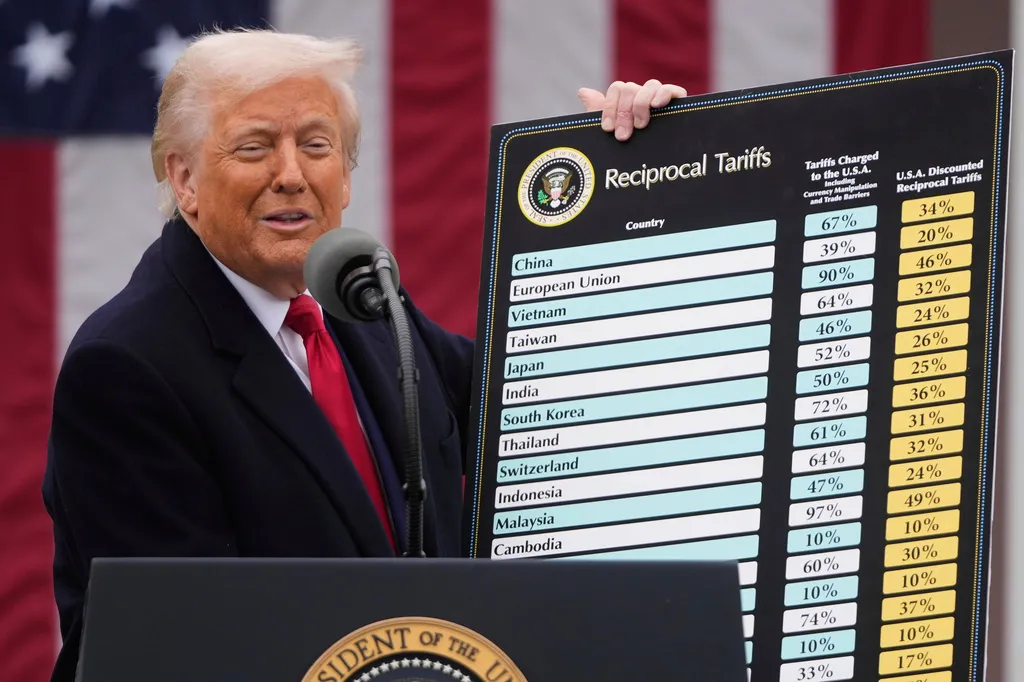
Nearly two-thirds of Americans blame President Trump for higher prices at the gas pump and in the grocery aisle, citing trade policies and the war with Iran for driving inflation. But the Democratic swing in Congress is unlikely to produce a fundamental reversal of the tariffs and other trade restrictions that have punished U.S. households and strained relations with allies .
Tariffs have never been just a Trump priority . Over the past decade, a bipartisan consensus has formed in opposition to free trade. The debate between Democrats and Republicans became less about whether to protect the U.S. economy and more about how best to protect it.
White House priorities reflected that consensus. It was just a few years ago that the Biden administration was accused of copying Trump’s “America First” approach with its “Build Back Better” program. Those two strategies were not exactly the same . Biden leaned more heavily on industrial policies like grants and subsidies than Trump. But Biden also expanded several of Trump’s tariffs on China, raising Section 301 tariffs on Chinese electric vehicles from 25 percent to 100 percent, increasing duties on certain steel and aluminum products to 25 percent, and raising semiconductor tariffs from 25 percent to 50 percent.
These were not minor adjustments. They showed Democrats’ willingness to expand industrial policy and counter Chinese competition. A return to the pre-Trump consensus on trade would make that political project considerably harder.
Not much has changed for Democrats since then. Despite strong incentives to oppose Trump policies, Democrats still hope to recapture their former working-class base by emphasizing manufacturing jobs and wages.
This middle-ground approach was visible in several of the midterms’ highest-profile campaigns, including those of Democrat James Talarico in Texas and Democrat Abdul El-Sayed in Michigan , who have called for selective tariff reductions, not a return to broad-based free trade.
Being more selective means targeting fewer of the allies and partners on which U.S. markets depend. Following the Supreme Court’s February decision invalidating Trump’s use of emergency powers to impose tariffs , the administration introduced a temporary 10 percent global import surcharge under Section 122 of the Trade Act of 1974 . That measure expired on July 24 and was replaced by new Section 301 duties targeting 60 trading partners over alleged failures to adequately restrict imports produced using forced labor.
The new duties generally impose an additional 10 percent tariff on imports from nearly 20 economies, including Canada, Mexico, Britain and India. The European Union, Japan, South Korea, Taiwan and Switzerland face rates structured to bring combined duties with existing most-favored-nation tariffs to 10 percent or 12.5 percent.
Reducing barriers on key allies makes economic and strategic sense. But China is a different story.
Chinese imports face multiple overlapping measures, including Section 301 tariffs ranging from 7.5 percent to 100 percent , as well as the new 12.5 percent forced-labor-related duty. And the Trump administration’s broader negotiations with Beijing have produced limited tariff relief. Instead, trade restrictions have expanded in the form of controls on advanced technology products and services.
Democrats now find themselves facing three goals: lowering prices at home, rebuilding relationships abroad, and grappling with China. And accomplishing all three goals at once is difficult.
Democrats could seek to reduce some of the most disruptive measures against traditional allies, particularly where tariffs undermine cooperation with Europe, Japan, Canada and South Korea.
But reducing friction with allies is not the same as embracing free trade. A Democratic Congress could just as readily support stronger domestic manufacturing incentives, targeted restrictions on Chinese imports, and expanded investment in semiconductors, batteries, critical minerals, pharmaceuticals and clean-energy technologies. Indeed, the Biden administration demonstrated that industrial policy and protectionist trade measures can operate together.
There are also institutional constraints. Congress has delegated significant trade-policy authority to presidents from both parties. Much of modern tariff policy rests on executive authorities, including Sections 232 and 301 of existing trade legislation . Congress can exercise oversight, change statutory authorities and influence appropriations. However, changing the political balance in the House or Senate does not automatically remove tariffs already imposed through executive action. Nor would a Democratic majority necessarily agree on how far to go in limiting presidential authority, particularly when some of those same powers could be useful to a future Democratic president.
Ultimately, the midterms may alter the tone and priorities of American trade policy more than its underlying direction. There remains a bipartisan consensus that economic security, domestic manufacturing capacity, and technological leadership are the core objectives of American economic policy. The disagreement is about which instruments to use — and which countries to target.
Jeffrey Kucik, Ph.D., is a fellow at the Wahba Initiative for Strategic Competition and an adjunct project of political science and law at the University of Arizona
Topics in this story
Gathered from external sources. Rights to this text belong to whoever originally published it.