Scientists and fishermen celebrate return of bluefin tuna
Marine biologists and fisherman reflect on the increasing numbers of bluefin tuna in UK waters.
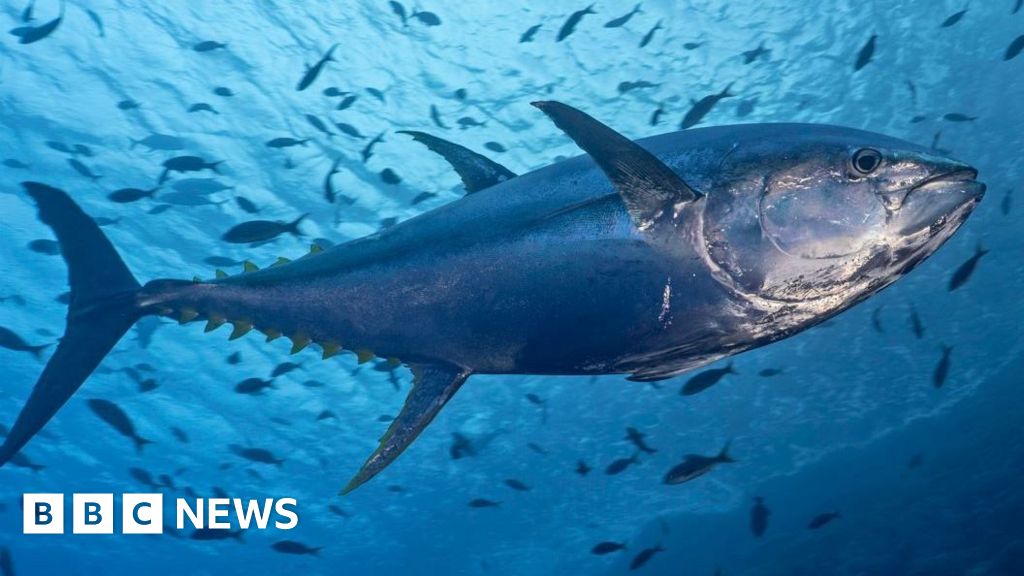
Scientists and fishermen are working together to get a better understanding of the increasing number of Atlantic bluefin tuna in the UK's waters.
Ecology professor at the University of Exeter Dr Lucy Hawkes said the bluefin population had collapsed through overfishing by the mid-1960s but was now thriving.
The Department for Environment, Food and Rural Affairs (Defra) called the return "one of the most exciting developments in our fisheries for decades" and the Marine Management Organisation (MMO) has approved the highest ever quota and number of permits to fishermen to catch them.
Newlyn fisherman Andrew Pascoe said: "I don't see any reason why the permits can't double again in the next three or four years if the science is good and the management says we can catch more."
Hawkes said the bluefin population had collapsed by the mid-1960s because there had been "some really excessive takes, particularly of juvenile bluefin".
"Too many were being killed before they ever had a chance to reproduce," she said.
She worked on an international research project, Thunnus UK, which tagged tuna in a bid to better understand their ecology.
Hawkes said: "One of the reasons a partnership with the fishing industry is really vital is because those are people who are out on the water all the time looking at the tuna.
"The stories I hear from anglers and skippers in the South West is that the numbers of fish they're seeing are going up dramatically."
Fisherman Pascoe said: "Since we saw the first tuna returned to our waters about 14 years ago now, the numbers have risen double every year, and the last two or three years there's absolutely thousands of them out there and right the way up through the English Channel - not just off here."
This year, the International Commission for the Conservation of Atlantic Tunas (ICCAT) increased the UK's annual quota for bluefin tuna from 63 tonnes in 2024 and 2025 to 230 tonnes for 2026, 2027 and 2028.
The MMO doubled the number of commercial licences it offered from 15 last year to 30 this year, and offered 145 permits to to recreational fishers in England in 2026 and six in Jersey.
Defra said UK commercial fishers could land 120 tonnes of bluefin tuna this year, worth an estimated £1.4m based on historic landing prices.
A further 26 tonnes have been made available for the commercial-scientific trial fisheries, worth about £300,000 based on historic landing prices, it added.
Andy Wills, the MMO's interim head of future fisheries, described this year's bluefin tuna season as "an important milestone in the development of this emerging fishery as it features more quota and more permits than ever before".
A Defra spokesperson also said it was a momentous time.
"The return of bluefin tuna to UK waters is one of the most exciting developments in our fisheries for decades, creating new opportunities for commercial fishers, recreational anglers and coastal communities across the UK," they said.
Fishermen across the South West and six in Jersey have been granted bluefin licences.
Pascoe said: "All successful licence holders have got 4,000kg [8,820lb] of bluefin tuna for the year, and that's equivalent to about 3,600kg [7,940lb] of landed weight."
He said the equipment required to convert to catching tuna included rods, reels, lures and ice bags.
"All that equipment runs up to about £7,000 or £8,000, but it's a viable fishery.
"If we catch the whole quota, you could be talking about £50,000 or £60,000 worth of income, so it's a good fishery."
Hawkes said the total quota for the whole of Europe was about 40,000 tonnes, "so we are a very small slice of the pie".
"It doesn't mean our pie shouldn't be ethical, done with the highest standards of welfare, and what we can do as scientists is provide the best evidence to help that to continue to go in the right direction," she added.
"We're losing traditional species farther north with climate change and we've got these sort of species coming behind, tuna not directly linked, but octopus and bream species coming through," he said.
"So we have to make sure that we get the management right of these new species because, if we don't, there's nothing else for us to catch."
Brixham fish merchant Ian Perkes said there was a cost to the larger tuna population.
He said: "Tuna eat about 20% of their body weight per day, so your average 200kg [440lb] tuna per week, well, you can imagine.
"It's an awful lot of fish that we're missing, the sardines, mackerel and herrings.
"If the tuna stay, of course it will increase the revenue for all - the fishermen, the fish merchants and the town.
"It's a shot in the arm for us, which is brilliant.
"I'm a firm believer they're here for feed, so all the time there's something for them to eat, I'm pretty sure they'll stay."
Emily Theobald, science and policy lead at the Cornish Fish Producers Organisation, said she thought there were a few reasons for the rising numbers of bluefin tuna.
She said: "We're in a warming phase and global warming is certainly contributing to the fish returning here after things like sardine and feed, which are also doing really well as a result of global warming, so it's probably a combination of conservation and environmental factors."
Pascoe said he thought along the same lines.
He said: "It's the highest regulated fishery I've ever taken part in and that's why the stock has recovered.
"The fish are coming our way again now, not directly linked to climate change, but the plankton shift with the climate change and the warming waters.
"This has meant that the bait fish has come, and the whole food chain has come through that, and the tuna is coming back to our waters because there's lots of food here for them now."
In August, a giant Atlantic bluefin tuna was landed off Whitby on the Yorkshire coast for the first time in about 60 years.
It weighed 338kg (745lb) and was 2.93m (9.6ft) long and the following day another was landed which weighed slightly less.
Hawke, a member of the University of Exeter team which has tagged six tuna off Whitby, said: "One of the fish we caught, we believe, is the largest bluefin that's ever been caught in British waters, including the 1920s, 30s, and 40s, which was the heyday of bluefin tuna fishing."
She said the Thunnus UK team had been tracking bluefin tuna in the Channel since 2018 and not one of the 165 fish tracked had ever gone into the North Sea.
She said: "These are exceptionally migratory bluefin.
"It's entirely possible that these fish are actually Canadians coming over for a little summer holiday in the UK.
"They could also be the same genetic population as the ones that are being caught down in the Channel off Falmouth and Plymouth.
"It could be that these are an older version of them, maybe they're bigger because they're older and there's no way for us to know the answer to that question without doing the sort of science that we are."
For the first time, fishers granted licences to catch bluefin tuna must complete a training course run by the Angling Trust.
A spokesperson for the trust said: "Fishing for bluefin tuna is unlike anything else currently encountered in our waters.
"It is a large, powerful, highly mobile fish, and handling one safely, for the fish and for the people on board, takes specific skills."
The training, an online course and an in-person day, covered a syllabus which taught fish welfare, handling, equipment choices, revival and release technique, data recording and avoiding disturbance to other marine life, organisers said.
The spokesperson said: "We have a fantastic fishery on our doorstep that a decade ago was unimaginable, and it has become a valuable source of income for charter businesses and the coastal communities around them.
"We want that to continue and to equip everyone taking part with the knowledge to fish responsibly."
Follow BBC Cornwall on X , Facebook and Instagram . Follow BBC Devon on X , Facebook and Instagram . Send your story ideas to spotlight@bbc.co.uk .
Project to identify what bluefin tuna feed on
New bluefin tuna licences granted for trials
Could giant tuna fishing be set for a comeback?
First giant tuna caught off Yorkshire since 1960s
Chefs and fishers learn to adapt to new species
Department for Environment, Food and Rural Affairs
Topics in this story
Gathered from external sources. Rights to this text belong to whoever originally published it.