How connections have shaped us
The world today is a big interconnected village.
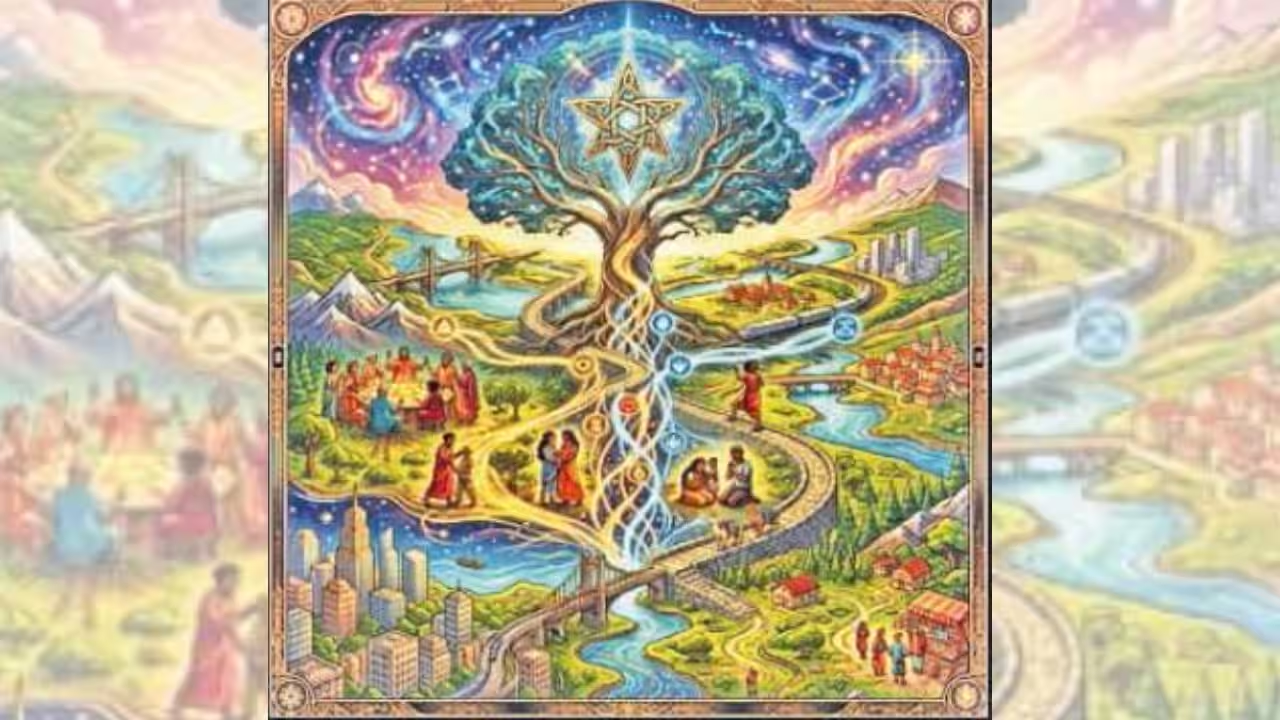
The world today is a big interconnected village. Notwithstanding some political impulses to ‘pull up the drawbridge’, the sinews of globalisation run deep, whether through trade, climate or politics. Actually, the arteries of this globalised world have been millennia in the making. In Earth Shapers:How Humans Mastered Geography & Remade The World, author Maxim Samson takes a deeper look at these connections, not just analysing them , but also their physicalimpact on earth, the legacy they leave behind, and how they shape, and were shaped by, societies and international politics.Samson’s story begins in a tiny town in Libya called Ras Lanuf, which saw fierce battles at the height of the Libyan civil war in the last decade. But its roots go back to 4th century BC, when the Carthaginians and Cyreneans drew up their borders at the site of this town. Two millennia later, Mussolini would erect a triumphal arch at the very location.But Ras Lanuf would have another distinction: it would be the central pivot of a massive engineering project conceived by the Italian colonists – the Libyan Coastal Highway that stretched nearly 2,000km from Tunisia in the west to Egypt in the east, along Libya’s Mediterranean coast. Libya under Gaddafi dynamited Mussolini’s arch at Ras Lanuf. But, the highway still remains a major terrestrial artery in the region.Similarly, the mindboggling Inca Highway or Qhapaq Nan in South America, stretching over a mammoth 40,000km across the Andes Mountains, connecting the Amazon Rainforest with the Atacama Desert, was a symbol of power and prestige for the Inca Empire. Per the author, Incas used the highway to not just exert control over their vast territories, but also to integrate newly conquered lands and peoples. But the same Great Highway would be repurposed by the Spanish conquistadors, for rampant extraction of minerals and gold, riches found in abundance in South American lands.The author’s thesis, that grand connective infra can be reoriented to serve very different political interests over centuries, is a theme that runs across the book. This is again vividly seen in Mozambique, where once-colonial power Portugal built a disjointed railway infra that was solely aimed at reasserting Portuguese power, and for extracting resources – the legacy of which burdens Mozambicans even today.In the western hemisphere, the Panama Canal – another feat of grand engineering – may not have happened at all. The French tried to build the canal first, but failed miserably. Then Americans debated an alternative route via Nicaragua.But after TheodoreRoosevelt insisted onPanama, Washington supported an insurrection in the region against Colombia, and imposed onerous conditions on the new Panama state, to both construct and control the canal – impacting climate, and millions of lives in the region.Of course, not all connections are permanently physical or exploitative, per the author. The Baltic Way human chain in 1989 – spanning 700km, and involving around 2mn people – saw the residents of the Baltic nations of Estonia, Latvia, and Lithuania lock arms in a show of solidarity, and to protest against Soviet Union, exemplifying connections as a form of resistance.In sum, humans will always seek to connect. Plus, when you break one connection – like the divided Korean Peninsula – yearning for other connections – restoring the spiritual vitality of the inter-Korean Baekdu-daegan mountain range – take root.You use AI every day. Now get your AI Quotient. Take the AIQ test.
Topics in this story
Gathered from external sources. Rights to this text belong to whoever originally published it.