In 2026, engineers made an epoxy composite with sterilised post-consumer diaper fibres; at 25% fibre, flexural strength rose 1,303% and tensile strength about 88% over the plain resin
Discover the innovative 2026 study that reveals how sterilized post-consumer diaper fibers can significantly enhance the strength of epoxy composites, providing a sustainable solution for municipal solid waste management.
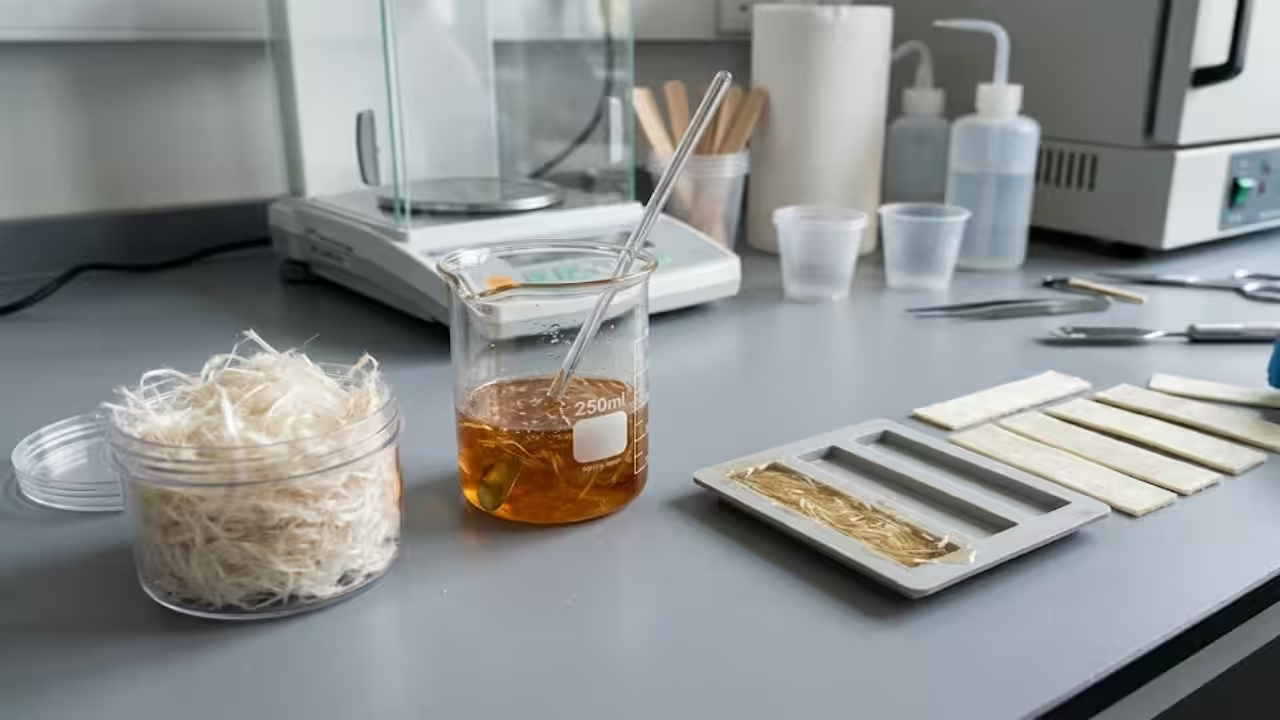
Disposable nappies address an issue for parents and create a problem for cities. A nappy is a tidy sandwich of cellulose fibre, plastic sheets and a gel that absorbs fluids, and it is thrown away after one use. Most of it goes to landfill or an incinerator. It is tough to separate the layers and the waste is, to put it mildly, unpleasant to manage.Existing recycling projects show that disposable nappies contain several recoverable materials. The European Commission explains that disposable nappies mainly contain cellulose fibres, polyolefin plastics and superabsorbent polymer. In that project, the items are opened, sterilised by means of steam in a rotary autoclave, dried and divided into components by mechanical and optical separators. A separate study published in 2026 examined whether fibres recovered from sterilised nappy waste could reinforce epoxy resin.What the study showedPublished in Results in Engineering in June 2026, the paper Development and characterisation of post-consumer diaper waste reinforced epoxy composite: A circular economy approach to municipal solid waste management examines the use of sterilised diaper waste as reinforcement in epoxy resin. Epoxy is a rigid thermosetting resin used in adhesives, coatings, and composite materials. On its own, epoxy can be strong but brittle, so engineers often reinforce it with fibres to improve its mechanical performance.The researchers developed composites from sterilised post-consumer diaper fibres, according to the statistics presented in the study. At a 25% fibre content by weight, the composite's flexural strength rose from 2.08 MPa for the plain resin to 29.2 MPa, an increase of about 1,303%. Tensile strength rose from 13.1 MPa to 24.6 MPa, an increase of approximately 88%, according to the study. Flexural strength is a measure of how much the material resists bending. Tensile strength is the measure of how much the material resists being ripped apart.Those are remarkable numbers and they ought to be read carefully. What is more, a very significant percentage increase might start from a low foundation; thus the absolute strength numbers count as much as the headline percentage. Again, the result is from laboratory samples, not from a finished product tested in service. A reasonable summation would be that diaper fibre does seem to perform as a reinforcement in this system, and that more testing would be needed before anyone makes anything load-bearing out of it.Why the waste is worth the troubleThat breakdown shows why a composite maker might care. The European Union's EMBRACED project identifies used nappies, incontinence products and other absorbent hygiene products as a substantial waste stream that can be processed to recover cellulose and plastics. It reports that around 900,000 tonnes of this waste are incinerated or landfilled in Italy every year, 8.5 million tonnes in Europe and more than 30 million tonnes worldwide. The European Commission reports that Europe generates about 8.5 million tonnes of absorbent hygiene product waste each year, much of which has traditionally been sent to landfill or incineration. The EMBRACED process opens and steam-sterilises the waste, dries it and separates its recoverable components for further use. That breakdown shows why a composite maker might care. Cellulose fibre is the largest recoverable fraction, and fibre is exactly what a composite needs. A route that turns the fibre into a stronger epoxy would give recyclers a use for a material stream that currently has few buyers.Other routes, and the open questionsEpoxy composites are not the only idea on the table. In December 2025, BASF announced a pilot with Essity and TU Wien in which diaper waste was gasified at temperatures above 600 degrees Celsius.The pilot used gasification at temperatures above 600°C to convert the waste into a gas mixture containing carbon monoxide and hydrogen, which can serve as feedstock for chemical production. BASF said the process could handle used nappies and other absorbent hygiene products without complex pretreatment. Gasification breaks the waste down to its chemical building blocks, while the epoxy route keeps the fibre intact and puts it to work as a reinforcement.Any diaper-based composite has to answer some practical questions. Cellulose absorbs water, and moisture can weaken fibre-reinforced plastics over time. Collection has to deliver diapers separately from other rubbish, and sterilisation has to be reliable every time. Cost also matters, because epoxy producers will only use a recycled filler if it is consistent and cheaper or better than what they already buy. In short, a 2026 study reports that sterilised diaper fibre can strengthen epoxy, with the biggest gains at 25 per cent fibre content. It is early laboratory work, but it points to a possible second life for one of the most stubborn items in household waste.You use AI every day. Now get your AI Quotient. Take the AIQ test.
Topics in this story
Gathered from external sources. Rights to this text belong to whoever originally published it.