Iran’s war didn’t end. It changed units.
The ongoing conflict between the United States and Iran remains characterized by unverified claims of success and ambiguous thresholds for escalation despite six months of military exchanges and economic volatility.
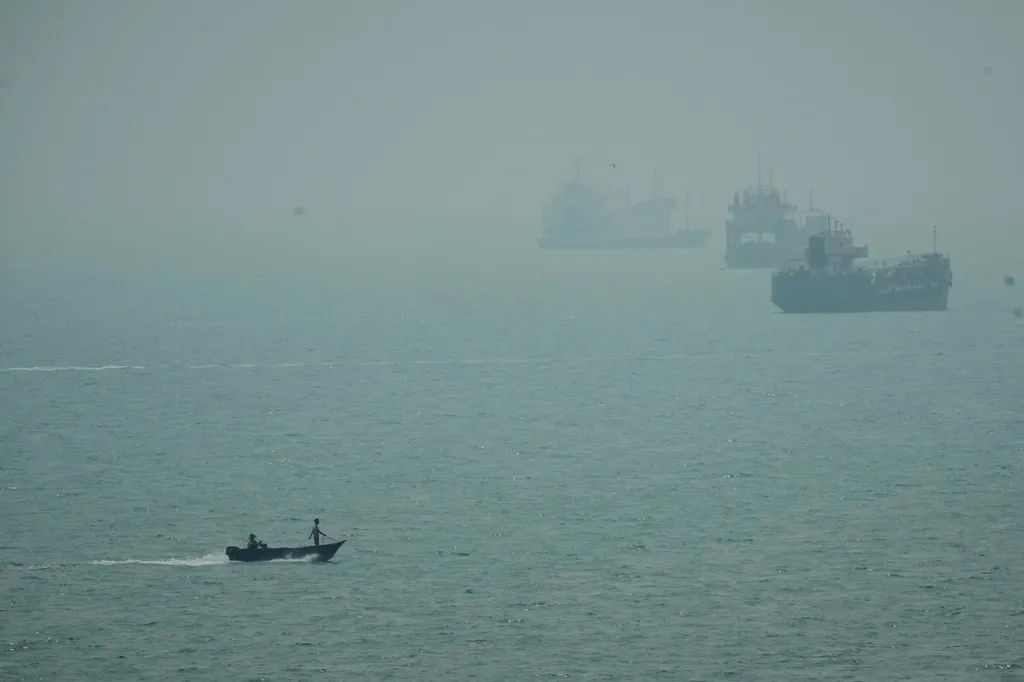
Iran’s Revolutionary Guard last Saturday fired ballistic missiles at a U.S. aircraft carrier and a guided-missile destroyer. CENTCOM says both ships evaded ; the IRGC says both were hit and fled the area. Neither claim is independently verified. What CENTCOM publicly confirmed was its response: Adm. Brad Cooper announced a ratio on the record — “If you shoot at two of our ships, we will impose an even higher economic cost — taking out three of yours”, and U.S. forces disabled two Iranian tankers near Kharg and Jask and sank a third in the Gulf of Oman. It was the sharpest exchange since direct fighting resumed last week, after more than a month without a U.S.-Iran exchange of that kind.
It also came a week after Trump posted an AI-generated video claiming Iran’s Kharg Island terminal had been “blown to smithereens.” Reuters found no evidence that the terminal had been destroyed, and Iran’s state oil company called the claim “laughable.” The days that followed brought a declaration that Iran was “officially a Failed Nation,” then a call for Iranians to “rise up and fight.”
Six months in, that sequence tells you something real. So far, Washington has hit Iranian tankers rather than the Kharg terminal itself. Trump, meanwhile, claimed terminal destruction that public reporting did not substantiate. Iran contested even the battle-damage assessment of an exchange it initiated. None of it identifies which side is closer to the threshold that would force a change in course. Both governments are fighting as if they already know.
Iran’s inflation, currency collapse, and export losses are measurable. So, roughly, are U.S. interceptor expenditures — reported estimates suggest that more than half of the prewar Patriot interceptor inventory has been expended since February. Neither number is a decision point. A falling currency doesn’t reveal when a regime changes behavior; a contested depletion estimate doesn’t reveal whether the remaining inventory is adequate. Treasury Secretary Scott Bessent has called Iran’s economy a “death spiral” that could collapse “within weeks or months,” a forecast, not a benchmark, with no stated mechanism for how economic hardship becomes a change in Tehran’s behavior.
Iran’s least visible — and potentially most important — variable is elite cohesion: how much civilian hardship the regime can absorb before it becomes a threat to the regime rather than merely a burden on the public. The system has spent decades learning to shift pain onto households while protecting its security apparatus.
Washington’s opacity is a choice, not a structural condition. The political calendar is public — the midterms are roughly two months away. What’s contested is the operational math. When reporters pressed on interceptor depletion, U.N. Ambassador Mike Waltz called the reporting “nonsense,” insisted the military had “everything that it needs,” blamed the Biden administration for having used up the ammunition, and said anyone leaking the relevant figures “deserve[s] to be in jail.” He was simultaneously invoking past depletion, dismissing claims that it had produced a present operational shortfall, and criminalizing scrutiny of the numbers that might distinguish one from the other. The denial and the demand for prosecution arrived in the same breath.
“Failing state.” “Death spiral.” These aren’t measurements — they’re commitments that get costlier to revise the longer they stand unchallenged by events. The clearest version of this problem isn’t a quote at all. It’s the video: the commander-in-chief published fabricated footage of Kharg Island — the oil-export hub whose sustained destruction would most directly alter Iran’s export calculus — while the military spent the following week striking tankers rather than the terminal itself. JD Vance called the clip “a message.” That’s an official input into the war, not atmosphere around it.
Six months have produced several pauses, an April ceasefire, a June memorandum, July stand-downs, an Aug. 1 halt tied to a reported “perimeters of a deal,” and now a resumption. None has held. The public record offers clues but cannot confidently distinguish whether pressure, mediation, or tactical repositioning drove any of them.
That is the actual finding. Not that Iran is secretly collapsing, or that Washington is secretly out of weapons, but that neither government has demonstrated the fact its rhetoric assumes: where the other side’s threshold sits, or how close either side is to its own. A war fought on that assumption has no natural stopping point built into it. It leaves two governments reading ambiguity, denial and incomplete information as proof that the other side is closer to yielding.
Charbel A. Antoun is a Washington-based journalist and writer specializing in U.S. foreign policy, with a focus on the Middle East and North Africa.
Topics in this story
Gathered from external sources. Rights to this text belong to whoever originally published it.