Ted Turner brought an environmental cartoon to TV in 1990; the foundation it inspired now backs young conservationists in 11 countries
When Ted Turner died on 6 May 2026, aged 87, tributes focused largely on the media empire he built and his role in founding CNN.
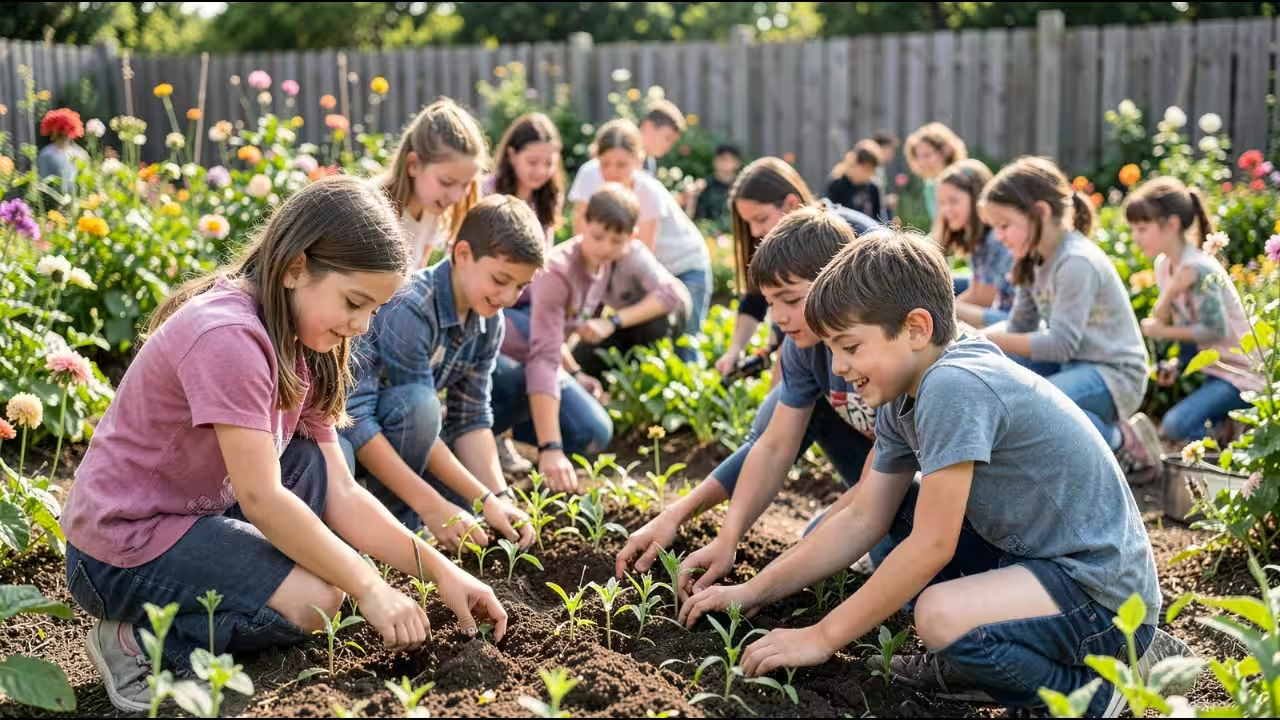
When Ted Turner died on 6 May 2026, aged 87, tributes focused largely on the media empire he built and his role in founding CNN. Another part of his legacy began with an environmental cartoon. Turner and his colleague Barbara Pyle developed the idea for Captain Planet and the Planeteers in the late 1980s, before the animated series launched in 1990. It followed young heroes who joined forces to confront environmental threats, introducing ecological issues to a younger audience through entertainment. In 1991, Turner and Pyle co-founded the Captain Planet Foundation, which continues to support environmental projects and help young people develop solutions in their communities. Its programmes include school gardens, environmental science challenges and youth-led conservation campaigns.Captain Planet and the Planeteers: how Ted Turner and Barbara Pyle brought environmental issues to televisionTurner’s environmental interests extended well beyond television. According to the Ted Turner Legacy page published by Turner Enterprises, he established the Turner Foundation in 1990, a family foundation focused on environmental protection, habitat conservation, sustainable living and community well-being. That same year, Captain Planet and the Planeteers launched on television. Created by Turner and Pyle, the animated series aired from 1990 to 1996. The show followed five young Planeteers from different parts of the world who combined their elemental powers to summon Captain Planet and confront threats such as pollution, poaching and deforestation. Its premise placed environmental protection at the centre of the story, presenting ecological problems in a format designed to engage younger viewers. The Captain Planet Foundation’s history explains how the series became the inspiration for its work with young people.The cartoon was one part of a broader conservation record. In 1997, Turner pledged $1 billion to support the United Nations, a commitment that led to the establishment of the United Nations Foundation in 1998. He also established the Turner Endangered Species Fund in 1997 to support biodiversity conservation, including work involving threatened species. Turner Enterprises says that, at the time of his death, Turner’s holdings included approximately 2 million acres of land and a herd of 45,000 bison. He also created the Turner Institute of Ecoagriculture to help protect his landholdings and advance research and education related to conservation and agriculture. Turner’s philanthropy extended beyond environmental conservation. TIME named him its Man of the Year in 1991, and he signed the Giving Pledge, committing to give the majority of his wealth to charitable causes. His conservation work reflected a long-standing interest in protecting natural systems, while the cartoon offered a way to bring environmental issues to a global television audience.Captain Planet Foundation origins: how a cartoon’s merchandising revenue supported youth projectsThe Captain Planet Foundation was co-founded by Turner and Pyle in 1991 as a corporate foundation within Turner Broadcasting System. According to its official history, Pyle negotiated for a portion of the cartoon’s merchandising revenue to support young people working to solve environmental problems. The idea was to turn the show’s message into practical opportunities for children and young people to act on environmental concerns beyond the television screen. In the early 2000s, the foundation separated from Turner Broadcasting System and became an independent 501(c)(3) public charity. The foundation’s profiles give 2002 as the year of the transition. The transition was organised by Turner’s daughter Laura Turner Seydel and her husband, Rutherford. Seydel went on to chair the foundation and remains associated with its work.Over time, the organisation expanded beyond its original grant-making model into programmes combining environmental education with practical projects. Its work now includes school gardens, hands-on science challenges and youth-led environmental campaigns. These initiatives aim to help young people identify problems in their communities and develop solutions, rather than limiting environmental education to classroom lessons. The foundation also broadened its focus to ocean conservation. In 2018, it partnered with Lonely Whale to launch Ocean Heroes Bootcamp, which trained young activists to develop campaigns against plastic pollution. The foundation has reported that more than 1,200 young activists from 56 countries were trained within three years. During the COVID-19 pandemic, Project Giving Gardens used school and community gardening networks to support food access. The foundation reported that more than 100,000 pounds of produce were harvested and distributed in 2020, equivalent to approximately 400,000 servings.Captain Planet Foundation programmes today: school gardens, STEM challenges and youth-led climate actionThe foundation’s current programmes continue to connect environmental learning with practical projects. Its official website identifies Project Learning Garden, the Green Heart STEM Challenge and Planeteer Alliance as key parts of its work. Project Learning Garden helps elementary schools establish and maintain gardens for hands-on learning. The foundation’s 2025 annual report lists programme locations across 41 US states. The Green Heart STEM Challenge serves middle-school students, inviting them to identify environmental problems in their communities and develop solutions. In 2025, more than 1,000 students in the Atlanta and Houston metropolitan areas took part in challenges addressing issues including electronic waste, food waste, fast fashion and single-use plastics. The foundation says three winning teams received mentorship and implementation grants to develop their ideas.Planeteer Alliance extends the model to young people beyond the classroom. Open to people aged 10 to 25, the programme provides environmental leadership training, campaign-design resources and opportunities to collaborate with other young advocates. Its 2025 annual report says participants recruited and trained more than 2,500 peers during the year. The report’s overview also records 22 youth-led WIND Summits and more than 60 other action-related events across 11 countries. These figures describe reported programme activity in 2025, rather than cumulative reach. The report describes several projects supported through the alliance. In Farato, The Gambia, Sanna Jambang and his team created a clean-energy demonstration site where residents could see solar energy in action, ask questions and explore how it might be used in their own homes. Elsewhere, projects have addressed reforestation, waste management, sustainable transport and conservation education. The foundation also highlights Daniel Olajuyigbe’s work with a team organising beach clean-ups in Lagos, Nigeria. The example illustrates how young participants have applied environmental campaigning to local waste problems. These examples are reported by the organisation and illustrate the range of activities it supports, rather than independently measured evidence of long-term environmental impact.Following Turner’s death, the Captain Planet Foundation said it would continue as his living legacy. More than three decades after the cartoon first aired, its work remains centred on a similar idea: environmental education can extend beyond awareness and encourage young people to take part in solving problems where they live. Through gardens, science challenges and youth-led campaigns, the foundation continues to put that idea into practice.You use AI every day. Now get your AI Quotient. Take the AIQ test.
Topics in this story
Gathered from external sources. Rights to this text belong to whoever originally published it.