WWII hospital shipwreck in Albania now hosts devil firefish, squid eggs and a rare monk seal 80 years after sinking
Europe News: More than eight decades after the Hospital Ship ‘Po’ sank in Albania’s Vlora Bay, its rusting remains have become part of a busy underwater ecosystem..
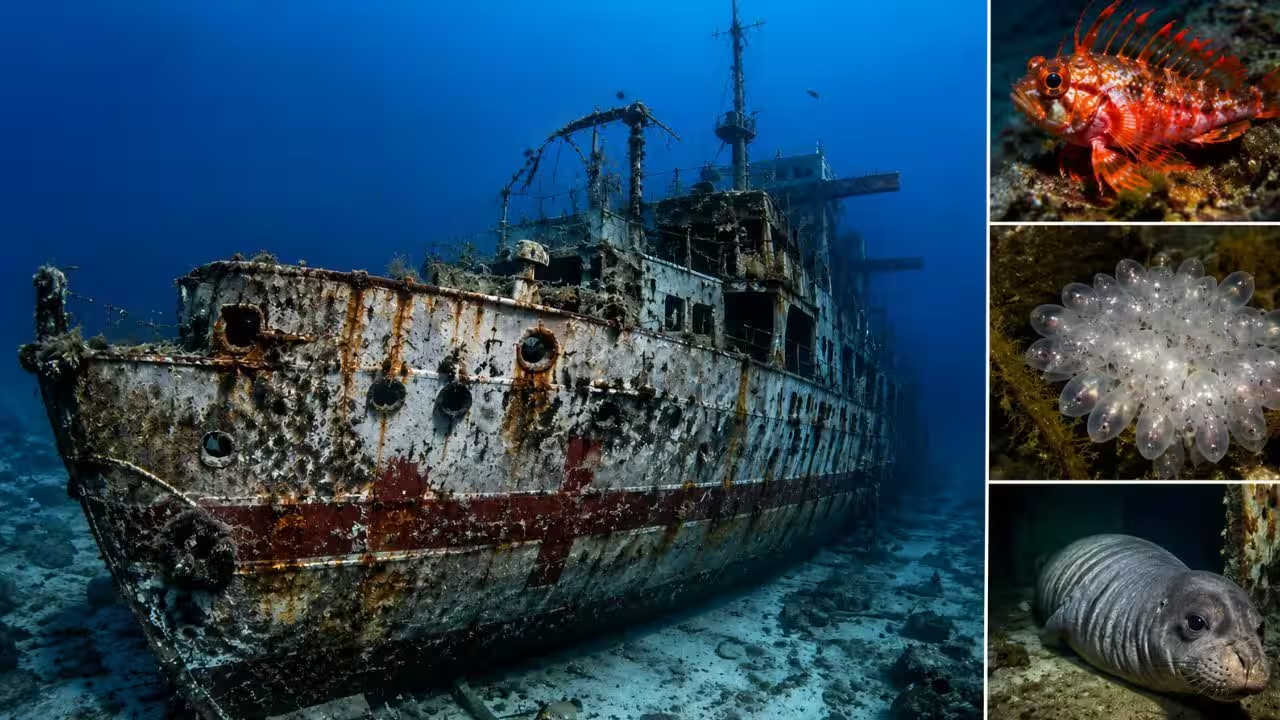
More than eight decades after the Hospital Ship ‘Po’ sank in Albania’s Vlora Bay, its rusting remains have become part of a busy underwater ecosystem. A new study has found the 134.98-metre wreck covered by dense biological communities, with fish, sponges, sea squirts and other marine life using its hard surfaces. The sighting was the first confirmed record in Vlora Bay since 1996. According to the research article published in Frontiers in Ocean Sustainability titled ‘First assessments on marine geomorphology and bio-colonization through the study and survey of the wreck of the Hospital Ship “Po” along the Albanian coasts (Vlora Bay)’ recorded the non-indigenous devil firefish and evidence of squid spawning around the wreck. Most strikingly, a critically endangered Mediterranean monk seal was photographed resting inside sheltered cavities of the ship in August 2023. Lying at depths of 33 to 37 metres within the Karaburun-Sazan Marine Protected Area, the wreck is now being studied not only as a remnant of wartime history but also as a structure that shapes local marine habitats and seabed conditions.Albania’s Hospital Ship ‘Po’ became a marine habitat in 1996The Hospital Ship ‘Po’ now supports a dense marine community in Vlora Bay, with more than 80% of its hard surface covered by biological growth. Researchers identified 54 taxa living on the wreck’s structure. Sponges, sea squirts, bryozoans, molluscs, algae and other organisms formed a layered community across the vessel. Fish surveys recorded 28 species from 14 families, including dusky groupers, morays, seabass, wrasses, seabreams and barracuda. Juvenile common two-banded seabream, painted comber and striped red mullet were also observed around the structure. The bow supported more complex assemblages than midship and stern areas.What did researchers find around the wreckAmong the most notable observations was the presence of the devil firefish, Pterois miles, a non-indigenous species recorded on the wreck’s hard surfaces. Researchers observed up to seven individuals at the same time. The survey also found large gelatinous egg clusters attributed to Ommastrephidae, likely Illex coindetii, attached to vertical surfaces at depths of 22 to 25 metres. These observations suggest the wreck may provide conditions suitable for reproduction and shelter. The study further recorded a transient Mediterranean monk seal, Monachus monachus, resting inside sheltered cavities in the upper structure.How does the wreck affect the seabed around itThe wreck does more than provide a surface for marine organisms. Its position also appears to influence the seabed around it. The 134.98-metre vessel lies upright at 33 to 37 metres depth and remains almost perpendicular to the dominant northwest-southeast water currents. Surveys identified a scour hollow reaching 2.1 metres below the reference seabed on the upstream side. Behind the stern, sediment formed a depositional trail extending about 45 metres. Sediment samples showed medium sand of about 350 micrometres at reference sites, while fine silt-clay particles below 63 micrometres occurred close to the wreck.Significance of the Hospital Ship ‘Po’ for future marine researchThe researchers describe the findings as an early step towards understanding how historic wrecks function within marine ecosystems. They developed two preliminary measures, the Geometric-Geomorphological Wreck Effect Index and the Ecological Hotspot Value Index, to summarise observations at the site. The ecological index was 0.83, based on benthic diversity, biological coverage and selected indicator groups.Catch the latest World News and Live updates. Download the TOI app.
Topics in this story
Gathered from external sources. Rights to this text belong to whoever originally published it.