In 2013, 80-year-old Miura climbed Everest despite four heart surgeries, taking the record after first reaching the mountain’s summit at 70 and again at 75
At 80 years old, Yuichiro Miura not only overcame four heart surgeries but also made history by successfully summiting Mount Everest, marking his third ascent of the world's highest peak.
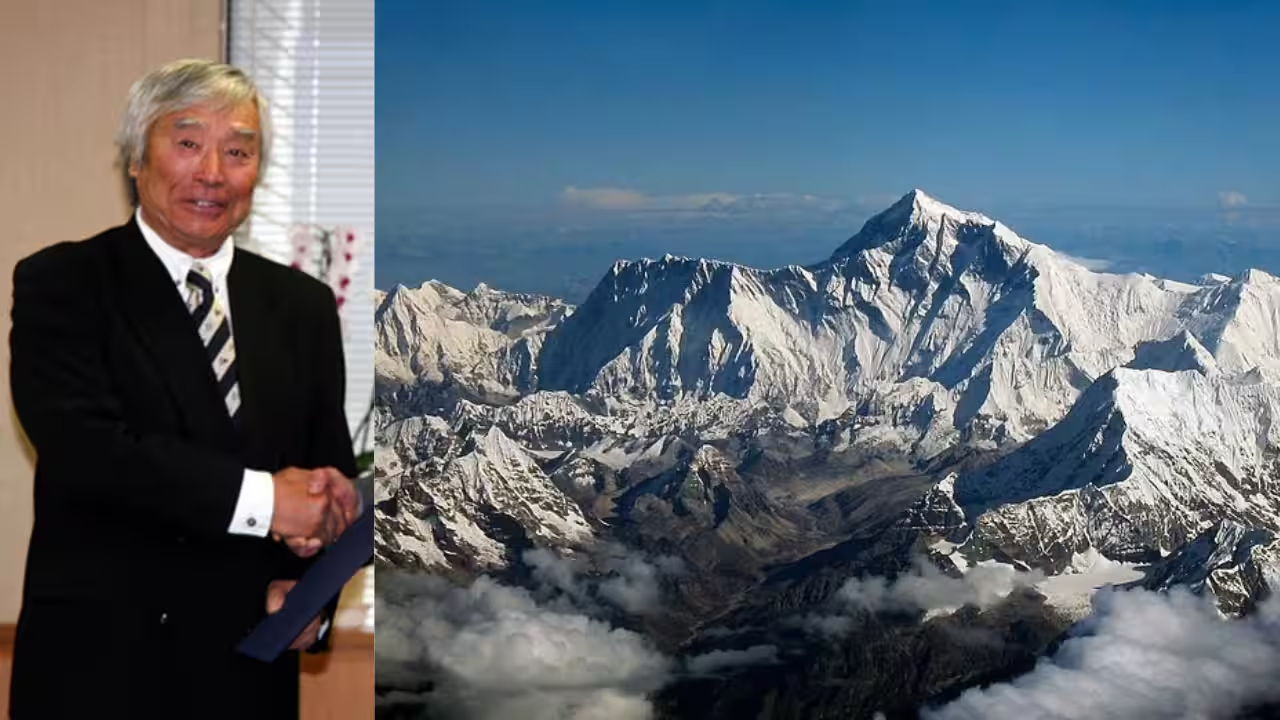
Yuichiro Miura became the oldest person to climb the world's highest mountain, as he reached the summit of Mount Everest at age of 80. The Japanese mountaineer had already reached the summit twice, first at 70 in 2003 and again at 75 in 2008. He made the third ascent even after having undergone four heart operations since 2007, including surgery for an irregular heartbeat earlier in 2013.Miura reached the 8,848-metre (29,035 ft) summit at about 9:05 a.m. local time with a team that included his son Gota and several Sherpa guides. He was 80 years and 223 days old, and Guinness World Records lists May 23, 2013, as the date of his record-setting ascent and still recognizes him as the oldest man to climb Everest.Everest was already familiar to himMiura skied down the mountain's South Col in 1970, decades before his first Everest summit and used a parachute to slow his descent. The stunt was filmed for the Oscar-winning documentary The Man Who Skied Down Everest. In 2003, Miura reached the top at age 70 and briefly became the oldest person to summit Everest, following which he returned five years later at 75 and set a new record. Other climbers also held the title subsequently, but Miura's third ascent in 2013 set a new mark at 80. Guinness records the 2013 climb as his third time reaching Everest's summit.The 2013 expedition came after a difficult period for Miura, when he had fractured his pelvis and left thigh bone in a skiing accident in 2009. His medical history also included recurring arrhythmia, and according to the Associated Press report published by CBS News, his January 2013 operation was his fourth heart surgery since 2007. That operation happened only months before his Everest expedition, but Miura still continued to prepare for the climb. His daughter told AP that he wanted to attempt the mountain because he was 80 and did not want to keep postponing the challenge.The government of Japan established the Miura Award, named after the alpinist, for people who challenge themselves to the limits of human potential. The award was initially conceived specifically for older people, but Miura reportedly insisted that it should be open to people of all ages, and was also expected to select the recipients himself.The final climb took hoursMiura and his team used the southeast ridge, the route that is associated with the first successful Everest ascent by Edmund Hillary and Tenzing Norgay in 1953. The team entered the final section of the mountain in the early morning on summit day, and spent several hours climbing toward the peak. At the summit, Miura spoke with his support team by telephone and said that he had never imagined reaching Everest's top at 80 and described the climb as exhausting.Miura was transported by helicopter to Kathmandu because of extreme exhaustion, after reaching Advanced Base Camp at about 6,500 metres. Guinness still recognizes the ascent because its record criteria require the climber to reach the summit under their own power, and an emergency helicopter evacuation during descent does not invalidate the record.Miura had already completed two successful ascents, returned after major injuries and undergone repeated heart surgery before attempting the mountain again. At 80 years and 223 days, he reached the summit for the third time, and the record remains listed by Guinness World Records, which identifies Miura as the oldest man to climb Everest.You use AI every day. Now get your AI Quotient. Take the AIQ test.
Topics in this story
Gathered from external sources. Rights to this text belong to whoever originally published it.