In the 1980s, Rutgers researcher Thomas Nosker mixed milk jugs with discarded Big Mac containers to make structural plastic lumber; about 1.5 million US rail ties have kept an estimated 300 million pounds of plastic out of landfills
US News: In an innovative breakthrough, Thomas Nosker, a Rutgers professor, created structural plastic lumber from milk jugs and Big Mac containers, resulting in 1.5 million railroad ties and diverting 300 million pounds of plastic waste from landfills.
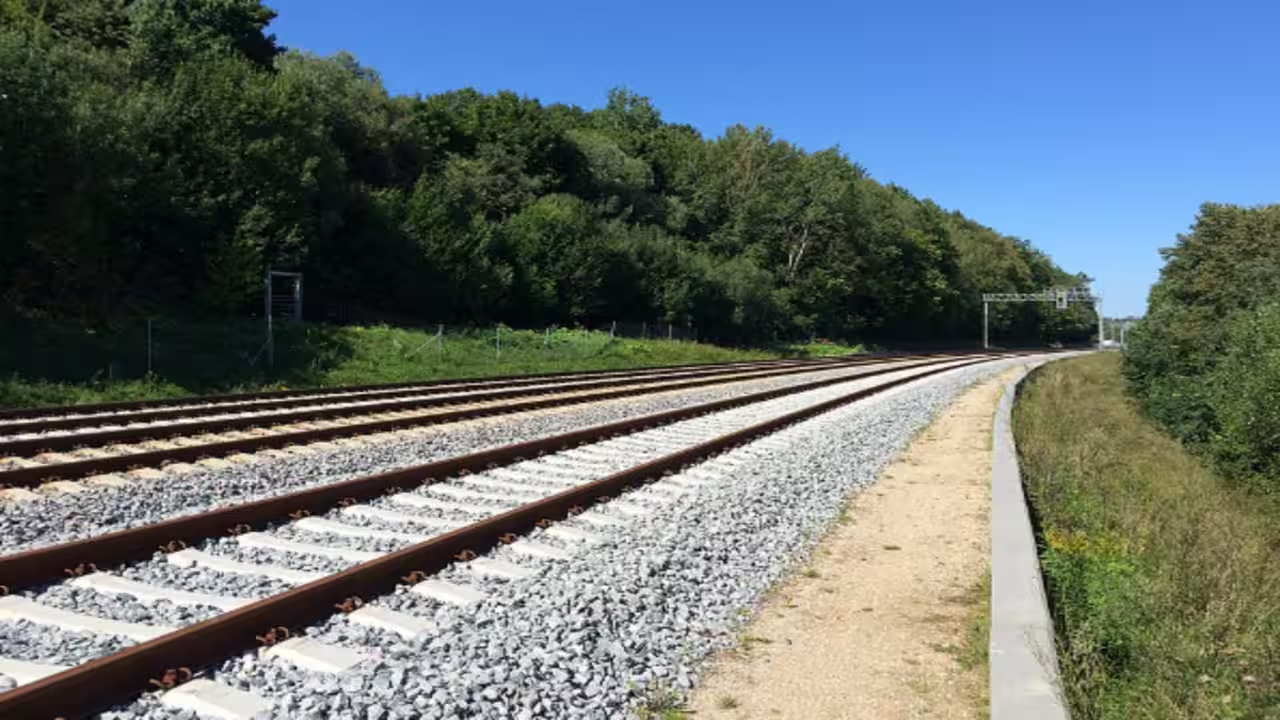
During the 1980s, Thomas Nosker was a doctoral student at Rutgers University who set out to address a mounting problem. It was the rapid accumulation of plastic packaging waste with no practical recycling pathway, according to a Rutgers Research profile of his work. Packaging materials such as plastic were rapidly replacing glass containers on store shelves, and the used bottles were piling up with no practical way to recycle them, so most of it was simply headed for landfills. This material was what Nosker eventually came up with after countless experiments and it is now called structural plastic lumber, a material that can replace wood and steel in their structural forms. Years later, that same material was used to manufacture roughly 1.5 million railroad ties across the United States, keeping an estimated 300 million pounds of plastic out of landfills, waterways and oceans.HDPE milk bottles were too cheap to recycleBottles manufactured using polyethylene terephthalate, called PET, could easily be sorted and processed for resale into items such as carpet or insulated clothing. High-density polyethylene, called HDPE, which is the plastic in milk jugs, was more problematic. As Nosker notes, the price of HDPE was so low that it didn't make economic sense to wash used milk jugs before recycling them on their own.Combining HDPE with polystyrene from Big Mac containersIt was during this time that the real breakthrough came, as Nosker began experimenting with blends rather than treating each plastic separately. He mixed HDPE with polystyrene salvaged from discarded Big Mac containers, the clamshell packaging McDonald's had used for its sandwiches before phasing it out beginning in the late 1980s and continuing into the early 1990s amid environmental pressure. Blending the two plastics sidestepped the economic problem entirely, since the finished composite drew its value from strength rather than the purity of either input material, meaning the low-value HDPE no longer needed to be washed or sorted on its own to be useful. Nosker found that certain blend ratios produced a much stronger material, likely because the particles of each plastic interlocked rather than separating.Proving plastic could replace woodConvincing an industry built entirely around wood lumber to accept a plastic substitute was never going to be easy; the material needed to prove its durability in the field, not just in a lab. As described in Rutgers's account of the invention, Nosker and his colleagues took a show-don't-tell approach, building actual structures rather than relying only on laboratory data, because wood had long been the default building material and skepticism toward a plastic alternative ran deep.In 2002, Nosker helped build New Jersey's first structural recycled-plastic bridge, a 40 to 42-foot vehicular span over the Mullica River in Wharton State Forest near Atsion Lake, in the Pine Barrens, an ecologically sensitive region where wood and steel structures typically degrade faster due to moisture and acidity in the soil. The accomplishment may have helped the material gain wider acceptance in the U.S. Army; in 2009, the Army demonstrated that a bridge built with the technology could carry a 73-ton M1 Abrams tank at Fort Bragg, North Carolina.1.5 million railway ties across the United StatesAmong other qualities of the final product, one should consider its density. As stated in Rutgers Research, the material is now used worldwide in bridges, railway ties, docks, and picnic tables, and has so far gone into roughly 1.5 million railway ties in the US. With each tie weighing approximately 200 pounds, Rutgers estimates that some 300 million pounds of plastic have been kept out of landfills and oceans as a result.Where the technology is used todayRutgers has since licensed the technology to two firms, AXION International Inc. of Zanesville, Ohio, and Sicut Enterprises Limited, based in London. According to Rutgers, both companies manufacture railroad ties and building materials from the recycled composite. In addition to railway ties, plastic lumber has found use on docks, picnic benches, park benches and parking bollards all over the U.S. and internationally. The Chicago Transit Authority has used the ties on its elevated tracks for track repair in an urban setting.Nosker holds more than 82 U.S. patents and pending patent applications related to plastic lumber and its manufacturing processes, according to Rutgers, work that has generated substantial licensing revenue for the university over the decades. He is currently working on the development of plastic composites reinforced by graphene for making light yet strong materials for use in vehicles and military applications. Even so, the plastic lumber project remains among Nosker's most visible contributions, a solution to a packaging waste problem that began with two of the most common items in American refrigerators and fast-food bags: a plastic milk jug and a foam sandwich box.Catch the latest World News and Live updates. Download the TOI app.
Topics in this story
Gathered from external sources. Rights to this text belong to whoever originally published it.