From 19 Hawai Sepoys and 4 aircraft to Rafales and Sukhois: The IAF's 94-year journey
NEW DELHI: Four Westland Wapiti biplanes, six RAF-trained officers and 19 Hawai Sepoys.
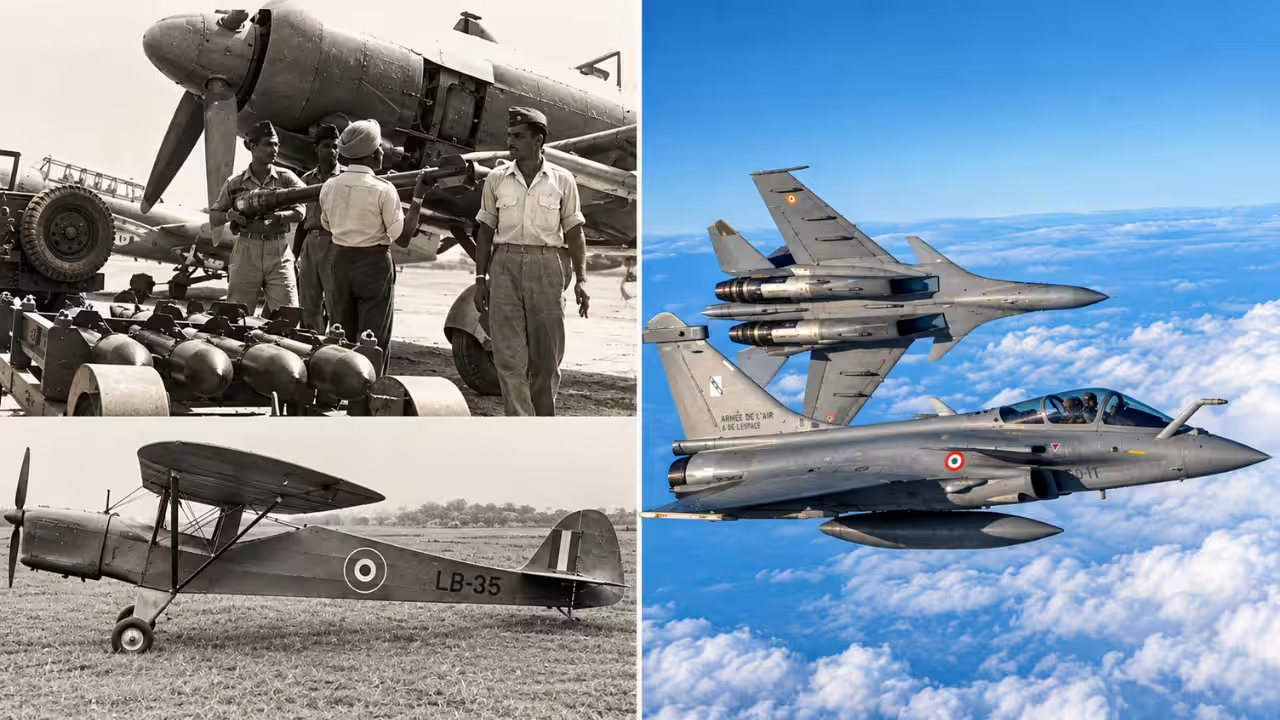
NEW DELHI: Four Westland Wapiti biplanes, six RAF-trained officers and 19 Hawai Sepoys. That was the Indian Air Force in 1933, when its first operational flight took off from Drigh Road in Karachi, then part of British India.The Wapiti was a far cry from the fighter jets of today. A two-seater biplane, it reflected the modest beginnings of a force that would go on to fight wars, defend India's skies and carry out missions far beyond the country's borders.More than nine decades later, the IAF operates Rafales, Su-30MKIs, Mirage-2000s, MiG-29s, Jaguars and Tejas, supported by transport aircraft, attack and heavy-lift helicopters, drones and a layered air-defence network. In 2025, it put many of those capabilities to work during Operation Sindoor.The distance between those four Wapitis and today's fighter fleet is not simply a measure of technological progress. It is also a record of the wars India fought, the lessons it learnt and the kind of air force it gradually decided it needed.As the IAF completes 94 years on October 8, its journey tells the story of how each conflict, each new aircraft and each technological advance helped shape the force it is today.1932–1945: Six officers, 19 Hawai Sepoys and a world warThe IAF was established on October 8, 1932. Its first operational flight followed six months later, on April 1, 1933.Six RAF-trained officers and 19 Hawai Sepoys made up the small unit at Karachi's Drigh Road. The four Wapiti IIA aircraft formed the nucleus of what would eventually become No. 1 Squadron.The early years were far removed from the era of precision weapons and network-centric warfare. In 1936, the fledgling force saw its first operational action from Miran Shah in North Waziristan, now part of Pakistan, supporting Army operations against insurgent Bhittani tribesmen of Pashtun origin near what is today the Pakistan-Afghanistan border.More aircraft and personnel followed. A second flight was raised in April 1936 and a third in June 1938, bringing No. 1 Squadron to full strength. When World War II began, it was still the only IAF formation, with 16 officers and 662 men.Then the war changed the pace of everything.India, then under British rule and part of the Allied war effort during World War II, saw the creation of Coastal Defence Flights to protect key ports and coastal installations.These flights were based in several strategically important coastal cities across the subcontinent: Madras, Bombay, Calcutta, Karachi and Cochin, with another later established at Visakhapatnam.The aircraft and roles also began changing as the demands on the force grew.By 1941, the IAF had begun moving away from the Wapiti. Tiger Moths were being used for elementary training, while No. 1 Squadron moved to the Westland Lysander. No. 2 and No. 3 Squadrons operated the Audax before the Hurricane entered the picture.By the end of 1942, the IAF was operating five squadrons. In 1943, No. 7 Squadron moved to the US-built Vengeance dive bomber. By the end of 1944, nine squadrons were active, most flying Hurricanes and one flying Spitfires.The growth was rapid. By 1946, the force had around 28,500 personnel, including about 1,600 officers. Twenty-two Distinguished Flying Crosses and several other decorations had been awarded to its personnel during the war.In March 1945, the force received the prefix "Royal".That prefix, however, would not last long.1947–1962: Partition, rebuilding and the arrival of jetsIndependence in 1947 brought freedom, but also a sudden reorganisation of the military.The division of assets meant the IAF lost personnel and equipment to the newly formed Royal Pakistan Air Force. Its strength was nearly halved. Several units were disbanded or transferred, while the remaining force had to reorganise even as the Kashmir conflict began.There was little time for a clean transition.The IAF continued expanding its capabilities during the conflict. Spitfires and Tempests were used, a photo reconnaissance flight was formed and plans were made to rebuild B-24 Liberators from salvaged aircraft.In January 1950, India became a republic. The word "Royal" disappeared from the force's name.The IAF at the time had six fighter squadrons, flying a mix of Spitfires, Vampires and Tempests. There were also bomber, transport, observation and communications elements. Pilot training was being expanded through dedicated flying training schools.The jet age was already beginning to change the force.The Vampire brought jet fighters into the fleet. The Ouragan arrived in 1953. Then came the Mystere IVA, Hunter and Canberra. The IAF's planned strength was expanded from 15 squadrons towards a 33-squadron force.The 1961 UN mission in Congo gave the Canberras a chance to operate far from India's borders. At home, however, the security environment was changing quickly.In 1962, India signed protocols with the Soviet Union for the acquisition of MiG-21 fighters and surface-to-air missiles.The Soviet-made aircraft would go on to become one of the most recognisable names in Indian military aviation.1965–1971: MiG-21s, Gnats and a changing balance of air powerThe years after the 1965 India-Pakistan war brought another round of modernisation, coming soon after the setback of the 1962 war with China and amid then-Prime Minister Lal Bahadur Shastri's efforts to strengthen the armed forces.MiG-21FLs began replacing older aircraft, while the Gnat, which had performed well during the 1965 war, returned to production. By 1968, four more Gnat squadrons had been formed.The Su-7BM also joined the IAF fleet.The IAF was no longer simply adding aircraft. It was building a system around them.Older equipment was phased out while MiG-21s, Su-7s and HF-24s increased in numbers. The air defence Ground Environment System was being planned to improve surveillance and response, while the Air Force Academy at Dundigal was inaugurated in January 1971.Then came December 1971.The IAF flew thousands of sorties during the war and secured air superiority in the eastern theatre during the Bangladesh Liberation War.Gnats and MiG-21s became central to the fighting. The war demonstrated what a much larger and better-equipped IAF could do compared with the force that had entered the Kashmir conflict two decades earlier.India's military dominance eventually forced Pakistan to accept one of the largest surrenders in military history.The fleet continued to change after the war. Jaguars and Mirage 2000s joined the inventory, adding new capabilities to an increasingly varied fighter fleet.That variety would become one of the defining characteristics of the IAF.1999: How Kargil changed the use of air powerThen came the Kargil conflict in 1999 posing a very different problem.There was no conventional air war in the traditional sense. Indian aircraft had to operate over some of the world's highest and most difficult terrain, while avoiding crossing the Line of Control.Operation Safed Sagar became one of the IAF's most closely watched operations. Mirage-2000s carried out precision attacks, while MiG aircraft provided additional strike and support.Operation Safed Sagar provided a major boost to the forces on the ground.Mi-17 helicopters were also used in the operation.The experience showed the importance of accurate navigation, intelligence, precision weapons and the ability to operate at high altitude. Official figures released by the government later put the IAF's Kargil effort at around 5,000 strike missions, about 350 reconnaissance and electronic intelligence missions and roughly 800 escort sorties, apart from more than 2,000 helicopter sorties.The Mirage-2000, in particular, acquired a new reputation during the conflict after being used for precision attacks against key positions.The lessons from Kargil did not end with the guns falling silent.From parade ground to the frontline: Women in IAFAnother important chapter in the IAF’s journey has been the growing role of women in the force.Women officers began joining the IAF in the early 1990s, initially in ground duties before moving into transport aircraft and helicopters. In 2016, Avani Chaturvedi, Bhawana Kanth and Mohana Singh became the first three women fighter pilots.The journey continued with Shivangi Singh becoming India’s first woman Rafale pilot, while Bhawana Kanth became the first woman IAF officer to qualify as a Fighter Combat Leader in 2026.During Operation Sindoor, Wing Commander Vyomika Singh emerged as a prominent face of the IAF, briefing the nation alongside Colonel Sofiya Qureshi.From ground duties to fighter cockpits and frontline operations, women have steadily expanded their role. On Air Force Day 2026, their leading drill sequences and marching contingents marked another step in that journey.2016 onwards: Tejas and the push for an Indian fighterFor much of its history, the IAF had relied on aircraft designed and built abroad — British, French, Soviet and later Russian, American and other European platforms.The Tejas changed that equation.The indigenous Light Combat Aircraft was designed as a multi-role fighter with digital avionics, fly-by-wire controls and extensive use of composite materials. The first Tejas squadron was inducted into the IAF in 2016.It was not an overnight replacement for the established fighter fleet. The IAF continued operating its Su-30MKIs, Mirage-2000s, MiG-29s and Jaguars even as Tejas numbers grew.The more recent Tejas Mk1A represents another step. In September 2025, the defence ministry signed a Rs 62,370-crore contract with HAL for 97 aircraft, 68 fighters and 29 twin-seaters.The aircraft are to have more than 64% indigenous content and incorporate systems including the UTTAM AESA radar. Deliveries under this contract are scheduled to begin in 2027-28.However, the programme has also faced delays. The IAF is still awaiting deliveries under an earlier order for 83 Tejas Mk1A aircraft, highlighting the challenge of converting indigenous manufacturing plans into operational strength.That is significant for another reason. The Tejas programme is increasingly about building an Indian aerospace manufacturing base, rather than simply producing one aircraft.Rafale, Su-30MKI and a very different fighter fleetThe other side of the modernisation story is the arrival of advanced foreign-origin platforms.The Rafale brought a new level of multi-role capability. The Su-30MKI became the IAF's heavy fighter workhorse. Mirage-2000s and MiG-29s remained important parts of the combat fleet, while Jaguars continued to perform strike roles.The fighter fleet is only one part of the picture.The IAF's transport arm has grown around aircraft such as the C-17 and C-130J. Apache and Chinook helicopters have added attack and heavy-lift capabilities. The C-295 is gradually replacing the older Avro transport fleet.The C-295 programme is also an important marker of how India's approach to military aviation is changing. Sixteen aircraft are to be delivered from Spain, while 40 are being manufactured at the Tata-Airbus facility in Vadodara.So the modern IAF is not just about fighter jets flying faster and carrying more weapons. It is about getting troops and equipment into difficult areas, moving supplies, watching the battlefield, protecting air bases and keeping an air picture running across hundreds of kilometres.2025: Operation Sindoor and the new face of warfareOn May 7, 2025, the IAF found itself in a conflict very different from the air battles of 1965 or 1971.Operation Sindoor was launched after the Pahalgam terror attack.India said nine terror infrastructure sites in Pakistan and Pakistan-occupied Jammu and Kashmir were targeted in the opening strikes. The PM Modi-led government described the action as "focused and measured", with the initial statement saying no Pakistani military facilities had been targeted.The operation subsequently widened.Pakistan launched drones and missiles towards Indian military targets. India's response involved a layered air-defence network. Akash systems operated alongside legacy systems such as Pechora and OSA-AK, while the Integrated Air Command and Control System helped bring information and responses together.The significance of Sindoor lay partly in what was happening behind the aircraft seen in the sky.Radars, command centres, air-defence systems, drones, electronic warfare, missiles and fighters were all part of the same operational picture. The government later said the IAF's IACCS worked alongside the Army's Akashteer and the Navy's Trigun to provide a common real-time picture during the operation.The IAF also carried out strikes against Pakistani military targets later in the operation.The counterterror operation hit 11 Pakistan airbases, including strategically crucial Nur Khan airbase near its capital Islamabad and Sargodha airbase.According to Indian government accounts, Indian aircraft hit airbases and command-and-control infrastructure, while Indian air-defence systems countered Pakistani missile and drone attacks.It was a reminder that modern air warfare is increasingly about networks as much as aircraft.A fighter may deliver the weapon, but the information that tells it where to go can come from a much larger web of sensors, satellites, radars, intelligence platforms and command systems.Beyond the battlefield: The IAF that rescues and evacuatesThere is another side to the IAF that rarely gets the same attention as fighter aircraft.Transport aircraft and helicopters have repeatedly been used in disaster relief, evacuation and humanitarian missions. From flood rescue and earthquake relief to evacuating Indians from conflict zones abroad, airlift has become a routine part of the force's job.That role was also highlighted in the IAF's 2026 Vayushakti exercise, which featured not only fighters but C-17s, C-130Js, C-295s, helicopters and remotely piloted aircraft. The exercise included scenarios involving airlift, rescue and evacuation alongside combat missions.It is a very different job from sending a fighter on a strike mission, but it depends on the same thing: Getting an aircraft, crew and equipment where they are needed, quickly.At 94, the next challenge awaitsThe IAF is now looking at a future in which the fighter fleet will have to work alongside drones, loitering munitions, long-range missiles, electronic warfare systems and increasingly sophisticated air-defence networks.The government has also cleared the next steps for the Advanced Medium Combat Aircraft, or AMCA. In May 2025, the AMCA programme execution model was approved with industry participation, allowing Indian private and public-sector companies to bid independently or as joint ventures or consortia for development of the prototype.There is also another Rafale requirement in the pipeline. In February 2026, the Defence Acquisition Council gave an Acceptance of Necessity for Multi Role Fighter Aircraft, identified as Rafale, along with combat missiles and an airborne high-altitude pseudo-satellite system. The government said the majority of the MRFA aircraft would be manufactured in India.The direction is clear even if the final shape of the fleet will take years to emerge.From four Wapitis in 1933 to today's Rafales, Tejas and advanced air-defence systems, the Indian Air Force has come a long way.Its journey has been shaped by wars, the lessons learnt from them and decades of technological progress. What began with a handful of officers and Hawai Sepoys has grown into a modern air force with capabilities extending far beyond those of its early years.Ninety-four years after its first flight, the IAF continues to grow and adapt, just as it has through every major chapter of its history.
Topics in this story
Gathered from external sources. Rights to this text belong to whoever originally published it.