California’s 5-foot Mill Creek dam blocked coho for decades; a 2016 fish-passage redesign reopened 11.2 miles, and salmon spawned upstream weeks later
A fish-passage redesign at California's Mill Creek dam opens access to 11.2 miles of stream habitat for endangered coho salmon and steelhead trout, leading to successful spawning just two months after completion.
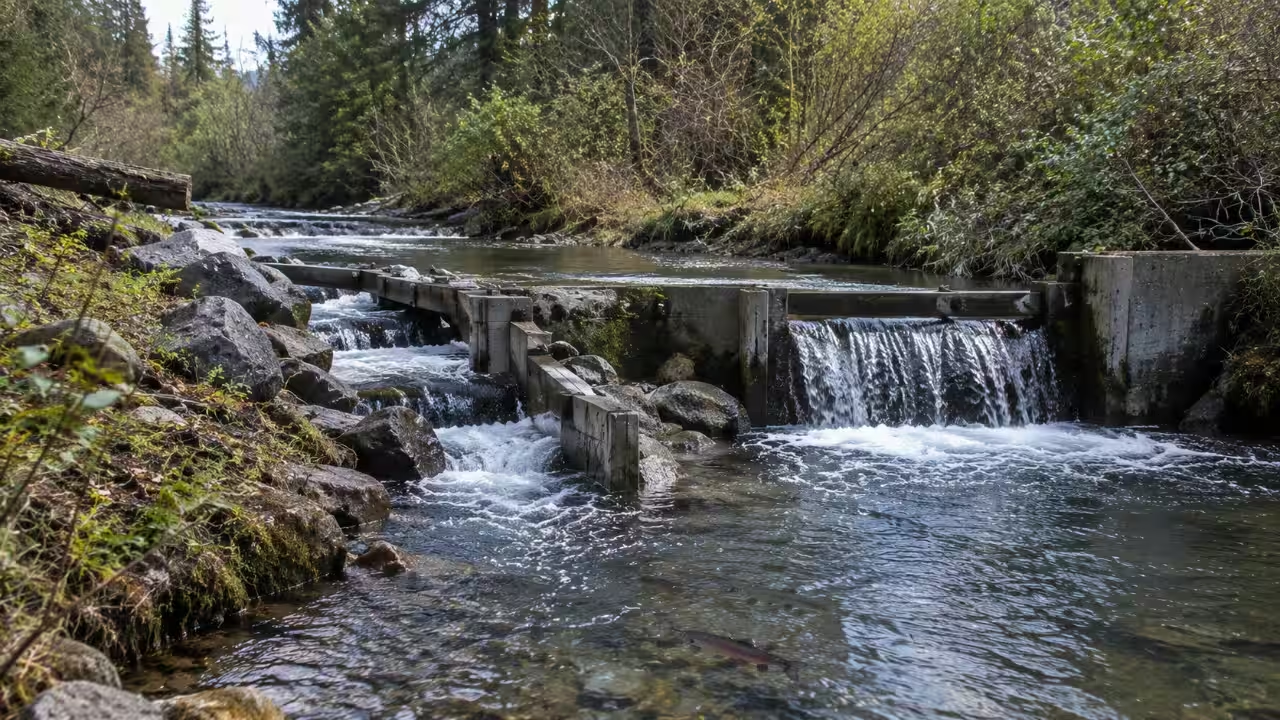
For decades, a five-foot concrete dam on Mill Creek in Sonoma County, California, prevented fish from reaching upstream habitat. The obstruction was addressed in 2016 by a fish-passage project through a redesigned channel, which restored access to 11.2 miles of stream habitat. The dam had restricted fish movement towards upstream stretches that retain water throughout the year, limiting access to spawning and rearing habitat. According to California Sea Grant, after the problems caused by the dam were identified, the NOAA National Marine Fisheries Service deemed it the highest-priority barrier for remediation.Mill Creek is a tributary of the Russian River, west of Healdsburg, and its watershed supports federally endangered coho salmon and threatened steelhead trout. The project formed part of wider efforts to restore the stream's ecological function. Its central objective was to provide fish with passage between the lower creek and the habitat beyond the dam while accommodating the requirements of neighbouring property owners.The redesign combined a roughened ramp with a side channel The engineering solution aimed to modify the existing barrier, adding a new channel around it instead of relying on conventional passage structure alone. According to Prunuske Chatham Inc. (PCI), the construction involved establishing a new channel of approximately 200 feet. This comprised a roughened ramp that led toward the dam crest, followed by a side channel which was excavated around its right-bank abutment.The point of the two routes was to accommodate two different flow conditions of the water that were prevalent at the site. The first challenge was that, at lower flows, water would be concentrated in the side channel. Conversely, the water would pass through both channels when the flows were higher. In response, the main ramp was incorporated with large boulders, smaller stones, cobbles, and gravel, which helped in creating multiple pathways through the structure. In this way, the movement of adult and juvenile salmon was made easier while achieving the site’s specific engineering requirements.Trout Unlimited led implementation of the project and worked side by side with PCI on the design and construction. The project also involved California Sea Grant, UC Cooperative Extension, and public agencies such as the California Department of Fish and Wildlife and the Sonoma County Water Agency. As far as the funding was concerned, it was provided by three agencies: the NOAA Restoration Center's Community-based Restoration Program, the California Department of Fish and Wildlife's Fisheries Restoration Grant Program, and the Sonoma County Water Agency.Post-construction monitoring documented upstream spawning In October 2016, the construction of the main and side channels was completed, and follow-up biological monitoring of the region showed that coho salmon spawned above the former dam site. Considering the fact that this happened weeks after the work was completed, this was a very substantial change. On top of that, before the remediation, coho salmon had only been recorded spawning in the lower reaches of Mill Creek.California Sea Grant’s habitat enhancement monitoring programme kept track of the changes through surveys which were conducted before and after the remediation. As per their record, spawning showed increased activity above the former barrier during the winters once the construction had been completed. This was enough to discern that the redesigned passage has restored access to habitat which had been previously inaccessible.More signs of the resurgence of fish were recorded by the Trout Unlimited project in March 2017, which showed that more than eight coho salmon redds, or nests, were present upstream of the project site that year. For the assessment, both physical conditions at the site and biological evidence were considered, including adult spawning activity and juvenile fish use. The results demonstrated that a targeted modification to a longstanding obstruction could reconnect a substantial length of stream habitat.You use AI every day. Now get your AI Quotient. Take the AIQ test.
Topics in this story
Gathered from external sources. Rights to this text belong to whoever originally published it.