A 37-centimetre Qianlong vase appeared in a Cornish property brochure; it later sold at Sotheby’s for £304,800
A large imperial porcelain vase, standing thirty-seven centimetres tall and made for the Qianlong emperor, passed down through a single English family
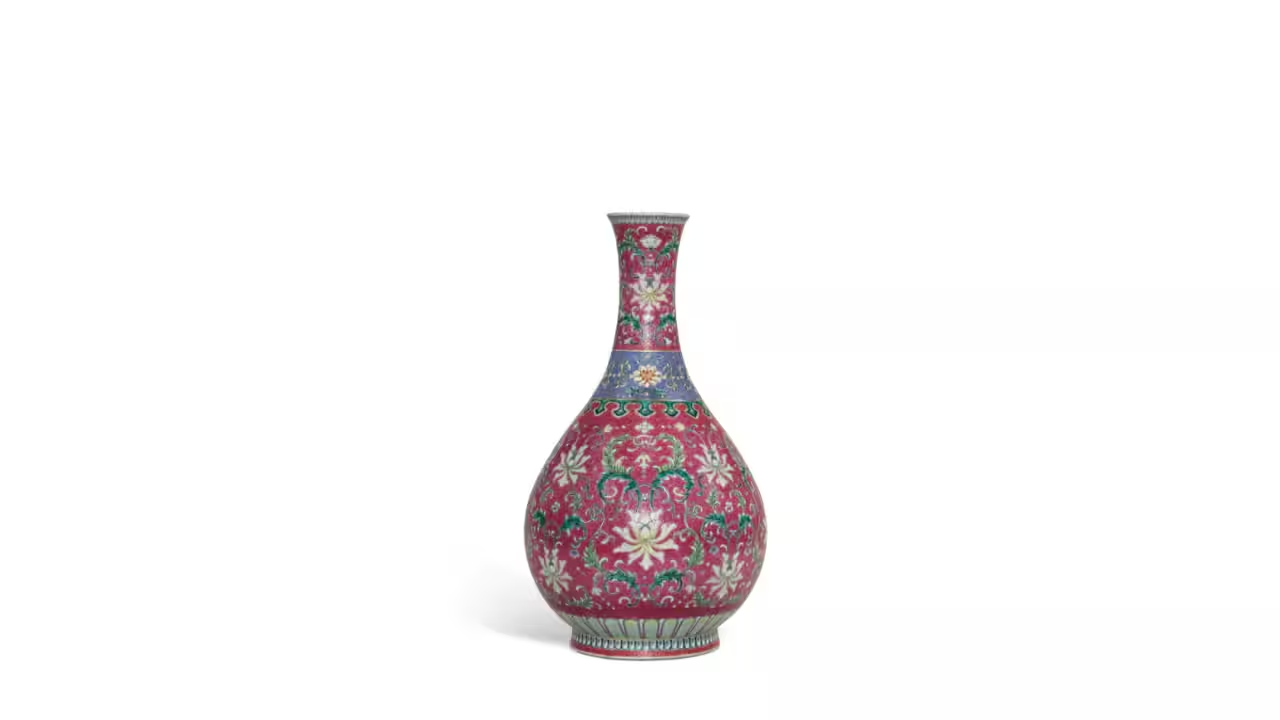
A large imperial porcelain vase, standing thirty-seven centimetres tall and made for the Qianlong emperor, passed down through a single English family before arriving at Sotheby's. Estimated at between £100,000 and £200,000, it sold in November 2025 for £304,800, comfortably above the top end of the estimate. Its story combines rare craftsmanship, an ownership history leading back to a famous collecting family, and a surprising appearance in a property brochure. Here’s why a Sotheby's specialist called it pure gold, how the design was made, and what it can teach anyone with an old family treasure at home.The genuine Qianlong porcelain vase stood out among thousands of mostly fake Chinese art submissionsEvery day, Sotheby's receives unexpected objects through its online submissions portal, where owners upload a few photographs of something they suspect might be valuable. In Chinese art, that flood is overwhelming. Julian King, International Specialist in Chinese Works of Art at Sotheby's, said that the vast majority of the thousands of submissions the auction house receives in this category turn out to be fake, which makes a genuine piece exceptionally rare. This vase was different. King recognised it on sight, "This vase is pure gold," he said. The auction house catalogued it as lot sixty-one in its Chinese Art sale, listing it as property from an English family collection, according to the Sotheby's lot page.Carved through ruby enamel to reveal white lotus patterns, the sgraffiato technique behind this vaseThe Sotheby's lot page explains that sgraffiato, also spelt sgraffito, means carving through a surface layer to reveal a contrasting layer below. Here, the carving cuts through ruby enamel down to the glazed porcelain, revealing the design in white. Although the method came to prominence in China as early as the Song dynasty, it returned to the fore in the eighteenth century alongside the yangcai palette, whose name means foreign colours. The catalogue note, citing the research of Liao Pao Show, links its introduction at the imperial kilns in Jingdezhen to efforts from 1741 onwards by Tang Ying, the long-time kiln supervisor, to please the Qianlong emperor who had criticised earlier porcelain. In other words, this painstaking technique was refined partly to satisfy a demanding ruler.No other vase of this design appears to survive: Seal mark of a rare Qianlong pieceFew objects can claim to be unique, yet the Sotheby's catalogue note says no other vase of this extraordinary design appears to survive. The note describes the form as the classical yuhuchunping shape, popular since the Song dynasty, combined with brilliant ruby enamelling, baroque-inspired scrollwork and intricate sgraffiato. The vase stands thirty-seven centimetres tall, and its base carries a six-character seal mark in underglaze blue. Most related vases appear to have been made in pairs for the Qianlong court, and the note points to comparable examples in the Palace Museum in Beijing, the Yale University Art Gallery and the Hakone Museum of Art in Japan. That context helps explain why Sotheby's describes the piece as a rare and exuberant example of Qianlong taste.The vase descended through Dame Agnes Jekyll's family and sat in a Cornish houseAuthenticity was only part of the story. According to Sotheby's, the provenance, meaning the documented ownership history of an object, proved decisive. The lot page records the vase as belonging to the collection of Dame Agnes Lowndes Jekyll, who lived from 1861 to 1937, and passed to her by descent. Sotheby's describes her as a Scottish-born British artist, writer and philanthropist from a prominent collecting family; her father, William Graham, was a patron of Pre-Raphaelite artists. The vase was illustrated in an estate agent's brochure for the Cornish house where it had long sat. A piece of imperial porcelain had, in effect, been pictured to help sell a property, a reminder that remarkable objects can sit quietly in everyday domestic settings for many years.What the £304,800 result shows about reviewing family heirlooms through online portalsAccording to Sotheby's, the vase sold in 2025 for £304,800, well above its estimate of £100,000 to £200,000 for the auction held on 5 November. It is one of five recent success stories gathered by Sotheby's, all of which began with little more than a few photographs and a hunch. Many people never make the first move, assuming an auction house is meant for someone else's treasures rather than their own. Auction houses like Sotheby's describe their submission portal as one of the most accessible doors into the auction house, and it invites owners to share details and photos for a complimentary online estimate. If a family object has sat unexamined for years, this vase is a persuasive reason to ask a specialist to take a look.You use AI every day. Now get your AI Quotient. Take the AIQ test.
Topics in this story
Gathered from external sources. Rights to this text belong to whoever originally published it.