Relatives hold cremations without bodies for Nepal’s missing flood victims
Fewer than one in 10 recovered bodies of people killed in deadly floods has been formally identified.
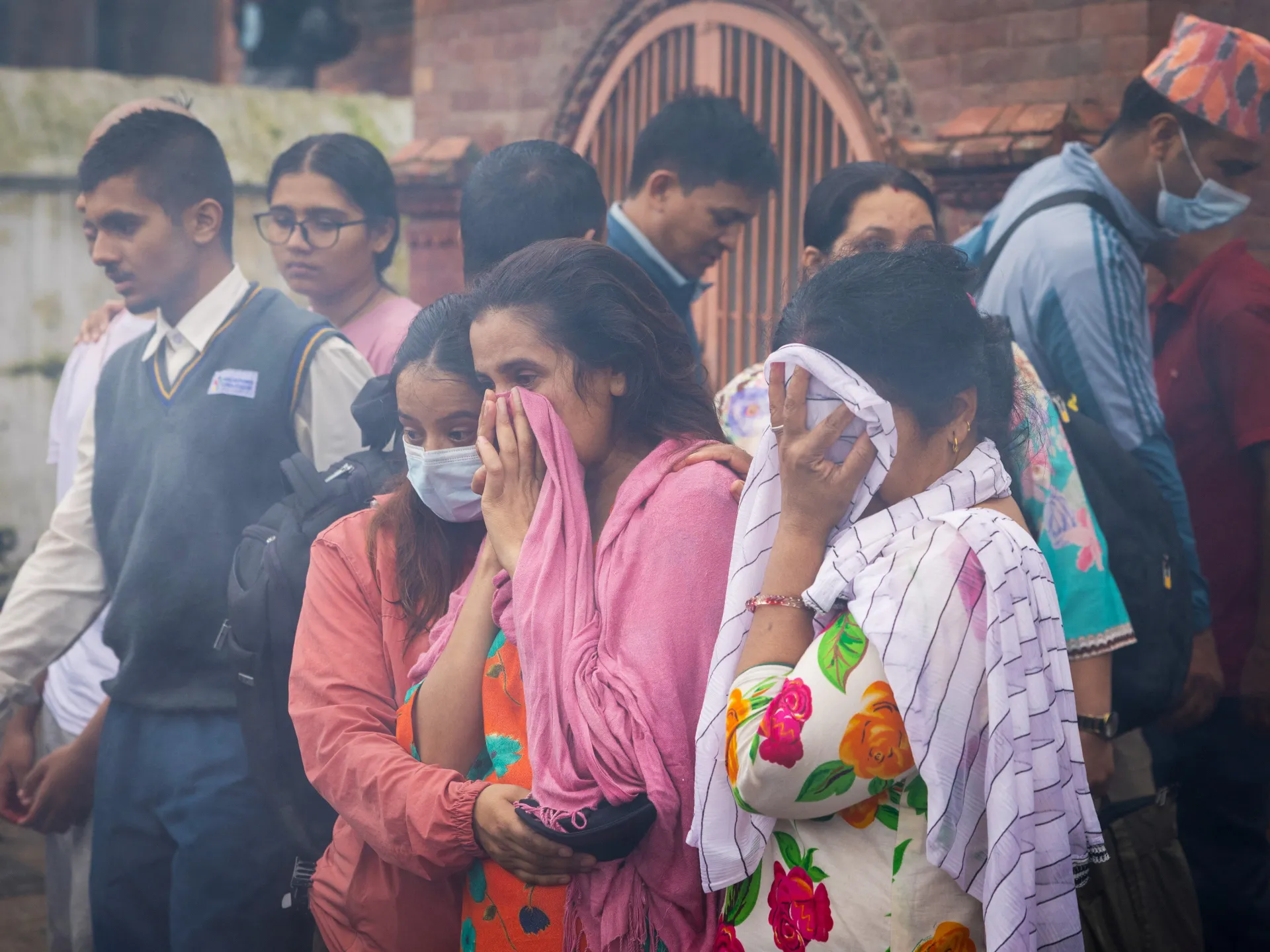
Kathmandu, Nepal – Nine days after his father, Dinesh, went missing, Sujan Achhami, 23, carries a body to the bank of the Bagmati River next to the famous Pashupatinath Temple in Nepal’s capital, Kathmandu. He lays the body on the Brahmanal – a stone on which corpses are placed for rituals. The priest reads mantras, directing Sujan to wash the body and offer a traditional clay lamp and flowers.
Catastrophic flash floods swept through northern and central Nepal on August 26, killing more than 1,200 people and leaving almost 5,000 others missing. With hopes of finding them alive – or even dead – fading, grieving relatives are being forced to say goodbye without bodies. So, many are instead performing symbolic last rites using effigies made of sacred kusha grass.
“We searched for them everywhere,” says Khim Bahadur Gharti Magar, whose uncle Tham Bahadur Pun, 71, a former British Army soldier, and aunt Chausara Pun, 64, were on a pilgrimage in northern Nepal when the flood hit. “We couldn’t find them.”
He has also performed these symbolic last rites for his missing relatives, right here on the bank of the Bagmati.
“There were 17 buses in the group they were with. During our search, we found four other people [dead bodies] who were part of the pilgrimage group. That’s why we decided to cremate,” Magar says.
Sher Bahadur Pun, the deceased man’s son-in-law and a senior health official with the Nepal government, says the family has given DNA samples to police in the hope their identities might be traced later.
For Dinesh Achhami’s family, the search for the 41-year-old has been equally devastating. A driver from Barabishe municipality in northern Nepal, Achhami was in Rasuwa – the district hit worst by the floods – at the time the surging waters barrelled down from Tibet. “We looked everywhere because we had no clear idea where he was hit,” says his uncle Raju Achhami.
Maniram Tharu narrowly survived the flood while working at the Upper Trishuli 1 hydropower project. His 30-year-old brother Dipendra – also a hydropower worker who was employed in a different, downstream project – and sister-in-law Phool Maya Tamang, in her 40s, have been missing since the flood.
“I cannot find their names on the list of those reported safe,” he says. “We don’t know where to go, what to do. We are worried. They have small children who are safe because they are living with other family members.”
The scale of the disaster has overwhelmed the authorities. Nepal Police spokesman Abi Narayan Kafle says storing recovered bodies remains a major challenge.
“The proper way would have been to preserve bodies until identification is established but we are not in that condition,” he says. “Many bodies are already in very bad shape, decomposed, some even in pieces, and cannot be preserved for extended periods.”
So authorities are temporarily burying unidentified bodies – with the aim of exhuming them and handing them to relatives once their identities are established.
Out of 1,344 bodies recovered so far, a total of 1,030 bodies have been buried in this way. Just 96 bodies have been handed over, after being identified by families, authorities say.
According to Kafle, the bodies have been properly numbered and have been buried at various sites in Chitwan, Nuwakot, Rasuwa, Kathmandu, Pokhara and other regions of Nepal.
But, he said, police have collected DNA samples from all bodies found so far before their burial, “to enable identification and matching with families later”.
Many in Nepal have been outraged by the government ‘s decision to carry out mass temporary burials of the deceased, describing it as going against Hindu religious traditions.
At the bank of the Bagmati next to Pashupatinath Temple, a veteran priest tells Al Jazeera that the past two days have been among the busiest he has witnessed since the 2015 earthquake, in which nearly 9,000 people died. Then, he said, most families “at least had bodies” to cremate.
As Nepal deals with its latest humanitarian crisis, the priest is this time helping carry out the symbolic cremations. He says they’re legitimate, according to Hindu scriptures. But that families are having to perform symbolic rituals is still a tragedy, he says.
Topics in this story
Gathered from external sources. Rights to this text belong to whoever originally published it.