In a 2010 Italian field study, researchers mixed solar-dried orange peel into steep soil plots; after 20 rain events, soil erosion was about 50% lower under the tested conditions
A 2010 study in Italy demonstrates that solar-dried orange peel can significantly decrease soil erosion on steep land, with findings showing a 50% reduction in erosion rates, highlighting its potential as a sustainable agricultural practice.
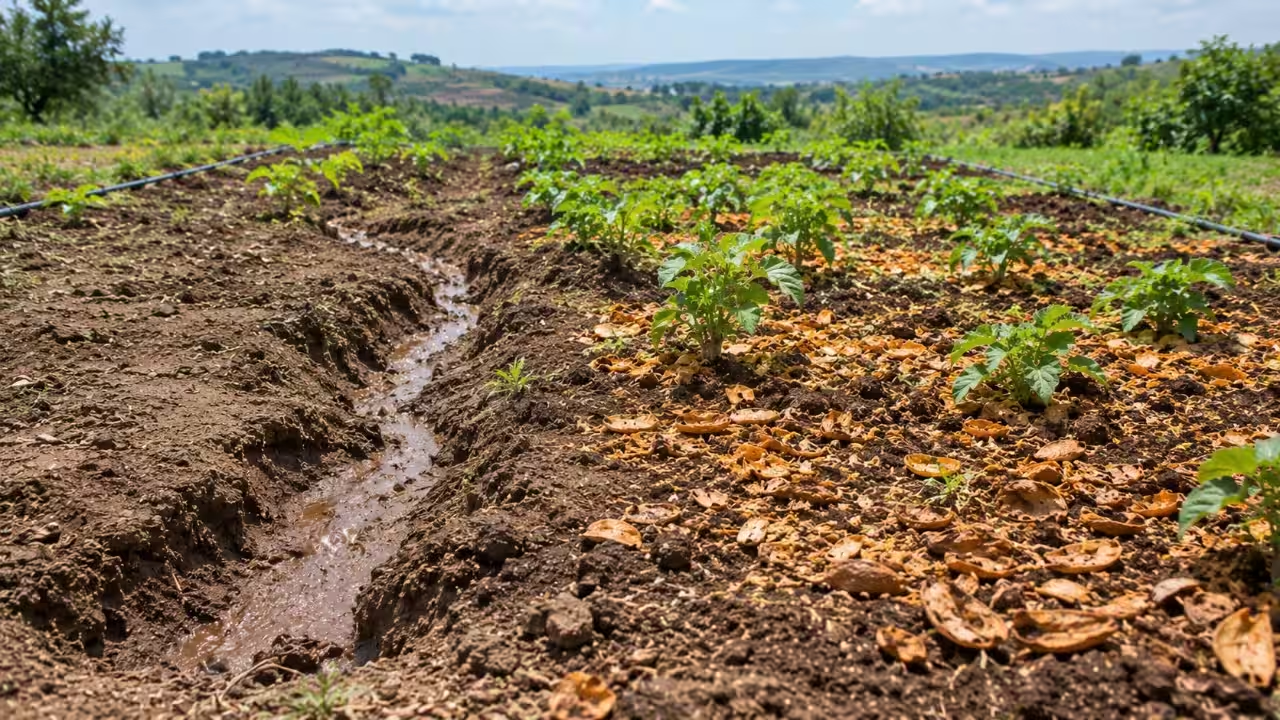
Soil erosion can gradually strip away the fertile surface layer that plants depend on, especially on steep land exposed to heavy rainfall. Protection of slope areas has remained an issue to be solved by farmers and landowners. Several studies have been done to check whether agricultural residues, normally wasted after processing the food materials, can provide a solution to this problem. A 2010 study by Bombino and colleagues in southern Italy checked whether solar-dried citrus peel could help control runoff and soil erosion. The study results indicated that orange peel, which is normally left after producing juice, was effective in reducing soil erosion.Eight experimental plots tested the citrus-peel treatmentAccording to Bombino and colleagues’ 2010 paper on land spreading of solar-dried citrus peel, the experiment used eight plots, each measuring 2 square metres, arranged in two wooden boxes set at a 100% slope. In four plots, the researchers added citrus peel, while the remaining four were left untreated. The 100% slope indicates that the vertical rise is the same as the horizontal distance. Solar-dried citrus peel was shredded into small pieces (4 to 8 mm) and mixed into the top 3 cm of soil at a rate of 3 kg per square metre. Then, the plots were subjected to natural rainfall and the researchers were able to observe runoff and sediment loss in treated and untreated soils under field conditions. The experiment was conducted during 20 rain events. Different rainfall conditions and plots with different ground cover properties were observed.Soil erosion fell by about 50%According to Bombino and colleagues, the key result was a 50% reduction in soil erosion in the treated plots compared with the controls. There was a 10% average decrease in the surface runoff as well. During this experiment, sediment yield and sediment concentration were, on average, 55-60% less in treated plots than in the controls. The decrease in runoff varied depending on observations and reached up to 33% at maximum. Runoff is the water flowing over the soil surface, whereas sediment yield is the soil carried out of the plot. In other words, despite the small decrease in runoff volumes, the decrease in soil loss may be much higher. The results suggest that solar-dried citrus peel can help minimize erosion under the tested conditions. Yet, it does not mean that the same effect will take place under other conditions.Organic matter may have improved soil conditionsThe study authors hypothesized that adding citrus peel would improve soil quality and promote plant growth. Organic material affects soil structure and the passage of water and could thus aid in the passage of rainwater into the soil instead of running on top of it. Plants are able to act as a shield from raindrops and slow down surface water. Plant roots might also play a role in keeping soil particles bound together. Improved soil quality and plant development were two possible explanations offered for decreased erosion. This interpretation needs to be carefully qualified. While there were clear distinctions made between treated and untreated plots in the experiment, there was no way of proving the degree to which each potential mechanism contributed to the decreased erosion.Citrus waste also requires careful handlingUsing citrus peel on land could provide a useful outlet for waste from fruit-processing industries. However, applying organic waste to soil also requires consideration of what happens as it decomposes and releases liquid. A later study, Evaluating the Pollution Risk of Soil Due to Natural Drainage of Orange Peel: First Results, published in Environments in 2021, investigated the potential pollution risk associated with drainage from orange peel. In their study, the scientists studied the organic liquid that came out of the substance under the conditions of the experiment. The authors concluded that the risk of soil pollution from natural drainage of orange peel was negligible, given the limited amounts of leachate and organic load, although they noted that heavy rainfall could aggravate the hazard.The paper reports three lysimeter tests on orange peel: one with raw peel left to drain naturally and two others exposed to 100 mm of simulated rainfall after the peel had already drained or been solar-dried. In about 14 weeks, the peel volume fell by roughly 90% and the raw-peel test released 37.7 L of leachate, about 19% of the initial peel volume. The authors found that the organic load reaching the soil was negligible. Unlike the erosion study conducted in 2010, this study raises a new question. In combination, the studies show the need to consider both the advantages and disadvantages of using agricultural waste.Further field testing is neededThe 2010 study by Bombino and colleagues suggests that solar-dried citrus peel can reduce soil erosion, but only under the specific experimental conditions tested. This information could be useful in any attempt to preserve lands which are either steep or erosion-prone, as well as discovering other uses for by-products from agriculture. Nevertheless, the experiment was carried out on a relatively small number of plots under certain conditions in southern Italy. Further research is needed to test the treatment in different soil types and climates and to assess how long the effect lasts. For now, the study only suggests that citrus peel may be useful in soil conservation, not that it is a guaranteed solution. The actual applicability of the material will depend on its efficiency in real-life situations.You use AI every day. Now get your AI Quotient. Take the AIQ test.
Topics in this story
Gathered from external sources. Rights to this text belong to whoever originally published it.