A New Age of ‘Analog Dressing’ Is Upon Us
Spotted at NYFW: clothes that go off the grid.
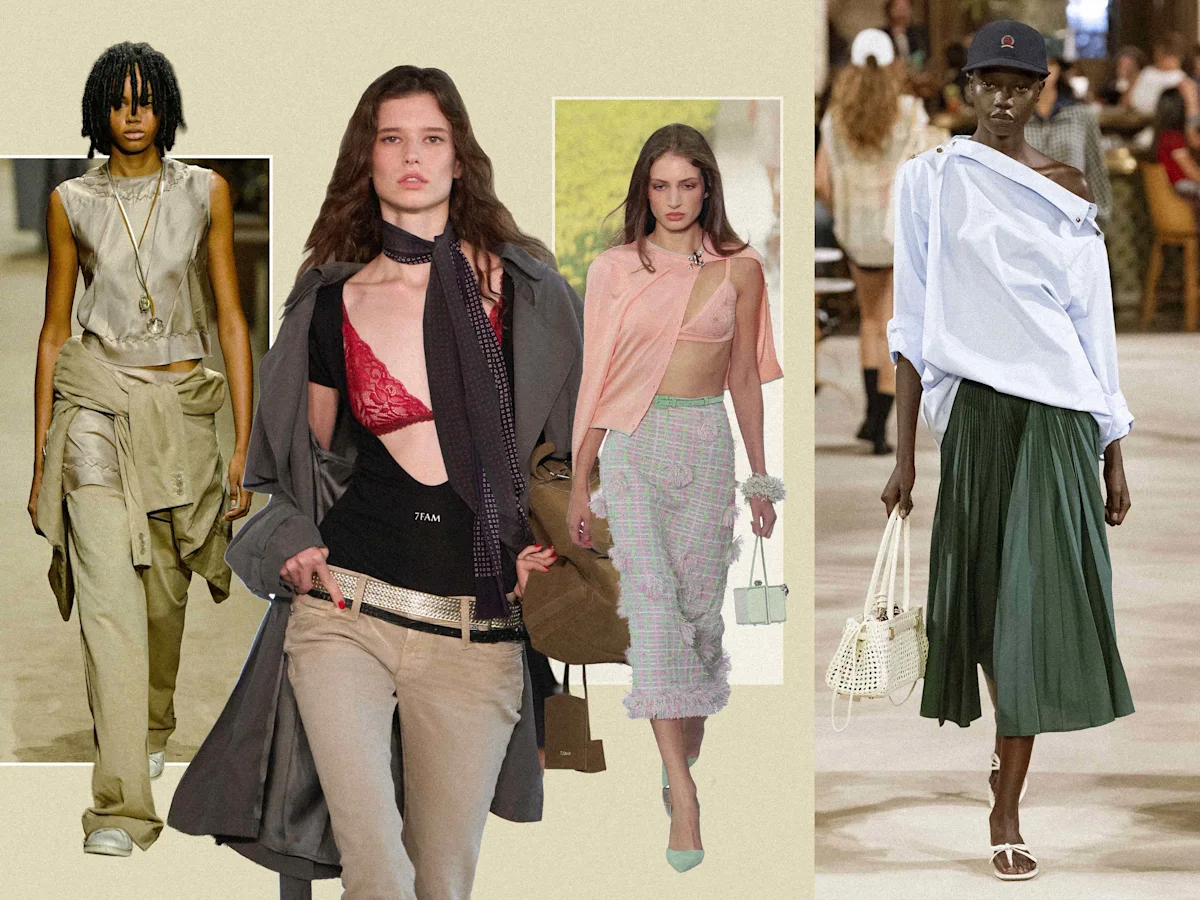
Let's take a second to remember what it was like to get dressed before we walked around all day with professional-level cameras in our pockets: We rarely took pictures of ourselves doing mundane tasks—and if there was an impending photo opportunity on the horizon, one couldn't test-shoot a look from multiple mirror selfie angles and instantly send the shots to a friend for opinions. This was not that long ago, and yet, it feels like a wistful epoch of yore, tinged with a dreamy sepia filter in our collective memories. To put on clothes without overanalyzing how one's outfit might be documented in any number of situations that could arise (or, gasp, within a candid snap) is an intoxicating notion, a hall pass to experiment with haphazard layering or forego your steamer.
In a world where having a glossy and meticulously crafted digital persona has become the baseline standard, messy, spontaneous styling equals freedom—and freedom is nothing if not the ultimate luxury. So it only makes sense that some of the biggest brands showing at New York Fashion Week this season have been leaning hard into garments that read as undone and authentically lived in. Blouses with buttons fastened askew at Altuzarra. Sheer tees scrunched and stretched in awkward ways at Brandon Maxwell. Crisp shirting seen at Tommy Hilfiger that appears to be thrown on backward, as if frantically shimmied into after oversleeping. Think of these beautifully imperfect runway moments as the Brick device of the fashion world: sanctioned permission to stop thinking about how your every move might be perceived, and just relax into the physical world. Welcome to the new era of analog dressing.
"These don't really translate in pictures," my editor tells me as she opens her camera roll in a cab between events to show me images of the latest Derek Lam collection , built around artfully folded utilitarian separates and flouncy little dresses. On her six-ish-inch screen, the pieces look weirdly wrinkled and crinkled, as if they had gone straight from the dryer to being slept in all night. In person, though, the creases and shadows are what give them character.
Character is also a descriptor that's always well-applied to Rachel Comey's line, regardless of the current trends. So it's fitting the designer is a shining example of this sort of 20th-century bedroom styling I've noticed permeating the Spring/Summer 2027 shows. Her latest creations were packed with charmingly mussed details that won't necessarily translate to an algorithm's whims: long sleeves casually tied around one's waist, necklines pushed to the side, silky silhouettes that could be neatly ironed, but look cooler when rumpled. The looks at Coach gave a similar impression of being thrown together on the fly, full of tossed-aside blazers knotted at the hips, and extra-long pants puddling over scuffed white sneakers. Meanwhile, even Carolina Herrera—a proper and polished ladies-who-lunch label if there ever was one—incorporated a sweater set with the cardigan secured with a single button shifted over one shoulder as if the wearer couldn't be bothered to find a more flattering way for it lay. The shift was subtle but palpable, and made such sophisticated clothes seem slightly more approachable.
I find many of these runway looks to have same ineffably interesting aura as Jane Birkin with her eponymous structured tote, legendary for the way it was marred with scuffs and covered in stickers and baubles. Or French model-turned-designer Inès de la Fressange, who famously wore the same falling-apart white jeans and blue sweaters when she wasn't on location with houses like Chanel. Essentially, it's the kind of strikingly dissonant visual clutter that you can't look away from in real life, clothes that draw you to someone before they even speak. It's something I've been thinking a lot this week as I run to all corners of the city: how many of the wardrobe choices that have made me do a double take are just non-industry people going about their regular lives. There was the girl grabbing coffee in extra-baggy hip slung jeans and short tweedy jacket over a tank, and the dog walker in a pristine tennis skirt and just-cropped-enough structured sweatshirt, their clothing combinations worn with the ease of a second skin.
Analog dressing, however, is not confined to daytime activities. There's also 7 For All Mankind to consider: The beloved denim behemoth's latest catwalk reflected the sort of cig- and Jägerbomb-tinged throw-on-and-go looks that arise out of partying from midnight straight into work the next morning. With a parade of Hot Mess Express models—an assessment I type with love!—the show was an homage to the give-no-f*cks glamour of early 2000s club culture: dangerously low short-shorts, tottery platform stilettos (or totally bare feet), and long and silly skinny scarfs.
As only those who came of age in that era can tell you, what made it so special was the lack of constant surveillance, thus giving participants the nerve to dance and get into trouble with abandon. It's logical that generations who grew up with multi-step skincare tutorials and matching athleisure sets might want to channel some of that manic movie-quality energy into their own wardrobe. Sure, the haphazardly thrown together nightlife clothes reflect a sense that the wearer is either on their way to or stumbling home from a crash-out, but that's sort of the point: the stakes of losing one's composure in public have never been higher. The idea of doing so without instant documentation is downright liberating.
Does IRL magnetism even matter anymore if it doesn't win you any new followers or likes? This seems to be the question that we're all grappling with as many of us reassess our relationship with technology in this age of filters, everything-maxxing, and AI scandals. The mental load of thinking about how to both live one's life and perform it online for others to consume has become exhausting, a task none of us knew we were taking on when we downloaded our first social media apps in the 2010s.
I know that, at least for me, approaching my wardrobe in the morning has always been a refuge, a way I can control who I'm going to be at least for that day. Sometimes it's armor against judgment; other times it's a representation of my current state of mind. Occasionally, it's a full-blown thirst trap for no particular reason, because life is too short not to dress hot when you're really feeling yourself. In short, I get dressed by way of instinct—and the only time my gut-impulse formula falters is when I start overanalyzing what other people might think, worrying that the outfit I'm gravitating toward might be something I regret on the grid. It comforts me that designers seem to be experiencing the same fatigue, and are now leaning into the kind of fashion that's meant to be worn for one's self in the physical world. It's tangible style at its best, designed to be pulled and twisted and tied throughout the day without overthinking. But will we really wear the best of it all without finding a way to capture every possible angle for posterity? Honestly, I doubt it. But here's hoping that after the shot is secured, these clothes will inspire us to shove our phones deep in our bags and, at least for a little while, dance like no ones recording.
Topics in this story
Gathered from external sources. Rights to this text belong to whoever originally published it.