US ranchers wrestle with soaring costs - and their loyalty to Trump
Many farmers in states that backed the president say they are being hit from all sides, with the crucial midterm elections just weeks away.
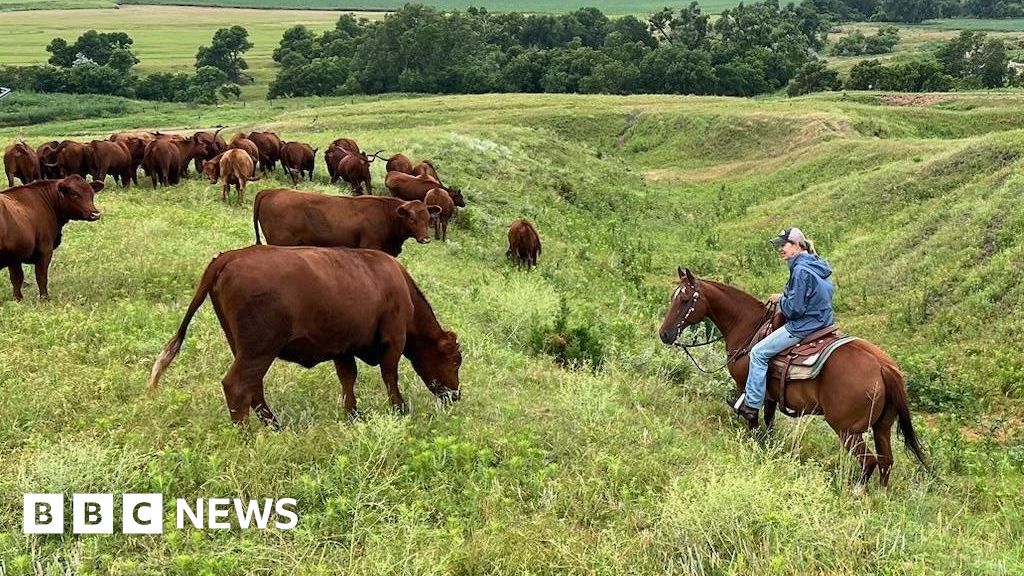
Nebraska rancher Yvette Mannon was already having a rough year.
In April, a wildfire destroyed 1,600 grazing acres and 13 miles (21 km) of fence along the ranch she bought in 2002. The ranch is nestled in a corner of Nebraska that's home to rolling green hills under sweeping Midwestern skies, the landscape dotted with grain silos and feedlots alongside fields and fields of bovines.
Mannon's 300 cattle survived the blaze - but the fencing needed to be replaced, and the herd still needed to be fed.
With steel prices at their highest levels in years, heavily affected by tariffs imposed by US President Donald Trump, that meant spending $4.89 a foot - for a total exceeding $300,000.
On top of that, because so much good grazing land had been destroyed, Mannon also needed a tractor out every day delivering hay to her cattle - at a time when diesel prices, spiking due to the Iran War, were up more than 40% from the previous year.
Then in August, the Trump administration announced it would import 300,000 metric tons of duty-free foreign beef in a bid to lower consumer prices. The news hit right before the September-November window when most US calves are weaned and sold.
"So we're 'Buy American', 'Let's Make America Great'," said Mannon, 63, who voted for Trump. "But for you guys over here, sorry."
"It just felt like a betrayal," she said.
Many farmers and ranchers across the US say they are being hit from all sides. Recent years have been difficult, with drought affecting crops and already historically low cattle herds. But they say government policies have added to the strain.
That has left some in Nebraska, which overwhelmingly backed President Trump during the last election, reassessing their political allegiances.
Dan Osborn, an independent candidate running against Trump-backed Republican Pete Ricketts, is performing surprisingly well in the polls ahead of November's Senate race.
Republicans seem keenly aware of the discord and frustration among farmers. Both Trump and Nebraska Governor Jim Pillen have in recent weeks announced relief policies aimed at lowering fuel costs for farmers and ranchers, who say they have been struggling for months.
The Iran War has sent diesel and fertiliser prices skyrocketing - both daily necessities for agricultural operations. Tariffs have affected machinery costs and repairs, as well as steel and lumber prices.
And decisions by the Trump administration - whether it be importing foreign beef or opening up the southern border to Mexican cattle - have sent already-volatile markets into overdrive.
Many producers are losing hundreds of dollars per head of cattle.
"All of this hit cattle markets, as a whole, negatively," said James Mitchell, an assistant professor and agricultural economist at the University of Arkansas.
Cattle markets run in 10-12 year cycles, he said, with some good years and some bad. The industry recently enjoyed a particularly lucrative period, where low supply and high demand drove up prices. But now, the market is clearly on a downswing.
Jake Wolfinger, 45, has been weathering the downturn at his feedlot near Lexington, Nebraska. He and his wife are both Ohio natives hailing from multi-generational farming families. They moved to Nebraska - which enjoys lush land and the most groundwater in the nation - to strike out on their own.
The Wolfingers bought a dilapidated feedlot in 2010, which they have turned into a sophisticated operation with 5,500 cattle. Neighbours point to them as an example of what hard work can still do in a tough industry.
But Wolfinger did not factor the Iran War, tariffs or foreign beef imports into his planning.
"Things were just chumming along pretty good," he said, selling cattle for $240 per hundredweight - but that's dropped to $225. That may not seem like much, but it means a loss of potentially hundreds of dollars a head.
Wolfinger is also contending with sky-high diesel costs, with some equipment going through 400-gallon tanks a day.
A Trump supporter, Wolfinger said he voted for the president because "we needed his spirit in this country". He also expressed frustration with what he called "woke DEI" policies on the left.
But he is unhappy with the way the president has intervened in the beef market.
"People need to stay the hell out of farmers' business, because it's harvest time," Wolfinger said.
'People need to stay the hell out of farmers' business'
Forty miles northwest, near Callaway, Nebraska, 54-year-old Duane Kimball stands in his shed surrounded by machinery - and a huge Trump banner along one wall.
"The daily upcharge… is kind of painful," he said.
"I know a lot of people have had to go back to their banks and increase their lines of credit."
Kimball believed the Iran War would have ended long ago.
But he does not blame Trump for all of his economic challenges. "To pin that on this administration, I don't think is a fair assessment," he said.
He pointed to cumbersome regulations as well as the rising cost of machinery and fertiliser - trends that began before Trump returned to the White House.
Mannon, who returned to her native Nebraska and bought the ranch after a career in banking, believes the agricultural industry will show its feelings at the midterms.
But like many around here, she prefers not to engage in too much political debate.
That is not a problem for her friend and nearby rancher Jim Jenkins. A former independent senatorial candidate, Jenkins is fiercely proud of Nebraska agriculture and his own ranch, which is on land his family homesteaded more than 150 years ago.
Jenkins has been so incensed by the policies he feels are harming Nebraska's agricultural industry that he wrote an opinion article over the summer in an Omaha paper.
He has felt the squeeze personally too, citing high diesel, fertiliser, lumber and steel costs - everything from barbed wire to fence posts.
That has been compounded by "uncertainty" over what may happen next, he said, and what the next Trump announcement might mean for the industry.
"Those are the things that keep you up at night," the 69-year-old told BBC News.
An outspoken Trump critic who didn't vote for the president during any of his White House bids, Jenkins knows he is an outlier among his conservative neighbours. When Trump was first elected, Jenkins said he hoped he would turn out "to be a practical business guy".
Now, he said, "I think he's been anything but practical".
But for many Trump-supporting farmers and ranchers, the president's decisions - even when they hit them economically - deserve the benefit of the doubt.
"We've all known this about Trump. He just kind of could be a little 'shoot, fire, aim,'" Wolfinger said. "I wish you could, you know, put the gun back and holster it and then think about it."
But, he said, "I think he's, for the most part, trying to run this country in the right direction".
What are the US midterms? A simple guide
The Republican candidates walking a Trump tightrope
Don Cantrell, whose grandfather started farming family land that now stretches to 12,000 acres, said he is still getting hit on diesel and admits the president "does some stupid things" and "says some stupid things".
But Cantrell believes Trump has been the "best president overall". His establishment of DOGE - the Department of Government Efficiency - for example, was exactly what he felt the country needed.
"Let's cut government waste," he said. "There's so much waste."
Trump also maintains stances on social issues - like abortion and praising Christianity - that align with many Nebraskan voters' personal convictions.
"I think, in general, if you're conservative in this country, you're going to vote conservative," Wolfinger said.
Don Batie, 67, agrees: "There's a lot of other issues besides agriculture."
Still, the economic realities are hard to ignore, he said.
Batie retired from farming last year for a combination of personal and economic reasons. The corn and soybean farmer watched as prices fell from $7 a bushel for corn in early 2022 to just $4.29 three years later.
But costs have not gone down, he said, with tariffs and inflation contributing to his bottom line. As a result, he has had to abandon his longtime dream of passing on the 400-acre farm he owns to his daughter.
"It just wasn't going to work now," he said, sitting at the dining room table in the home he grew up in.
He only came to that realisation within the past year after crunching the numbers.
"I knew things hadn't been good," he said. "But when I started working on the numbers… I was like, 'This is going to be bad.'"
Batie voted for Trump in 2016 and again in the primary - but not in 2024, because he was disappointed with his policies. He said he had heard similar dissatisfaction throughout the state.
"They're still strong Republicans," he said of those people."But they're not a Trump supporter anymore."
All over Nebraska, however, the industry soldiers on.
On a rainy Thursday in Broken Bow, buyers clad in cowboy hats, plaid shirts and denim gathered for the regular indoor cattle auction.
Calves still need to be bought and sold, and ranch operations - many multi-generational - don not pause for politics.
Across the train tracks, past feed and hardware stores, Yvette Mannon summed up Nebraskans' resilience and fortitude.
"People in agriculture are eternal optimists," she said "Otherwise we wouldn't get in it."
Topics in this story
Gathered from external sources. Rights to this text belong to whoever originally published it.