Scientists found a 4-million-year-old baby tapir in Spain, the most complete juvenile skeleton of its kind ever found in Europe
Europe News: At the Camp dels Ninots site in Caldes de Malavella, near Girona in northeastern Spain, researchers have recovered a remarkably complete skeleton of a.
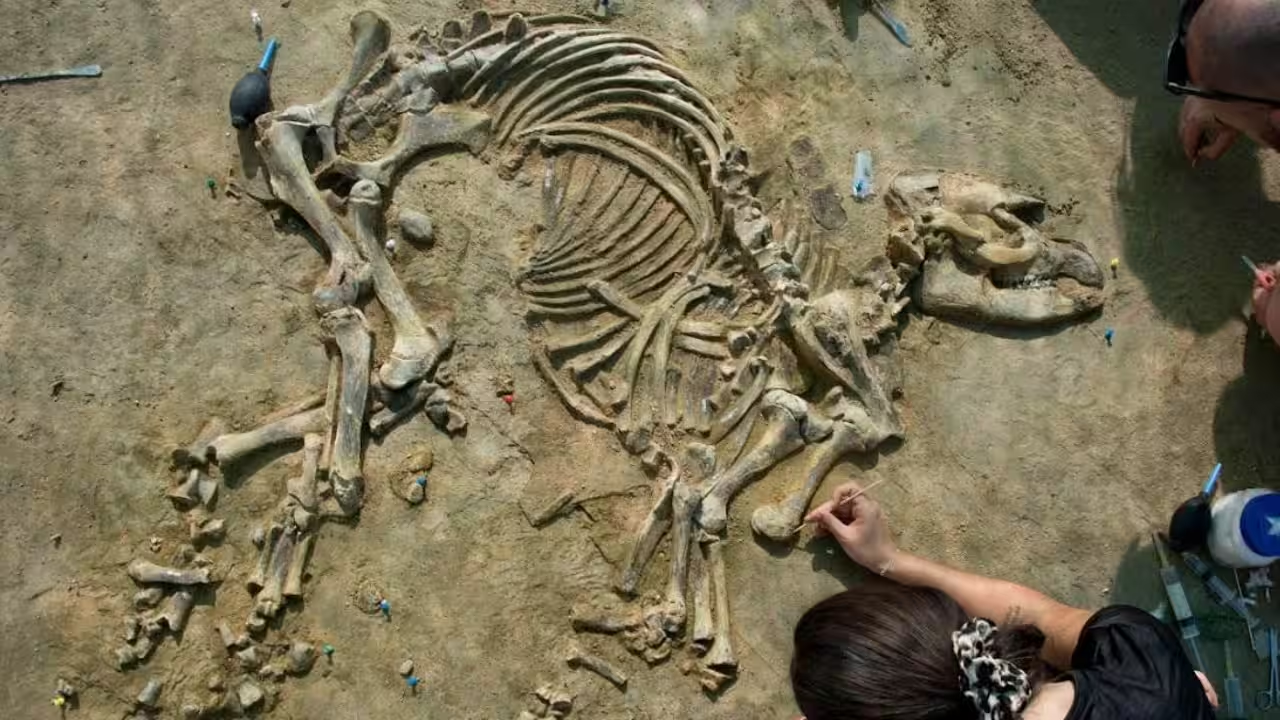
At the Camp dels Ninots site in Caldes de Malavella, near Girona in northeastern Spain, researchers have recovered a remarkably complete skeleton of a young tapir that died roughly 4 million years ago, when the region was still home to a humid subtropical landscape surrounding an ancient volcanic lake. The animal, estimated to have been about 1 year old, belongs to Tapirus arvernensis, an extinct species that lived across parts of Europe during the Pliocene. Its bones were found largely connected in their original anatomical positions, preserving an unusually detailed record of a juvenile animal that would otherwise be extremely difficult to study. Researchers from the Catalan Institute of Human Palaeoecology and Social Evolution, or IPHES-CERCA, say the specimen is the most complete juvenile tapir skeleton ever recovered in Europe. The discovery also brings the number of tapir individuals found at Camp dels Ninots to 7, making the site an exceptionally important record of this extinct European mammal.Why Camp dels Ninots has become a major site for studying ancient tapirsAccording to IPHES-CERCA, the Camp dels Ninots excavation has produced an unusually large number of Tapirus arvernensis remains, including individuals representing different ages and sexes. The newly recovered juvenile is particularly valuable because complete young skeletons are rare in the fossil record. Dr Bruno Gómez de Soler, an IPHES-CERCA researcher and co-director of the excavation, said the find provides an opportunity to study skeletal development, growth and other aspects of early life that are difficult to reconstruct from isolated fossil bones. Having several individuals from the same species and site also gives researchers an unusual opportunity to compare animals at different stages of development rather than relying on specimens recovered from unrelated locations.How an ancient volcanic lake preserved the tapir skeletons so wellCamp dels Ninots formed within a volcanic crater known as a maar, which later filled with water and became a lake during the Pliocene. Fine sediments accumulated on the lake floor over time, creating conditions that could rapidly bury animal remains and protect them from the processes that normally destroy fossil skeletons. That helps explain why the site has yielded exceptionally well-preserved animals, including tapirs whose bones remain in close anatomical association. Researchers have proposed that volcanic activity and gases released around the crater may have contributed to sudden animal deaths, although the precise circumstances surrounding individual specimens remain an area of investigation. The surrounding environment was also very different from modern northeastern Spain, with plant remains indicating a warmer, wetter landscape and dense vegetation around the ancient lake.What the juvenile tapir can reveal about how the species grewThe juvenile skeleton gives researchers something adult specimens cannot: a direct record of a developing Tapirus arvernensis. Young animals are particularly difficult to preserve because their developing bones are more vulnerable to destruction, scattering and scavenging before burial. Because Camp dels Ninots has produced tapirs of different ages, researchers can compare skeletal features across the population and begin reconstructing how these animals changed as they matured. The specimen will undergo further laboratory analysis after excavation, including detailed recording of the bones and examination of the surrounding sediment. Researchers hope those studies will clarify aspects of the animal's development while also revealing more about the conditions that allowed its skeleton to survive for approximately 4 million years.Why 7 tapirs from one site matter to palaeontologistsThe latest discovery strengthens Camp dels Ninots' importance as a reference site for understanding Europe's Pliocene tapirs. Tapirus arvernensis was one of the tapir species that inhabited Europe before the animals eventually disappeared from the continent, leaving their modern relatives restricted mainly to Asia and the Americas. Finding multiple individuals from one exceptionally preserved environment allows researchers to study not only individual animals but also variation within a single population. The combination of adults and juveniles is especially significant because it provides a rare opportunity to investigate growth and life history using fossils from the same geological setting. Rather than being simply another isolated prehistoric skeleton, the newly recovered tapir adds another piece to an unusually detailed record of an extinct animal and the environment in which it lived.Catch the latest World News and Live updates. Download the TOI app.
Topics in this story
Gathered from external sources. Rights to this text belong to whoever originally published it.