In 1971, scientists moved 10 insect-eating lizards to Croatia’s Pod Mrcaru islet; when they returned in 2004, more than 5,000 descendants showed larger heads and altered digestive systems for a plant-rich diet
Rest of World News: In a remarkable study of evolution, scientists observed how ten Italian wall lizards introduced to a Croatian island evolved into over 5,000 descendants with larger heads and plant-digesting guts in just over three decades. This groundbreaking research sheds light on rapid evolutionary changes in isolated environments.
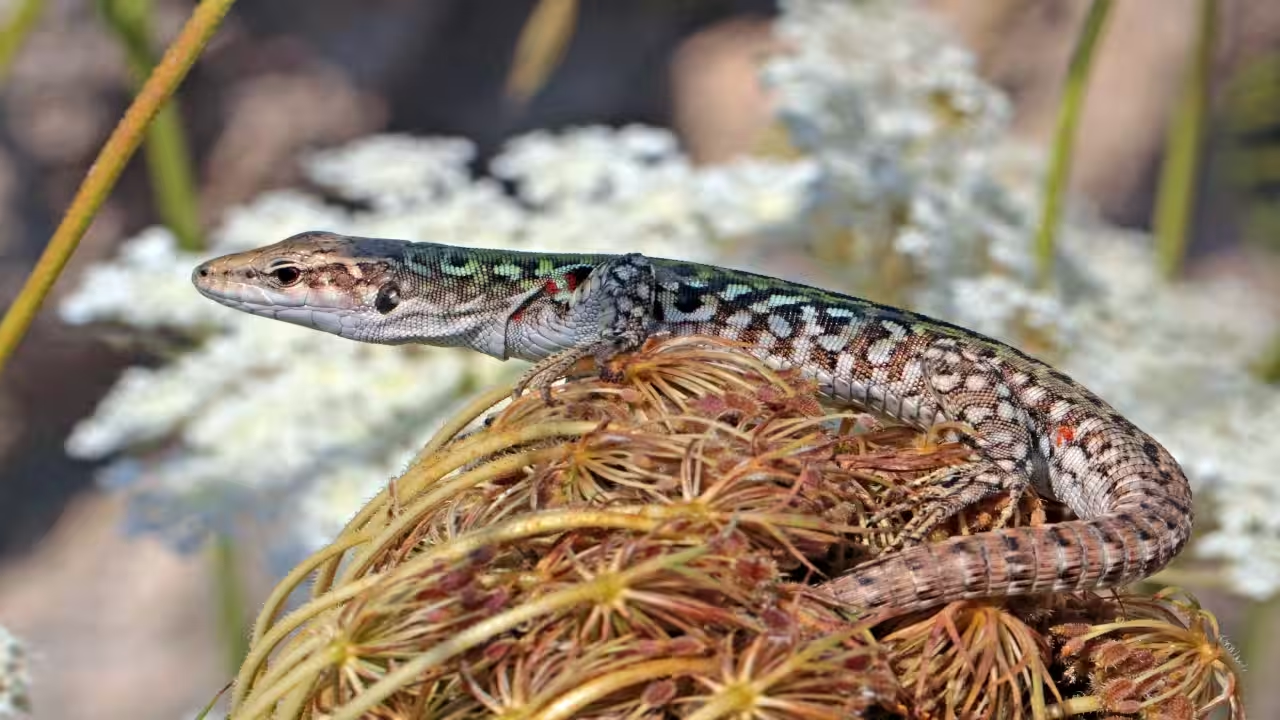
Off the Dalmatian coast, the Adriatic Sea is dotted with small, usually deserted islets, many of which are bare rock and brush too small to show up on standard maps. Pod Kopiste and Pod Mrcaru are two of these landmasses that are located close to the bigger island of Lastovo, only a few km apart. Other than the lizards that crawled across its limestone, they received very little attention for decades. The landscape was altered by a little experiment conducted by biologist Eviatar Nevo and his associates, which turned out to be one of the clearest real-time examples of evolution in a vertebrate species documented so far.In 1971, ten Italian wall lizards (five males and five females) were removed from Pod Kopiste and introduced to the nearby islet of Pod Mrcaru by researchers. The experiment was just to observe how two similar animals may compete if placed together on a limited plot of land. The resident lizard population of a related species, the Dalmatian wall lizard, already existed on Pod Mrcaru. It was a purposefully low-key study, the kind of thing that may have been forgotten once the islands became unreachable because of conflict.An island left undisturbed for decadesFor years, access to the area was blocked by political unrest and the Croatian War of Independence, making it impossible for researchers to monitor the lizards they had brought in. Scientists weren't able to visit Pod Mrcaru again until 2004, when conditions permitted travel to resume. Since a population founded by only ten lizards would be vulnerable to disappearing on a small island, nobody involved expected to find the population thriving when researchers returned.Instead, the team found the islet teeming with lizards. Genetic testing confirmed that the more than five thousand lizards now living on Pod Mrcaru were all descendants of those original ten animals and that the native Dalmatian wall lizards they had been introduced alongside, they had disappeared from the island entirely. The Italian wall lizards had not only survived for more than three decades but had also developed marked differences from the source population on Pod Kopište.New heads, new bite, new gutIn comparison to the source population, the Pod Mrcaru lizards' bite force had significantly risen, and their skulls had become markedly larger in relation to their body size. A detailed anatomical study published in the Proceedings of the National Academy of Sciences found pronounced differences in head morphology and bite force between the Pod Mrčaru and Pod Kopište populations. In the article, led by biologist Anthony Herrel, the alterations were described as an example of evolution occurring rapidly enough to be observed within one human lifetime.But the biggest revelation was an inner discovery. Its lizards had a diet significantly richer in plant material than the primarily insect-based menu on Pod Kopiste, and the animals had altered their digestive systems to match. Dissections revealed that the lizards had evolved cecal valves, muscular structures between the small and large intestines that restrict the transit of food and give bacteria more time to break down tough plant fibre into consumable nutrients. Such structures are widespread in plant-eating lizards, but researchers had not previously observed them evolving from scratch within a population in such a short time.A textbook case with lasting influenceSince then, the Pod Mrcaru lizards have become a touchstone in evolutionary biology, often cited as evidence that natural selection can act quickly when a population enters a new environment. Later studies have also examined differences in the gut microbiome and digestive physiology between the Pod Mrčaru and Pod Kopište population. What started as an off-hand experiment in competition between two species of lizard developed, seemingly by chance, into a unique, unbroken observation of evolution happening under real settings. The conflict kept researchers away from the islet for decades, leaving the introduced population without regular scientific monitoring while it adapted to its new environment.Catch the latest World News and Live updates. Download the TOI app.
Topics in this story
Gathered from external sources. Rights to this text belong to whoever originally published it.