The giant pre-historic insect found by miners
Griffinflies, a dragonfly-type insect, ruled the skies millions of years before the dinosaurs.
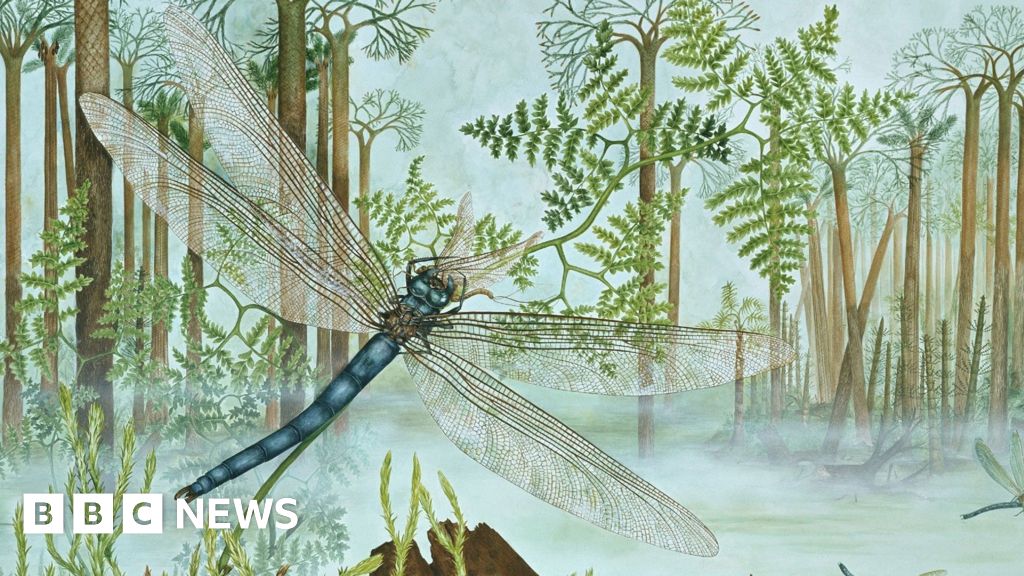
Before dinosaurs roamed the Earth, seagull-sized dragonfly-like insects known as griffinflies ruled the skies.
More than 300 million years later, miners unearthed two fossilised remains of the "gigantic" insects 500m (1,640ft) below the surface at Bolsover Colliery, in Derbyshire, in 1979.
The only known remains of whalleyala bolsoveri, with a 17.4cm wingspan, and arctotypus diluculum, believed to have had a wingspan of about 50cm, were discovered and are now housed at London's Natural History Museum.
The two "irreplaceable" specimens, dubbed the "Bolsover Dragonflies", are the only known example of the species ever to be found, according to the museum.
With a sculpture of the Bolsover Dragonfly set to be unveiled on a roundabout in the town on Monday to celebrate the discovery, what are griffinflies and how did they end up in Derbyshire?
Local historian and archaeologist Dr Simon Elliott said the "Bolsover Dragonflies" lived during the Carboniferous period, between 359 and 299 million years ago.
"The key thing is the environment in Bolsover was wet and swampy," Elliott explained.
"This period had the first reptiles on land, the first fish and a number of insects that already existed from earlier periods of history."
The Natural History Museum said griffinflies were "ferocious hunters" that would eat "anything and everything they can find".
Similar to dragonflies, griffinflies are described by the museum as the "large, extinct cousins of both dragonflies and damselflies".
"If it was in Jurassic Park, people would be running," Elliott said.
As well as giant dragonflies that had wingspans up to 71cm (2ft), the landscape was filled with poisonous centipedes that were 2m (6ft) long, as well as cockroaches and scorpions that were 1m (3ft) long.
The museum said giant insects were able to grow so large because vast forests removed huge amounts of carbon dioxide from the atmosphere, increasing oxygen levels to about 35%, compared with 21% today.
Over time, dragonfly-like insects became smaller and faster because birds, which evolved from dinosaurs, emerged as new predators.
Elliott said north Derbyshire and surrounding areas became key coal mining sites because of vast forests of bark-bearing trees that grew during the Carboniferous period and later formed large coal deposits.
The 61-year-old said the Bolsover Dragonflies would have died and fallen into the wet ground, which was "the key to it later becoming a fossil".
The layer of Carboniferous land was later covered by shallow seas from the Permian period, between 298.9 and 251.9 million years ago.
"The fossils were found 500m underground because miners had to dig through all the Permian magnesium limestone that covers Bolsover to reach the older coal seams below," said Elliott.
Richie Howard, curator of fossil arthropods at the Natural History Museum, said the Bolsover Dragonflies were so rare they were not currently exhibited in the public galleries.
"They are, indeed, the only known example of those species. No more have ever been found of either of them and, as the colliery is no longer active, probably no more ever will be," said Howard.
"Specimens of this nature are not usually exhibited because they would be irreplaceable if damaged or stolen."
Howard said whalleyala bolsoveri was discovered by a miner called Malcolm Spencer, while the arctotypus diluculum was found by another miner called Graham Ball.
The whalleyala bolsoveri is the "smaller" of the two specimens, said Howard.
The arctotypus diluculum, formerly named tupus diluculum, is the "larger" of the two specimens, but was incomplete and in "several fragments".
A sculpture of the "Bolsover Dragonfly" is being unveiled on a roundabout at the junction of Chesterfield Road, Riverside Way, Intake Road and Station Road on Monday.
It was made by school students in the area who took part in a 20-week programme to learn metal cutting, design, and welding.
Bolsover District Council leader Jane Yates said the sculpture was a "great source of pride for Bolsover".
"I find it fitting that the sculpture is overlooked by Bolsover Castle, making it a real focal point for people entering the town," she said.
"What makes this sculpture even better is that it was created by young people who have been given a chance to learn skills for life.
"I hope this sculpture remains here for many years to come."
Listen to BBC Radio Derby on Sounds and follow BBC Derby on Facebook , on X , or on Instagram . Send your story ideas to eastmidsnews@bbc.co.uk or via WhatsApp on 0808 100 2210.
Why are these beaches so rich in fossils?
Incredibly well preserved cicada fossil discovered in Germany
X-rays reveal tiny half-billion-year-old creature
Topics in this story
Gathered from external sources. Rights to this text belong to whoever originally published it.