Michigan farmers created a wind lease where even landowners without turbines could get paid; some received $1,000 per acre a year
Michigan farmers found a way to make wind development pay beyond the properties where turbines were actually placed.
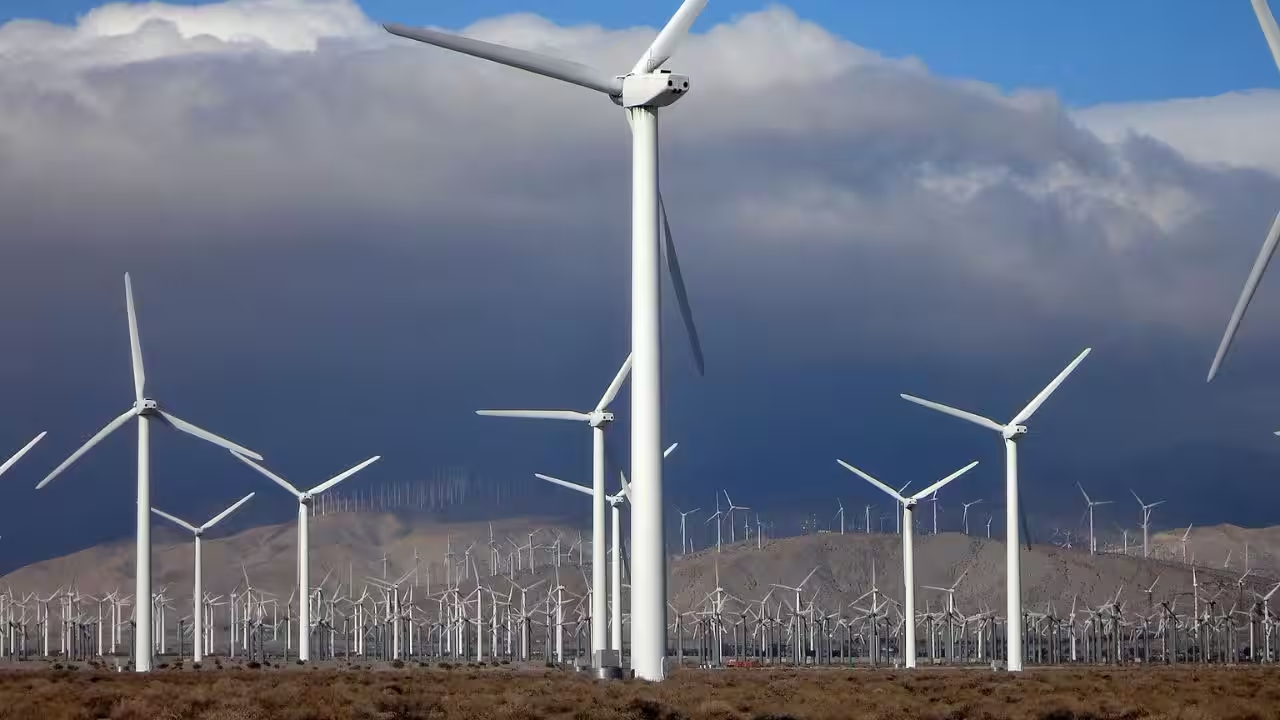
Michigan farmers found a way to make wind development pay beyond the properties where turbines were actually placed. In Isabella County, farmers worked together to create a lease that shared part of the revenue across participating landowners, meaning a farmer could receive a payment even without hosting a turbine. The arrangement was designed to reduce disputes between neighbours and spread the financial benefits more widely. The approach later became part of a broader discussion about how rural communities could structure long-term energy leases around local interests instead of individual turbine locations.How Michigan farmers created a wind lease that paid landowners without turbinesThe idea emerged as farmers in Isabella County considered a proposed wind farm and began looking closely at how similar projects had affected other communities. Brookings, in its account of the Isabella County project, describes how local farmers initially had reservations about turbines, including concerns about changes to the landscape, noise, wildlife and how farmland would be used. Instead of making an immediate decision, they visited existing wind farms, spoke with other landowners and examined different lease arrangements.One issue stood out. In conventional arrangements, the farmer whose property hosts a turbine can receive payments, while a neighbouring landowner may receive nothing. That difference can become a source of tension when several properties sit close together. The farmers then decided that the financial structure needed to be broader.Why the payments were spread across participating acresBrookings reports that the Isabella County farmers developed a lease in which participating landowners received the same payment per acre. A separate payment was added for properties that actually hosted turbines. This meant the location of a turbine did not determine whether a participating farmer benefited from the project.The arrangement also included a good-neighbour payment. According to Brookings, homeowners with smaller properties inside the project area could receive $1,000 per acre each year if they signed up. That gave people who were close to the development a way to share in some of the financial return even when they did not have enough land for a turbine.The structure was not simply imposed by the energy developer. Farmers shaped it themselves, drawing partly on experience with earlier oil and gas leases in Michigan. Brookings says Michigan State University Extension agent Paul Gross helped provide information while the farmers worked collectively on the terms.Importance of long-term energy leases for the farmersEnergy leases can provide landowners with a different source of income from ordinary agricultural production, but they can also last for decades. The Brookings account notes that the Isabella County project involved the possibility of a 50-year lease, making the terms particularly important for families thinking about their land over generations.Michigan Farm News has also examined the appeal and complications of long-term energy leases, highlighting why landowners need to look carefully at the details before signing. Such agreements can involve long commitments and conditions that extend well beyond the initial construction period.The issue is not simply how much money is offered. Lease terms can determine who receives payments, how land can be used and what happens over the life of the project.Other Michigan communities learned from shared wind paymentsThe idea of spreading wind revenue across a community was not entirely new. GreatLakesEcho reported in 2011 that energy companies were experimenting with community pooling agreements in Michigan, allowing nearby residents without turbines to receive compensation. One proposal for the Blissfield Wind Energy Project offered residents within half a mile of a turbine $1,500 a year.GreatLakesEcho also reported that pooling agreements were already being used in Gratiot County, where developers had worked with local residents and landowners. Richard Vander Veen of Wind Resources recommended the approach and stressed the importance of involving people early in the process.Gratiot County later became one of Michigan’s major wind-development areas. Greater Gratiot Development Inc. reports that the county now has 6 wind farms, with land payments going to more than 500 landowners. It also reports $108.1 million in additional tax revenue from wind development since 2012, alongside construction and permanent maintenance employment.Why the model remains relevant in MichiganThe same questions are appearing around new projects. The Midwesterner reported in March 2026 that NextEra Energy had secured nearly 60 land leases for its proposed Ionia Wind Energy Center in parts of Montcalm and Ionia counties. Under the reported terms, landowners would receive $29,000 annually for each turbine once operational, plus $10,000 per turbine during construction and other incentives.The reported project is still different from the Isabella County arrangement, and details such as the final number of turbines, capacity and footprint had not been released at the time of that report. But it shows that when farmers have a role in shaping how revenue is distributed, a wind project can involve a wider group of people whose land and daily lives are connected to the development.You use AI every day. Now get your AI Quotient. Take the AIQ test.
Topics in this story
Gathered from external sources. Rights to this text belong to whoever originally published it.