Engineering a cheaper way to play videogames
On a table in Arc’s Bengaluru lab, a gaming device sits attached to cardboard, its electronics exposed.
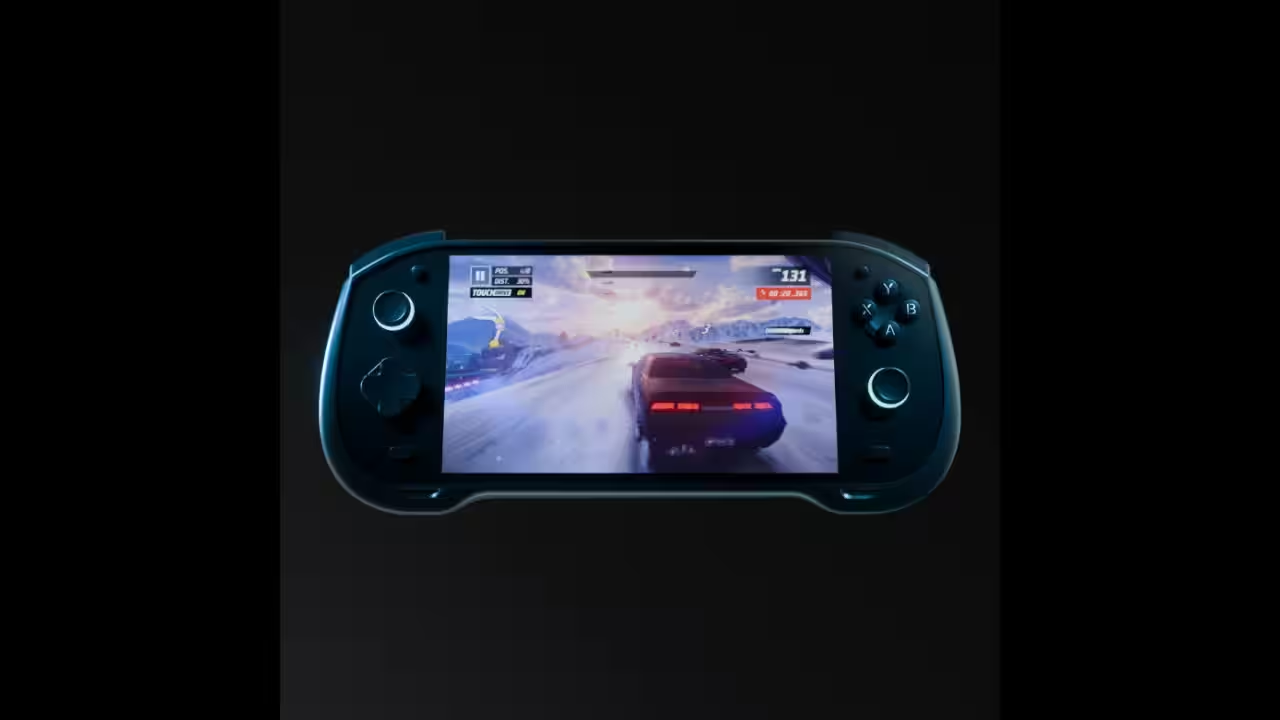
On a table in Arc’s Bengaluru lab, a gaming device sits attached to cardboard, its electronics exposed. It is an engineering prototype, waiting to be tested before being fitted into a proper case. During a video interview, cofounder Kaustubh K Jadhav lifts it towards the camera. This is device number 007, one of roughly 40 prototypes through which a young team is trying to answer a difficult question: can more Indians afford to play games beyond their smartphones?The answer, Arc believes, lies as much in software as in the machine itself. Its Rs 33,500 X1 handheld is being built around a relatively affordable, power-efficient processor, with engineers working to make games designed for other computers run on it.“Hardware was not the only thing that needed solving. The software systems were essential too,” says Jadhav. “Our attempt was to make a device optimised for the gaming requirements of somebody coming out of India, and primarily emerging markets.”Jadhav’s route into gaming hardware came through running and backing gaming businesses. He was previously co founder and chief operating officer of GameEon Studios, a game development company, and a partner at SyndiCap Venture Partners. “As a VC I set up a gaming fund out of India,” he says. He and cofounder Jobin Joseph have spent roughly four years working professionally in gaming, drawing on conversations with PC and handheld gamers to shape Arc’s approach. Their industry experience is complemented by a team whose skills span open-source software and aerospace engineering.The price barrier that Arc is trying to abolish is considerable. Sony’s PlayStation 5 Digital Edition will set an Indian gamer back Rs 64,990, before the cost of games or a screen. A title such as the upcoming GTA VI costs another Rs 5,999. For a household weighing gaming against other expenses, the machine is only the first bill. A handheld gaming device, like the one Arc is making, can easily cost double what Arc is charging as well.Architecting from scratchArc’s engineering effort begins with the processor. The X1 uses Qualcomm’s Snapdragon G2 Gen 2, designed for handheld gaming and based on ARM, a family of chip designs also found in smartphones. Many gaming computers use a different architecture, called x86. Architecture is essentially the set of instructions a processor understands.Jadhav says cost and battery life pushed the team towards ARM. “We could not build an x86 project because of the price, power management and battery life,” he says.But choosing the chip is only the beginning. Games written for a Windows PC cannot simply be dropped onto an Android-based handheld and expected to work. The software and processor speak different languages. Bridging that gap is where much of Arc’s effort goes.The team has built its own operating system, OwlOS, using the Android Open Source Project. This gives engineers an established starting point, while allowing them to change how the system handles games, controls and performance.Jadhav says it also integrates Proton, software that helps Windows games work on Linux, another operating system. Such a compatibility layer acts like an interpreter. Running PC games on ARM requires handling differences in processor instructions too, making compatibility an engineering task rather than a switch that can simply be turned on.“The last game we pushed out was GTA V. We were doing a sustained frame rate of around 30 to 35,” says Jadhav. Frame rate measures how many images appear each second, influencing how smoothly a game moves.Red Dead Redemption 2, a demanding game set in the American frontier, is another target. Each additional game title brings work on getting it running, improving performance and checking stability.“It is not a sprint, it is primarily a marathon,” says Jadhav. “We will spend time building something, testing it out, stabilising it.”Behind that effort is a 14-member team, including 11 engineers. Arc’s average employee age is 25. Some come from communities that develop open-source software. Others have worked in aerospace engineering, bringing experience in miniaturisation — fitting working systems into confined spaces.Jadhav says so far the device has passed through eight or nine iterations covering physical design, architecture and software. Around 50 testers have contributed feedback. Changes to major functions or the design trigger another round of testing.The work also extends to components players touch and feel. Jadhav says Arc has custom-designed its seven-inch screen, trigger buttons and vibration feedback.“The complete product design is in-house,” he says. Manufacturing draws on suppliers in India, Taiwan and elsewhere in Southeast Asia. “Certain parts can be manufactured in India. Certain parts cannot.”Affordability imposes limits. Jadhav says memory prices have complicated costs, and Arc is taking no margin at the stated price. More demanding games would use cloud services, with remote computers doing the processing, bringing internet and subscription costs.Deliveries are planned for early 2027. The team’s immediate task is to turn those exposed prototypes into reliable machines. “I would have loved to get it much lower. But as a small company, we have our limitations.”His longer ambition is to gather enough paying gamers to negotiate better Indian pricing for games and services.Our attempt is to build a gaming device for India and emerging markets. Hardware is not the only thing we need to solve; software is essential too. The goal is to get more devices into more hands, bring more games into the ecosystem and push for regional pricing. Over time, we want our engineering work to help build something different from what we have seen in the West so far. — Kaustubh K Jadhav, Cofounder, ArcYou use AI every day. Now get your AI Quotient. Take the AIQ test.
Topics in this story
Gathered from external sources. Rights to this text belong to whoever originally published it.