In 2016, Michigan paved a school-bus route with recycled tyre rubber; after 3 years, inspectors found no visible cracking or rutting
In 2016, Michigan tested an innovative approach to road construction by using recycled tyre rubber in asphalt, resulting in no visible damage after three years. Discover how this eco-friendly initiative could change the future of pavement materials.
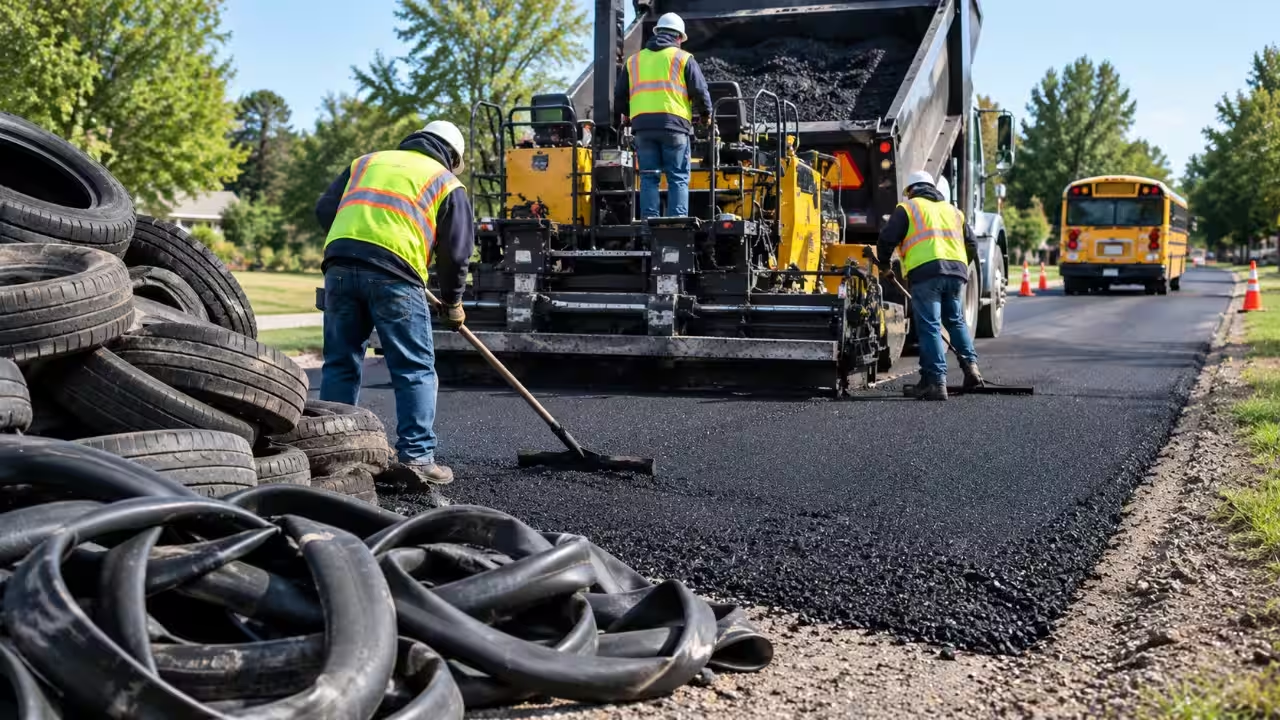
Every school day, buses travelled along a residential road in Davison, Michigan, carrying children to and from school. In 2016, the road became the site of a less conventional experiment: part of its asphalt was made with rubber recovered from discarded tyres. According to the Transportation Research Board, the test was small, but its setting made it useful. The road, Cambridge Drive between S. State and S. Dayton Street, carried the city's school buses twice a day during the school year.It also provided access to an apartment complex and received direct sunlight, exposing the pavement to both regular traffic and Michigan's changing weather. Three years later, researchers inspecting the experimental section found little to complain about. The pavement showed no visible cracking or rutting, while its condition rating remained high. The result offered a practical glimpse into how waste tyres could be given a second life beneath everyday traffic.A road built with old tyresThe material used in Davison was not simply pieces of tyre scattered through the concrete. In the experiment conducted by the researchers, they used pre-conditioned dry-process ground tyre rubber, or DP-GTR. The rubber particles measured between 400 and 600 micrometres in diameter. The study also notes that the Michigan section used a nominal maximum aggregate size of 12.5 mm, 4.9% binder and 10% DP-GTR. Unlike the wet process, where rubber is blended into the bitumen before the asphalt mixture is produced, the dry process introduces the rubber directly into the mixture during production. The rubber becomes part of the aggregate-binder system as the asphalt is mixed, allowing the process to be carried out with only minor changes to conventional asphalt plant equipment.What happened after three years?Davison Road was a useful practical test because the mixture had to withstand vehicle traffic rather than laboratory conditions. Researchers examining the road in 2019 found no cracking or rutting in their visual observations. Using the PASER pavement rating method, the Michigan section scored 8.1. The laboratory results were less straightforward. The authors used different laboratory methods to test cracking and rutting resistance in the rubber-modified mixes. Some laboratory cracking tests were less favourable after rubber was added.The field observations helped contextualise those laboratory results. The researchers reported good-to-excellent performance across the field sections in Michigan, Illinois and Georgia, with limited cracking, rutting, and other visible distress. A separate study of crumb-rubber mixtures published in the International Journal of Pavement Research and Technology also found that field sections built in Michigan showed no rutting after five years of service, while some cracking appeared in neighbouring control lanes using conventional bitumen.Why the experiment matteredOld tyres are difficult waste because they are bulky, durable, and hard to dispose of traditionally. Using them as road material helps keep rubber in circulation while reducing the need for some virgin materials. The Michigan study also showed why pilot studies matter: asphalt blends can perform differently in real traffic than in the lab. The 2016 Davison project did not prove that all rubber-modified roads are more durable, and three years was not long enough to assess a pavement's full lifecycle. It was, however, a relatively small pavement test on a low-volume residential road. Still, the lack of cracking or rutting after three years was a positive result.The researchers' 2021 study concluded that pre-treated rubber could improve some high-temperature and rutting-resistance properties of pavements. In Michigan, the goal was less to replace conventional asphalt immediately than to find a useful outlet for a troublesome material. An old tyre that might otherwise have become waste could instead become part of the road that carries schoolchildren each day.You use AI every day. Now get your AI Quotient. Take the AIQ test.
Topics in this story
Gathered from external sources. Rights to this text belong to whoever originally published it.