MIT researchers tested whether eggs break more easily on their sides or tips; their 2025 experiment found sideways drops were surprisingly less likely to crack
A groundbreaking study from MIT challenges the belief that vertically dropping an egg minimizes breakage, revealing that horizontal drops significantly reduce the chances of cracking.
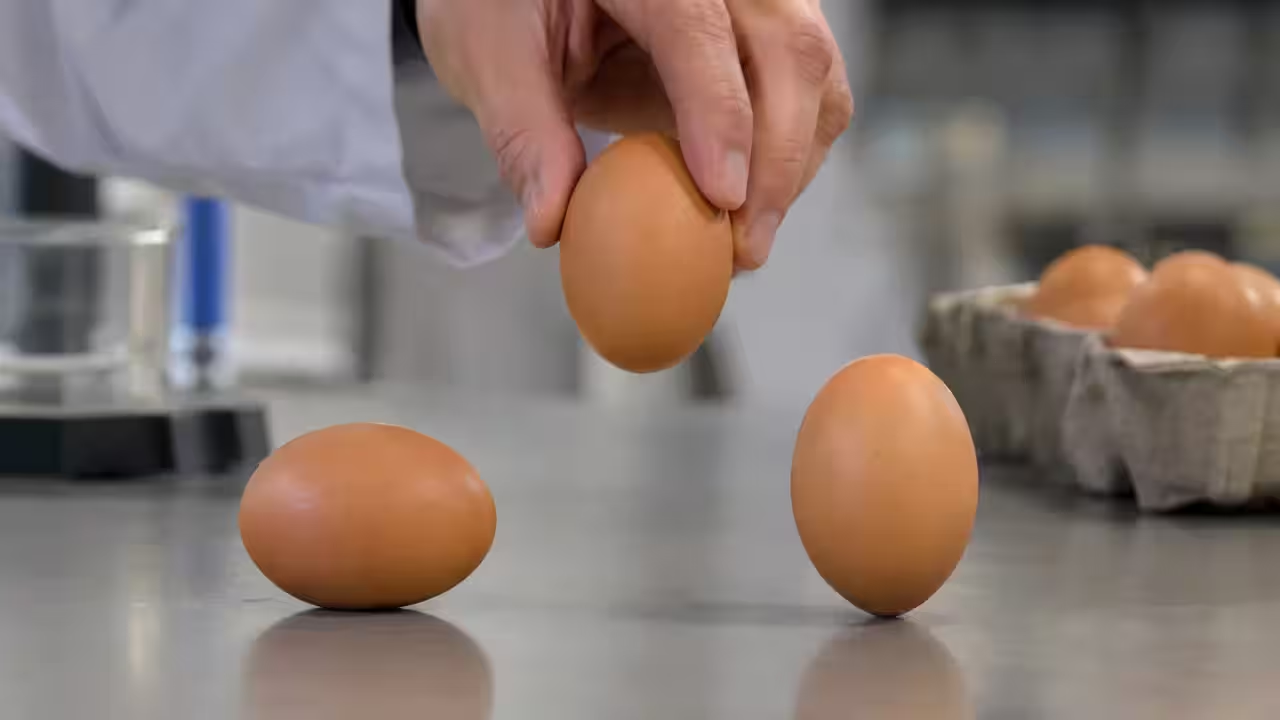
The conventional belief has always been that an egg can handle considerable pressure even when held between two fingers at its ends. The theory, myth or otherwise, has helped sustain an instruction in scientific experiments that is, if an egg is to survive a fall, it should be positioned vertically. However, researchers at the Massachusetts Institute of Technology (MIT) put this theory to the test at an annual egg-drop competition to see whether that assumption actually checked out. The investigation published on 8 May 2025 overturned the established assumption after it found that an egg placed horizontally absorbed more energy before cracking and was less likely to break on impact.The research grew out of a question put forth by Tal Cohen, an associate professor of civil and environmental engineering and mechanical engineering at MIT. Cohen's research group began questioning the validity of the assumption that the vertical position offered better protection. The egg-drop event was organised by his research group during the department's first-year orientation. In the exercise, students used protective material to mitigate impact forces, making the precise orientation of the egg very critical in the experiment.Compression tests reveal a difference in energy absorptionThree types of experimental methods were used by the Research team: static compression experiments, dynamic drop tests and numerical simulations. More than 200 eggs were put through experiments, and the first stage began with 60 compression tests. For each trial, an egg was placed between two plates of a mechanical testing machine, aided by paper supports which kept it in its designated position. Gradually, pressure was increased until the shell fractured, while the machine recorded the force and the distance through which the egg compressed.What the researchers found was that the force required to initiate a crack was almost the same in both vertical and horizontal positions. Within the margin of error, the eggs which were loaded vertically withstood an average peak force of approximately 46 newtons, as opposed to the horizontal eggs, which sustained 45.2 newtons.When it came to displacement measurements, the results revealed a significant divergence between the two orientations. Before cracking, the eggs positioned horizontally were compressed by an average of 0.213 millimetres, whereas the vertically positioned eggs were compressed by 0.161 millimetres. The horizontal position therefore allowed approximately 30 per cent more displacement under compression. Under their linear force-displacement model, researchers calculated the energy absorbed by the eggs before they fractured, which was represented by the area beneath the force-displacement curve. The calculations revealed that the horizontal orientation absorbed approximately 30 per cent more energy before the shell finally gave way to the fall.Following this discovery, they highlighted a fundamental divide between two distinct mechanical properties of an egg: stiffness and toughness. While stiffness describes an egg's resistance to deformation under an applied force, toughness is defined by the total energy an egg can absorb before failure. Simply put, an egg can be stiffer in one position, but it doesn't increase its chances of surviving an impact in that position.Drop experiments gave the edge to horizontal eggsResearchers wanted to see whether the differences measured under gradual compression would actually dictate how an egg fares during a fall. To find out, the team built a release mechanism utilising electromagnets, solenoids, and custom 3D-printed supports to stabilise each egg immediately before impact. When released, a mechanical testing machine’s platen would record the force generated instantaneously at the very moment when the egg landed on a surface. A total of 180 eggs were tested and dropped from the heights of 8, 9 and 10 millimetres, in three different orientations: horizontally on the equator, vertically on the sharp end and on the blunt end.Among the eggs that struck the surface along their equators, fewer fractures were found; however, between eggs dropped onto the sharp and blunt ends, there wasn’t much difference. In computer simulation, an egg positioned vertically saw its first fracture at a drop height of 8.6 millimetres; conversely, the horizontal configuration tolerated an additional 0.3 millimetres before it finally fractured. The horizontally positioned eggs had an underlying physics to their resilience as they stayed in contact with the impact surface for a longer duration, a feat consistent with their greater ability to deform.Why strength under pressure doesn’t predict a fall In the physical world, an egg’s capacity to sustain gradually applied force does not speak to how it will survive a sudden drop. After all, the dynamics are entirely different during the time of an impact. The shell must absorb the energy generated by the moving egg and undergo greater deformation before fracture, which gives it more distance over which to absorb that energy.You use AI every day. Now get your AI Quotient. Take the AIQ test.
Topics in this story
Gathered from external sources. Rights to this text belong to whoever originally published it.