Bristol's trees face growing pressure from disease and weather
The collapse of a 166-year-old copper beech raises concerns over Bristol's landmark trees.
Our oldest trees are increasingly vulnerable to disease, extreme weather and the effects of climate change.
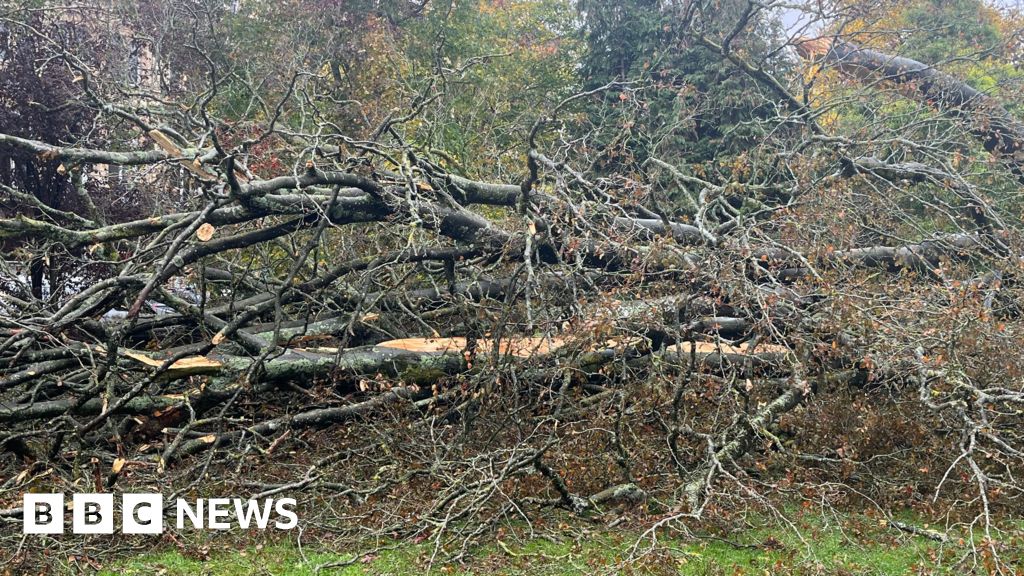
The collapse of a 166-year-old copper beech in Bristol's Victoria Square, which was already scheduled for removal, has raised questions about the future of the city's landmark trees.
Scientists warn that there is additional pressure on mature trees, with damage to their roots potentially leaving them vulnerable to falling.
Professor Andy Bailey, an expert in molecular mycology, said: "Trees just can't change quickly to adapt to climate change."
Flat owners 'helpless' after ceilings cave in
Calls to remove liveable neighbourhood road
Live TV challenge for woman who overcame heartbreak
He said soil compaction, caused by people walking over root systems, can reduce the amount of air reaching roots and prevent water from draining properly.
Wetter winters can make the problem worse while hot, dry summers place additional stress on trees.
Fungal infections can then take hold, often developing over many years as they gradually destroy roots and undermine a tree's structural stability.
Professor Bailey said: "A combination of environmental pressures and natural ageing can make mature trees more susceptible to fungal infections."
However, not all fungi are harmful. Many are naturally present in British woodlands and play an important role in ecosystems, providing habitats for beetles and other organisms that depend on decaying wood.
Bristol-based naturalist Steve England said extreme weather was already affecting local ecosystems.
"Climate change is definitely affecting trees," he said.
"If you look at some of the berry-bearing trees like hawthorn or rowan, the berries are dehydrating really early."
He said this could leave migrating birds with less food, while prolonged rainfall can destabilise trees growing in heavy clay soils.
"When there's lots of rain it can impact areas with heavy clay soils as the water doesn't get the chance to drain away," he said.
He pointed to two large beech trees which have fallen in Stoke Park, explaining that saturated ground can leave their roots unable to withstand strong winds.
The loss of the Victoria Square copper beech has also resonated with residents.
For 77-year-old Frank, who lives near where the copper beech once stood, the trees have long been part of family folklore with his Scottish grandfather believing they brought bad luck and refusing to walk underneath them.
"He would tell me that hundreds of years ago in Germany, five brothers had a sword fight over a lady they all wished to marry," said Frank.
"This duel happened but they all tragically killed each other and their blood all pooled into a small hollow in the forest where there was a tiny beech sapling.
"As it grew its green leaves changed to red but its seeds became infertile. The only way for the beech to reproduce was by taking cuttings from it."
He added: "In time its origins have been forgotten but you still can't grow it from a seed!"
Bristol City Council confirmed the decision to remove the Victoria Square tree was made in September.
The council said its trees were inspected every one to five years, depending on how heavily the surrounding area was used.
A spokesperson said: "We use a range of measures to help protect and preserve significant trees, including regular inspections and soil management to support root systems."
Professor Bailey said that understanding the pressures facing mature trees, from fungal infections to changing weather patterns, would be key to protecting Bristol's landmark trees for future generations.
Follow BBC Bristol on Facebook , X and Instagram . Send your story ideas to us on email or via WhatsApp on 0800 313 4630 .
Storm Boelo topples 166-year-old landmark tree
Thousands of diseased ash trees to be cut down
Topics in this story
Gathered from external sources. Rights to this text belong to whoever originally published it.