In 1999, a caretaker moved to an Australian island with a major little penguin colony; he spent 25 years maintaining its lighthouse and environment
Rest of World News: Explore the remarkable 25-year journey of Leo op den Brouw, the caretaker of Gabo Island in Australia, home to one of the world's largest little penguin colonies and a historic lighthouse. Discover the changes in wildlife, the transition of caretaking duties, and the rich history of this remote island.
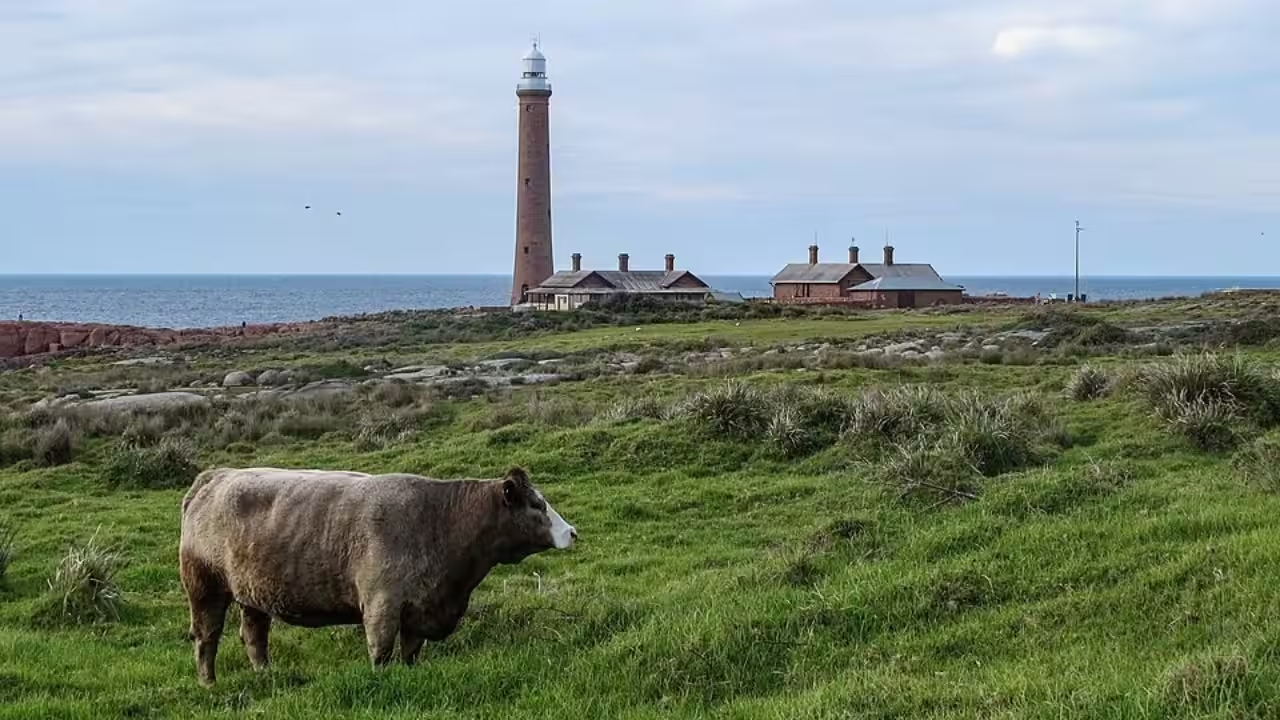
In 1999, Leo op den Brouw began what became a 25-year association with Gabo Island, a remote granite island off Victoria’s far-eastern coast. For the next quarter century, op den Brouw worked as part of a dual-caretaker system in month-on, month-off shifts, spending half of each year looking after the lighthouse and surrounding environment. When his segment of the rotation concluded for the final time in 2024, his position was transitioned over to Sandy Duthie to continue the specific rotating role, ending one caretaker’s long chapter while continuing a team tradition that stretches back more than 160 years.Gabo Island is around 14 kilometres from Mallacoota in far-east Victoria and measures only about 2.4 kilometres long and 800 metres at its widest. The island has a 47-metre lighthouse constructed from the island’s distinctive pink granite. Built between 1858 and 1862, the structure is Australia’s second-tallest lighthouse and the only operating island light station in Victoria. Meanwhile, the island’s remoteness has helped preserve some important habitat for seabirds and little penguins.A lighthouse on a remote islandGabo’s light station dates to the era when lighthouses depended on people living on-site to maintain their equipment and keep a watch over the coast. Over the decades, families and individual keepers called the island home, and by the time op den Brouw took charge, technology had changed the job, although the isolation that came with it remained. Modern caretakers still have to maintain the grounds, light station, and surrounding environment, often with limited communications and weather-dependent transport.Leo op den Brouw was never simply a lighthouse worker in the traditional sense. While speaking to ABC News, he described having “101 duties” to maintain the light station and environment. Keeping the property functioning, observing the weather and maintaining the historic site all fell under his responsibilities.It is worth noting that the island’s natural environment was inseparable from that work. Parks Victoria describes Gabo as a haven for plants and animals, with highly significant seabird colonies. Little penguins nest on the island, while whales, dolphins and seals can be seen in the surrounding waters. Additionally, the agency notes that little penguins come ashore after dark, especially from August through December.A penguin colony that changed over 25 yearsDuring op den Brouw’s time on Gabo, he watched its wildlife change, and one of the most striking examples involved the island’s little penguins. ABC News and Parks Victoria collectively highlight the island as supporting highly significant seabird habitats, noting it is surrounded by one of the world’s largest little penguin colonies. Serving as an essential on-site observer of these ecological shifts, the former caretaker estimated that the little penguin population had fallen from about 30,000 pairs to 10,000 pairs during his tenure. He further claimed that experts had reportedly struggled to determine the exact reason why the penguin population had declined.The decline was accompanied by a contrasting change in the island’s marine life, with hundreds of seals coming to live around the island alongside an increased presence of whales, including feeding whales and mothers with calves. While those observations provide a picture of these dynamic local shifts, they do not by themselves establish a measured increase in the region’s overall whale population.A new caretaker took over in 2024In 2024, at the age of 70, op den Brouw retired from his role and returned permanently to his family and life on the mainland. His successor was Sandy Duthie, a Scottish-born arborist who had moved to Mallacoota with his partner about five years earlier. The publication reported that Duthie had worked as an arborist for nearly two decades and first visited Gabo two years prior to becoming its caretaker.Alongside the responsibilities, he also inherited a landscape containing layers of history. ABC News reported that Gabo has both Indigenous heritage and a more recent history associated with European settlement and lighthouse keeping. Notably, the island’s assistant lighthouse keeper’s residence is now used as accommodation for visitors.With the lighthouse remaining operational despite the technological changes that have transformed the job, the management transition did not end Gabo Island’s caretaker tradition. Instead, it marked a change from one generation to the next. Leo op den Brouw had spent a quarter century maintaining the remote station and watching its natural environment evolve; Duthie now has the responsibility for carrying that work forward.Catch the latest World News and Live updates. Download the TOI app.
Topics in this story
Gathered from external sources. Rights to this text belong to whoever originally published it.