Nelson Mandela grew up in this tiny South African village; his childhood landscape is now being preserved as a heritage centre
Rest of World News: On the rolling hills of South Africa’s Eastern Cape, Qunu remains a small rural village, much as it was when Nelson Mandela spent his childhood there..
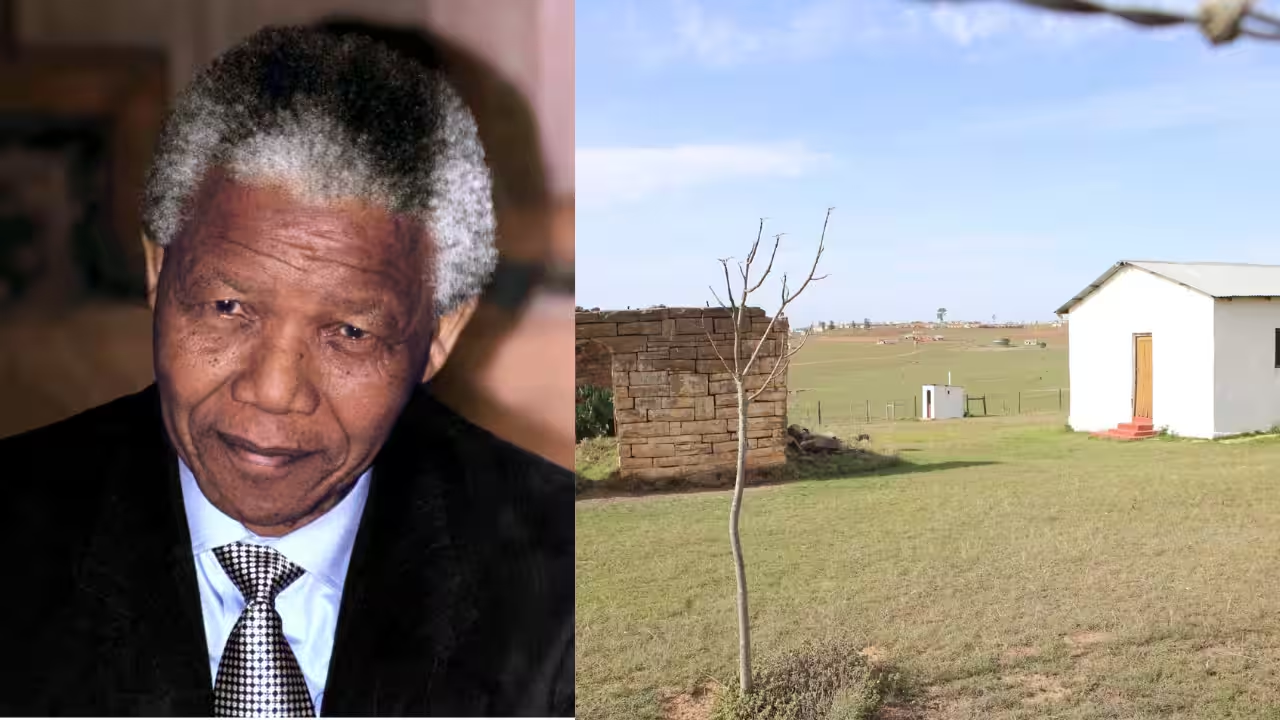
On the rolling hills of South Africa’s Eastern Cape, Qunu remains a small rural village, much as it was when Nelson Mandela spent his childhood there. There are no grand city streets or imposing landmarks to announce its place in history. Instead, the landscape holds quieter reminders of the boy who would later become South Africa’s first democratically elected president. A stone known as the Sliding Stone recalls the games of his childhood, while the Africa Native Mission Church marks where he was christened, as reported by Nelson Mandela Museum.Nearby are other places tied to his early years, including the remains of a school and sites connected with his family. Today, the Nelson Mandela Youth and Heritage Centre brings these fragments together within a wider effort to preserve Qunu’s heritage. The centre also serves a practical purpose, with programmes focused on education, leadership, arts and opportunities for young people in the surrounding community.How Qunu preserves the childhood story of Nelson MandelaThe village is part of a wider trail of places connected with Mandela’s life in the Eastern Cape. Qunu was where he grew up and started school, while nearby Mqhekezweni was where he spent much of his youth. Mvezo, his birthplace, is also part of the broader heritage landscape associated with his life.What makes Qunu different is the concentration of childhood landmarks that have survived there. The Nelson Mandela Youth and Heritage Centre sits in the village and was created as a place through which visitors could encounter the less public part of his biography; his beginnings, rather than the better-known years of political leadership and imprisonment.The centre’s role is not limited to displaying objects. It also supports learning, leadership programmes and activities involving young people.How a simple stone and church is connected with Mandela’s childhoodAmong the features at Qunu is a large stone associated with Mandela’s childhood. Known as the Sliding Stone, it is remembered as a place where Mandela played with other boys from the village.It is a modest piece of the landscape, and that is part of its significance. Unlike a formal monument, the stone points towards the ordinary routines of childhood; the sort of place that might otherwise have disappeared from the historical record.The stone remains among the places included in guided visits around Qunu, allowing visitors to follow locations associated with Mandela’s early life.Another surviving place is the Africa Native Mission Church in Qunu. It is identified as the church where Mandela, then known by his birth name Rolihlahla, was christened.The church adds another layer to the village’s story. Mandela’s childhood was shaped by both the traditions of his Thembu upbringing and the institutions introduced through missionary education. His early schooling and Christian upbringing became part of the environment in which his character and outlook developed.The church is therefore presented as part of the physical history of Qunu rather than as a separate attraction. Visitors moving through the area encounter a landscape made up of homes, religious buildings, school sites and other places associated with Mandela’s early years.Qunu’s heritage centre gives Mandela’s legacy a living roleThe Youth and Heritage Centre was built with a purpose that extends beyond tourism. It was established to support youth and community development through education, leadership programmes and activities involving arts, crafts and heritage.That approach reflects an idea associated with Mandela’s vision for the museum. He did not want it to become simply a static tribute to him. The intention was for his legacy to contribute to the development of the surrounding community.The Qunu centre has consequently been used for educational activities and youth programmes. Its facilities include accommodation, conference and catering spaces, exhibition areas and sporting facilities, allowing it to function as more than a conventional museum site.According to the Nelson Mandela Museum’s Annual Performance Plan of 2024–25, tour guide services around the Qunu site had resumed and local schools were using its facilities for educational programmes. The museum also described the centre as a place intended to create opportunities for young people and women in the surrounding community.Qunu’s museum site returns to public life after closureAs reported by the Department of Public Works, the centre’s development has not been uninterrupted. It was closed in 2019 while maintenance and renovation work was carried out.According to the South African Government website, Qunu reopened to the public on 18 July 2023, when Mandela statues were unveiled at the museum’s sites in Qunu and Mthatha. The reopening restored a venue that had previously been used for educational programmes and community activities.The wider site also includes family graves, a rondavel associated with his early years, his former home and his burial place. Together, these locations create a record of the different stages of his connection with Qunu.Catch the latest World News and Live updates. Download the TOI app.
Topics in this story
Gathered from external sources. Rights to this text belong to whoever originally published it.