In 2020, 11 sheep in Brazil ignored ordinary shade cloth and spent 38% of their time beneath solar panels, even though both shelters blocked sunlight
Rest of World News: A recent Brazilian study found that 11 sheep spent 38% of their time under solar panels compared to less than 1% under conventional shade cloth, suggesting solar panels may serve dual purposes in agriculture.
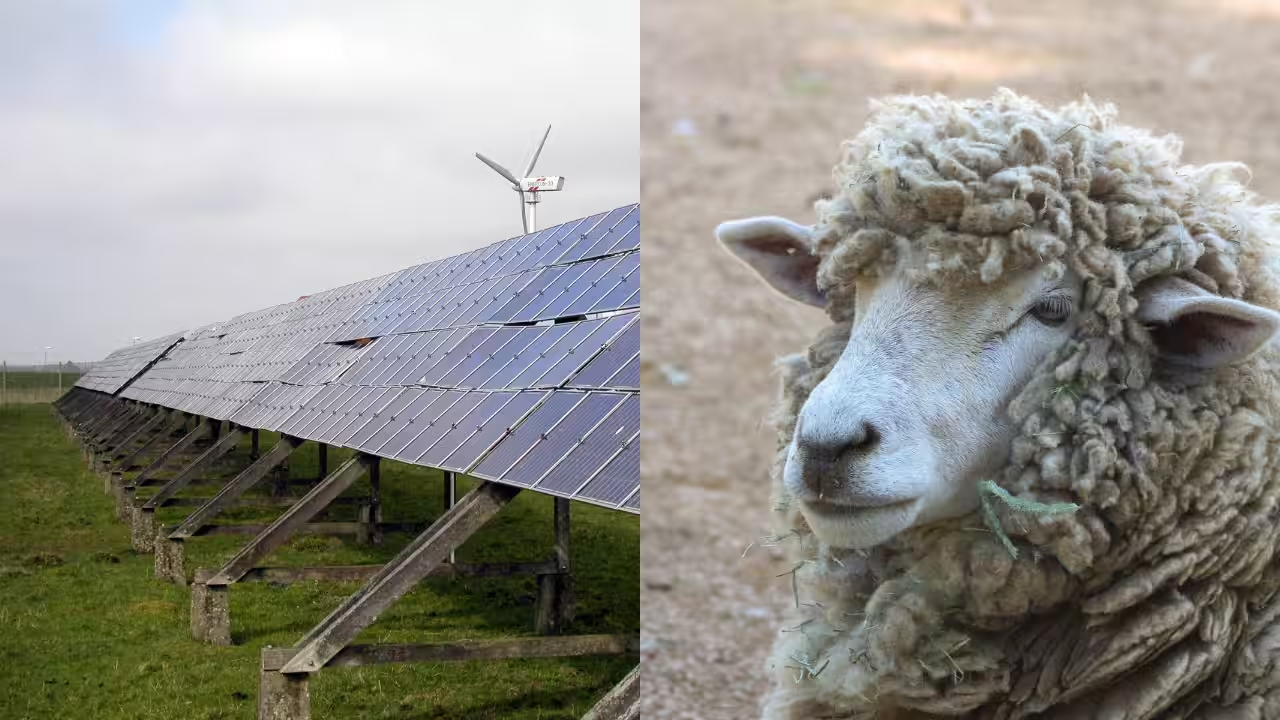
Five Corriedale lambs and six Corriedale ewes were given a choice between two shelters in a Brazilian experiment; one covered with photovoltaic panels and another made from cloth that was designed to block 80% of sunlight. The sheep barely used the cloth shelter, and spent 38% of their observed time beneath the solar panels. The experiment was conducted at the Animal Biometeorology Laboratory of São Paulo State University in Jaboticabal, Brazil. Researchers watched the 11 animals over five days, and recorded their behavior at 10-minute intervals from morning till late afternoon.The animals had access to both forms of shade as well as direct sunlight, and their behavior was recorded across activities including grazing, ruminating, standing, lying and spending time under each shelter. The results were published in the Journal of Cleaner Production in 2020, where the researchers reported that the sheep spent less than 1% of their time under the 80%-blockage cloth but 38% under the photovoltaic panels, with the remaining 61% spent exposed to the sun. The researchers measured environmental conditions under both shelters and found that the solar-panel shade reduced radiant heat load by about 40 watts per square metre when compared with the cloth shade.The two shelters blocked sunlight differentlyThe experiment was designed around a practical question in agrivoltaics, which was whether solar panels could serve two purposes on farmland and produce electricity while also providing usable shade for livestock. The U.S. Department of Energy defines agrivoltaics as the co-location of agriculture and solar energy, which includes livestock grazing beneath or between rows of photovoltaic panels. The agency notes that solar arrays can alter the microclimate underneath them, with daytime temperatures often cooler under the panels. Sheep are already being used for grazing at solar facilities in the United States and Europe.The sheep could choose between photovoltaic shade and a conventional artificial shelter, which matters because both structures were designed to reduce direct solar radiation. The panel structure nevertheless created a different environment, where the researchers recorded solar radiation, air temperature, relative humidity, wind speed and black-globe temperature in the shaded and exposed areas.As sunlight intensified, the animals increasingly moved away from direct exposure and toward the panel shade. The proportion of time spent outside the shelters fell from about 96.7% to 30.2% when solar radiation increased from 250 to 850 watts per square metre, and time spent under the photovoltaic panels rose from about 13% to 69.3%.The panels were producing electricity while providing shadeThe experiment also measured the energy produced by the photovoltaic system, and found that electricity generation, as well as solar radiation, increased. The researchers calculated that the system generated about 5.19 megawatt-hours of electricity over a year, based on their measurements and assumptions. They estimated that this would correspond to about 2.77 tonnes of avoided carbon dioxide emissions and roughly $740 in annual electricity savings under the conditions used in their analysis. Those figures came from the study's specific experimental and economic assumptions rather than from a full-scale commercial solar farm.The sheep study was small, involving only 11 animals, so its findings cannot by themselves establish that all sheep will prefer photovoltaic shade, and the researchers described it as an investigation of shade preference and radiant heat load, not a large livestock-production trial. A study published in Small Ruminant Research found that nine Corriedale ewes exposed to solar-panel shade experienced lower radiant heat load and reductions in wool-surface and skin temperatures while using the shade during periods of high solar radiation. The 2020 experiment had already shown that the sheep were not treating the two shelters as equivalent, and given a choice, they spent almost no time under the cloth and considerably more beneath the photovoltaic panels. The reason identified by the researchers was not that the animals could somehow detect electricity; their shade produced by the panel reduced the radiant heat reaching the animals, which made that space more attractive during periods of stronger solar radiation.Catch the latest World News and Live updates. Download the TOI app.
Topics in this story
Gathered from external sources. Rights to this text belong to whoever originally published it.