What is BRICS Pay, and can it rival the West’s SWIFT payments system?
BRICS Pay is a decentralised digital system for making international payments in currencies other than the dollar.
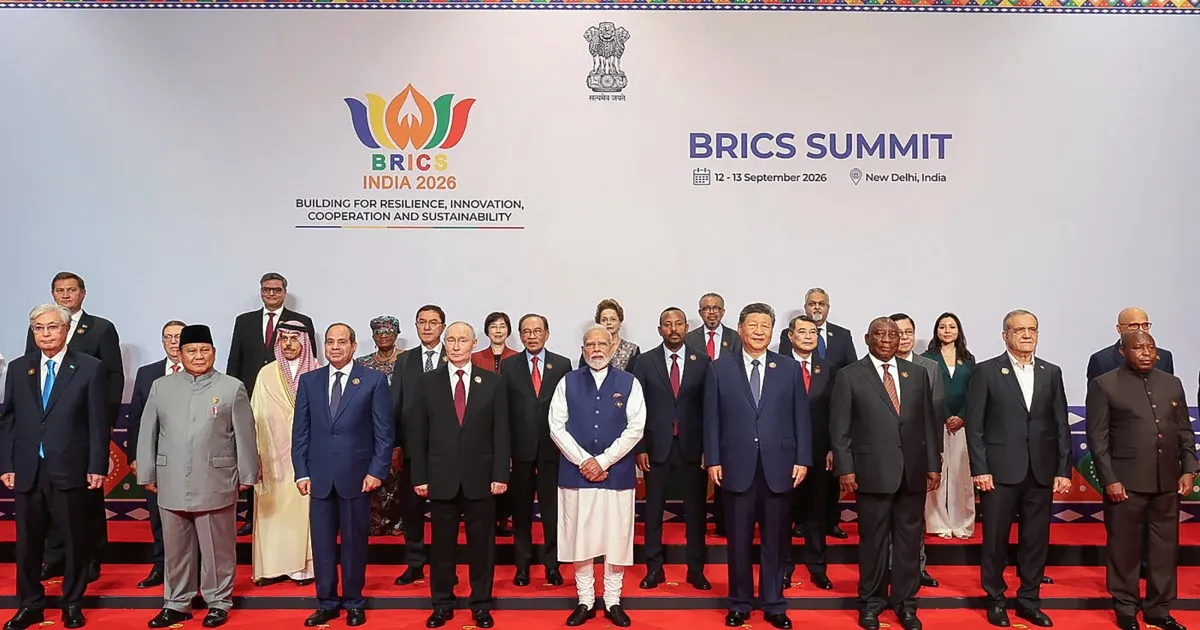
The central theme of the BRICS bloc of nations is to push back against the global economic dominance of Western countries. That core value was very much at the centre of this year’s 18th BRICS Summit , which took place last week in India.
At the September 12 and 13 summit in New Delhi, leaders committed to expanding local currency trading systems and cross-border payment systems by investing in BRICS Pay, an initiative of the BRICS Business Council.
“We acknowledge the work done to study the cross-border interoperability of payment and messaging channels, and the discussions on promoting trade settlements and investments using BRICS local currencies, while respecting national priorities and acknowledging that there is no one-size-fits-all approach,” leaders said in a joint declaration as the summit concluded.
They also encouraged the BRICS Payments Task Force (BPTF), a collaborative central bank expert platform focused on cross-border payment mechanisms, to “facilitate practical solutions for cross-border payments among BRICS countries, which are fast, low-cost, more accessible, efficient, transparent and safe”.
Manoj Kewalramani, chairperson of Bengaluru-based think tank Takshashila Institution’s Geostrategy Programme, told Al Jazeera that the declaration indicates “that the quest is not for a single system, but perhaps a suite of options that can be agreed between member states to de-risk their trade and financial dealings”.
While the New Delhi declaration did not indicate that BRICS nations aim to replace the dollar or build their own common currency, it highlights how BRICS is increasingly trying to find alternate payment systems amid geopolitical tensions and Western trade sanctions on members of the bloc, Russia and China.
If systems like BRICS Pay become fully operational, they could work as alternatives to Western payment systems like SWIFT, however.
Proposed by the BRICS Business Council in 2018, BRICS Pay is a decentralised digital payment ecosystem developed to simplify payments between BRICS countries.
BRICS stands for Brazil, Russia, India, China and South Africa, the initial members of the informal trading group. It was founded in 2006, with South Africa joining in 2010. Since then, more countries have joined – Egypt, Ethiopia, Iran, Saudi Arabia, the United Arab Emirates and Indonesia.
In all, that’s 11 member countries, accounting for roughly 49 percent of the world’s population and about 40 percent of the world’s gross domestic product (GDP).
According to the BRICS Pay website, it is a “strategic infrastructure” which can also be used by “friendly states” of BRICS countries. It is also meant to offer a “compatible option” for Western payment systems like SWIFT, Visa and Mastercard, but does not intend to replace them.
The payment system was officially endorsed by the BRICS Business Council in 2024 and in August this year, before the BRICS summit in New Delhi, the group’s finance ministers and central bank officials met in Jaipur, India, to discuss advancing the project.
It is currently in pilot and phased rollout stages and is not yet globally operational for all members.
BRICS Pay will connect national payment systems of member countries to each other so international payments can be made more easily.
This will mean that trading transactions between entities or individuals in two different countries can be processed in local currencies, removing the involvement of other currencies such as the dollar.
Payments in local currencies will be settled using QR codes, digital wallets or mobile applications.
Andrey Mikhaylishin, the CEO of BRICS Pay, told India’s Asian News International (ANI) on September 12 that many countries want to use their own payment infrastructure in this way.
“For example, Russia has Mir and a Fast Payment System. India has RuPay and UPI. Furthermore, the European Union is building its own payment infrastructure, called the European Payments Initiative. The UK also wants to create and build its own infrastructure,” he noted, adding that these systems, however, do not automatically work with each other.
“BRICS Pay is a payment ecosystem that can connect national payment infrastructures and give people the ability to use them when they are travelling in countries, not only within BRICS but around the world. It’s helpful for tourists who come to the country and gives them the service of using their own domestic means of payment,” he explained.
“On the other hand, we can talk about companies and banks that need to make settlements with each other. We do that too for B2B (Business-to-business) settlements. It’s a new kind of architecture, a fully decentralised architecture for settlements between countries,” he said.
“We don’t speak about de-dollarisation,” he said.
“We give more flexibility and more types of payment options for our citizens, companies and banks. If they want to use the dollar, they can use the dollar, too,” he added.
How are international payments made currently?
While BRICS Pay has yet to become fully operational, most transactions between countries, companies and even tourists take place through Western cross-border payments like SWIFT.
SWIFT is a cooperative company under Belgian law. It is owned by up to 3,500 shareholders linked to approximately 11,000 financial institutions across the world.
The system is overseen by the G10 central banks, as well as the European Central Bank, with its lead overseer being the National Bank of Belgium.
SWIFT is essentially a network used by banks to send secure messages about transfers of money and other transactions.
So if a company in India wants to pay a company in Europe, the payment currently passes through SWIFT.
More than 11,000 financial institutions around the world use SWIFT, making it the backbone of the international financial transfer system.
While most payments are made in the US dollar, the system also includes payments in the British pound, Indian rupees, euros, and yen, among others.
However, Russia has been banned from using the system due to its war on Ukraine. In February 2022, just days after Moscow’s invasion of Kyiv began, Western nations moved to block certain Russian banks’ access to the SWIFT international payment system.
This has made it harder for Russian banks to communicate with peers internationally, even in friendly countries such as China, slowing trade and making transactions costlier.
Since 2024, at the annual BRICS Summits, Russia has been pushing for alternative payment systems and promoting national currencies, in an effort to bypass Western sanctions.
Alejandro Reyes, adjunct professor in the department of politics and public administration at the University of Hong Kong, said that in such situations, BRICS Pay’s attractiveness is obvious.
“Russia’s experience with sanctions and the broader concerns among many emerging economies about dependence on Western-controlled financial infrastructure have created demand for alternatives,” he said.
But he stressed that BRICS is not a homogeneous bloc.
“India, Brazil, China, Russia the UAE and the other members have very different relationships with the dollar, with Western financial institutions and with one another. They also have different regulatory systems, capital controls and strategic interests,” he said.
“So the more plausible model is not a single centralised ‘BRICS payment system’, but a network of interoperable national systems, connecting mechanisms such as India’s UPI, Brazil’s Pix and other domestic payment platforms and allowing more transactions to be settled in national currencies.”
BRICS Pay has been designed to provide a parallel, interoperable channel to the Western SWIFT network and analysts say it has not been designed to replace it.
“I don’t see BRICS Pay replacing SWIFT globally in the foreseeable future. SWIFT has enormous advantages of scale, trust, standardisation, compliance infrastructure and network effects built up over decades,” Reyes said.
“But that doesn’t mean BRICS Pay is insignificant. If it develops successfully, it could gradually reduce reliance on SWIFT in particular trade corridors, especially for intra-BRICS transactions conducted in local currencies,” he explained.
“In that sense, the real challenge to SWIFT may be less that one new system displaces it and more that the international payments architecture becomes more plural and fragmented, with several networks operating alongside one another,” he added.
Have BRICS countries been using other payment systems?
Yes. BRICS countries have been using domestic payment systems.
UPI (or Unified Payments Interface) is largely used in India for retail transactions. While it is also present in other countries, including Singapore, France and the UAE, UPI is not used heavily for international trade, according to Kewalramani.
Brazil has also been using a payment system called Pix, which enables people to settle transactions through their bank accounts, while China uses Cross-border Interbank Payment System (CIPS).
Alicia Garcia Herrero, chief economist for the Asia Pacific at Natixis in Hong Kong, told Al Jazeera that CIPS already avoids the SWIFT system.
But she stressed that while these domestic systems within BRICS countries exist, “the key question here is whether they can be linked” through systems like BRICS Pay.
Topics in this story
Gathered from external sources. Rights to this text belong to whoever originally published it.