Too poor to hire a crew, Texas farmer Jackson Ellis and five sons learned oilfield work, then drilled five wells that, by 1949, brought in $5,000 a month
Discover how Jackson Ellis and his five sons turned their Texas farm into a successful oil operation by drilling wells, overcoming financial hurdles, and becoming self-reliant during the post-World War II oil boom.
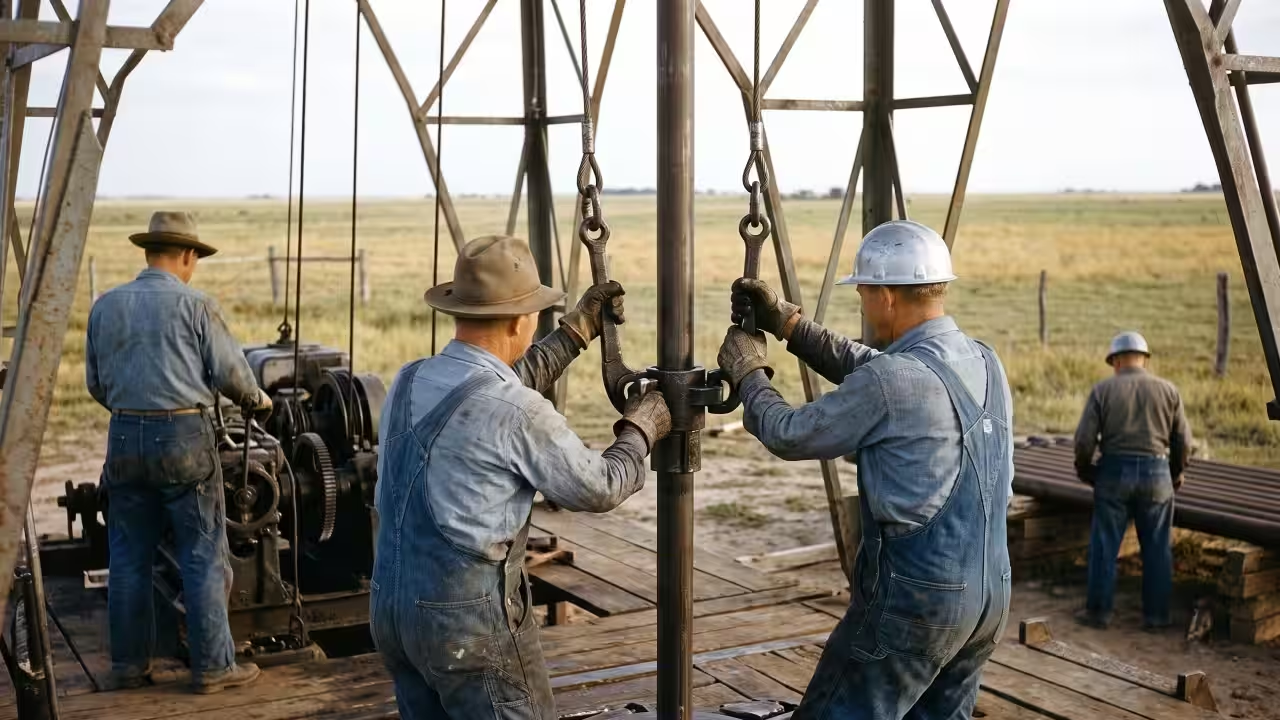
In the years after World War II, drilling for oil could be difficult for families who lacked capital. A family seeking more than a standard royalty often had to finance drilling itself or give a large share of the proceeds to someone who could pay for the rig and crew, because equipment and labour were expensive. Jackson Ellis, a Texas farmer with little spare cash, chose to learn the work rather than hire an outside crew.A family turned drilling crewEllis could not afford to hire a drilling crew, so he and five of his sons took on the work themselves and learned to operate the rig. A sixth and youngest son helped as a water boy, according to a 1949 account in TIME. On a professional rig, drilling machinery, derrick work and pipe handling require different skills. The family had to learn these tasks while working around heavy pipe, steel wire and machinery, all of which posed serious risks. The attempt succeeded. The family dug five wells, and by 1949 were making around $5,000 a month. That says it all. How a simple agricultural family evolved into a tiny oil operation. It didn't cost a bunch to get going. It took labour already under the same roof.Why family labour was importantA hired drilling crew had to be paid whether or not a well produced oil, so a dry well could be particularly costly for a small operator. By learning the work and drilling with family members, Ellis reduced the need to pay an outside crew, although the family's labour still involved substantial time, effort and physical risk. The arrangement reduced the cash needed to begin drilling, but it did not eliminate the possibility of losing money on an unsuccessful well.Small independent operators played an important role in Texas oil development, but the Ellis family's approach was distinct. The family worked its own property and relied on its own labour rather than depending entirely on an outside drilling crew. This reduced its initial cash requirements but did not eliminate the financial risks of drilling. Dry wells could consume time and money without producing revenue, making the reported success of five wells notable.What $5,000 a month meant At $5,000 a month, the reported income amounted to $60,000 a year in 1949. Adjusted for inflation, $5,000 a month in 1949 would be worth roughly $67,000 a month in 2026 dollars. That would have made the family's oil operation highly lucrative, although the historical account does not explain precisely which operating expenses were deducted. The figure should therefore not automatically be treated as net profit after equipment, fuel, repairs and other costs.The family was operating during a period of rapid oil development in West Texas. The Texas Almanack lists Kelly Snyder among the significant oil discoveries of 1948 and the Cogdell area among the discoveries of 1949. The Texas State Historical Association records that development of the combined Kelly Snyder field accelerated during 1949, attracting additional operators and drilling activity. This wider boom provided the regional context for the Ellis family's venture.Today, Texas oil and gas operators must meet regulatory requirements, including filing an organisation report with the Railroad Commission of Texas, obtaining the required drilling permit and maintaining the financial assurance required for their operations. The right to drill also depends on mineral ownership and lease rights. Requirements vary by operation, so the Commission's official guidance on regulatory requirements should be consulted. Ellis's story illustrates how learning the work and using family labour reduced the need for an outside crew, but it is not a general guide to modern drilling.Jackson Ellis and his sons addressed their lack of money for a drilling crew by learning the work themselves. By 1949, they had drilled five shallow wells on their property and were reportedly bringing in about $5,000 a month. Their experience shows how family labour and secondhand equipment helped one landowner take advantage of an oil opportunity, while the risks of drilling remained.You use AI every day. Now get your AI Quotient. Take the AIQ test.
Topics in this story
Gathered from external sources. Rights to this text belong to whoever originally published it.