Amazon cargo plane pilots may have considered aborting landing, NTSB says
Federal investigators say flight data suggests the pilots of the Amazon cargo plane may have attempted a go-around moments before the deadly crash.
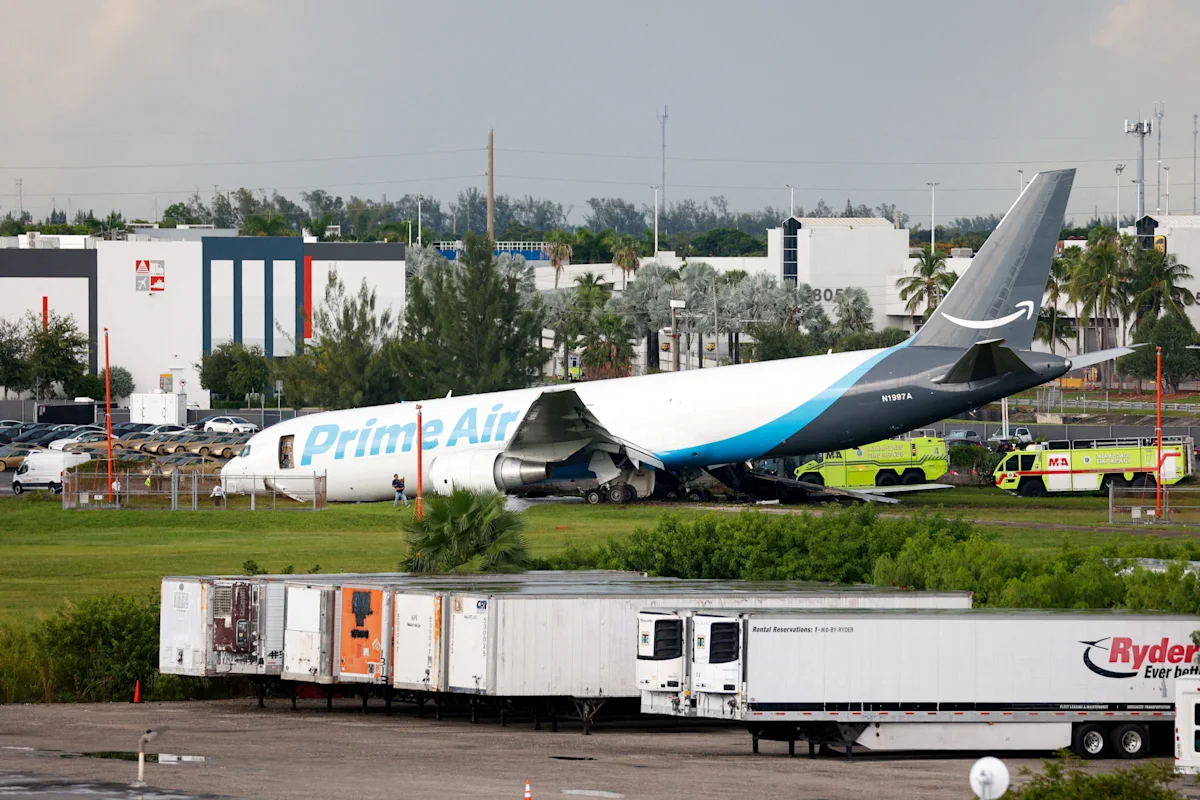
Federal investigators said Sept. 8 that flight recorder data from an Amazon Prime Air cargo plane suggests the pilots may have considered aborting the landing moments before the aircraft crashed at Miami International Airport , killing five people on the ground.
The crash happened shortly before 2 p.m. on Sept. 6. The Amazon Air Flight 7598, a Boeing 767-33A operated by 21 Air LLC, arrived from San Juan, Puerto Rico, and overran the runway , leaving a crash path of 1,300 feet beyond the paved runway in a scene described as "utter devastation" by National Transportation Safety Board Chair Jennifer Homendy.
Five people were killed , all occupants of two vehicles, a van owned by a contract cleaning company for airlines and another vehicle, according to Homendy. Miami-Dade Sheriff Rosie Cordero-Stutz said five others were taken to hospitals, including two pilots on board the plane who were treated and have since been released.
During a news conference Sept. 8, NTSB investigator Chihoon Shin said flight data showed the aircraft's nose landing gear and right main landing gear touched down about 30 seconds before the recording ended. The left main landing gear touched down about 19 seconds before the end of the recording.
Then a few seconds later, the brakes were released and the throttles were increased to "values consistent with go-around thrust," according to Shin. He added that there was no indication in the recorded data that speed brakes or thrust reversers were deployed.
"When we analyze the full list of parameters, we'll have a better idea of the aircraft performance during this landing. Was it normal? Was it not? And what was working and what was not?" Shin said.
Amazon Air cargo plane overruns Miami runway, killing 5 in crash
A view of an Amazon Prime Air cargo plane that airport officials said overran a runway at Miami International Airport, in Miami, Fla. on Sept. 6, 2026.
NTSB investigators to interview pilots of Amazon Prime Air cargo plane
Homendy said investigators plan to interview both pilots on Sept. 9 before releasing a summary of the cockpit voice recorder, which captured more than two hours of audio. The flight data recorder contained about 55 hours of data and recorded more than 400 aircraft parameters.
"We want to hear their account of the accident before we release a readout of the cockpit voice recorder," Homendy said during the news conference.
The NTSB also released information on the pilots' experience. Earlier on Sept. 8, local authorities identified the pilots as First Officer Jaime Felipe Silva Molina, 37, and Capt. Joseph Carol, 55.
According to Class 1 medical records cited by Homendy, Carol had logged 7,145 flight hours as of March, while Molina had logged 2,655 hours as of August.
The Miami-Dade Sheriff's Office identified the five people who were killed and the five who were injured in the Amazon Air cargo plane crash in an update on Sept. 8.
Ridoel Averhoff Diaz, 32, occupant of van
Roosevelt Sebastian Perdomo Torres, 36, occupant of van
Three victims remain hospitalized, including two in critical condition and one who is stable, Cordero-Stutz said.
The van was a 2012 Ford Econoline owned by Professional Ocean Service Corp., which was carrying seven employees. It was inside airport property at the time of the crash.
The other vehicle hit was a Toyota Corolla Cross, which was traveling outside of the airport's perimeter fence.
The NTSB's investigation remains ongoing. Homendy said investigators spent Sept. 8 documenting the crash scene, measuring runway and tire marks, collecting debris and examining the aircraft.
The aircraft departed with a takeoff weight of 252,182 pounds and was expected to land at 231,236 pounds, according to Homendy. The plane's cargo weighed 32,222 pounds and consisted primarily of contact lenses.
Investigators said no hazardous materials were aboard.
The cargo plane was on its third flight of the day, Homendy previously said. It had flown from Cincinnati to Miami, and from Miami to San Juan, earlier on Sept. 6 before the crash.
More than 60 rescue units and about 200 emergency personnel responded to the crash, working to free trapped occupants of the vehicles and plane, as airplane fuel leaked for hours. The plane was also engulfed in flames.
The incident prompted the airport to close two of its four runways. Though the airport stopped all flights immediately after the crash, flights had resumed by the evening of Sept. 6.
By the evening of Sept. 8, Homendy said one runway was reopened for "departures in the easterly direction."
Topics in this story
Gathered from external sources. Rights to this text belong to whoever originally published it.