Meet Enos Mills, the Kansas teenager who built a cabin near Longs Peak at 15 and helped create Rocky Mountain National Park
Rest of World News: At 15, Enos Mills had already built himself a small cabin near Colorado’s Longs Peak. It was an unlikely beginning for someone who would later become .
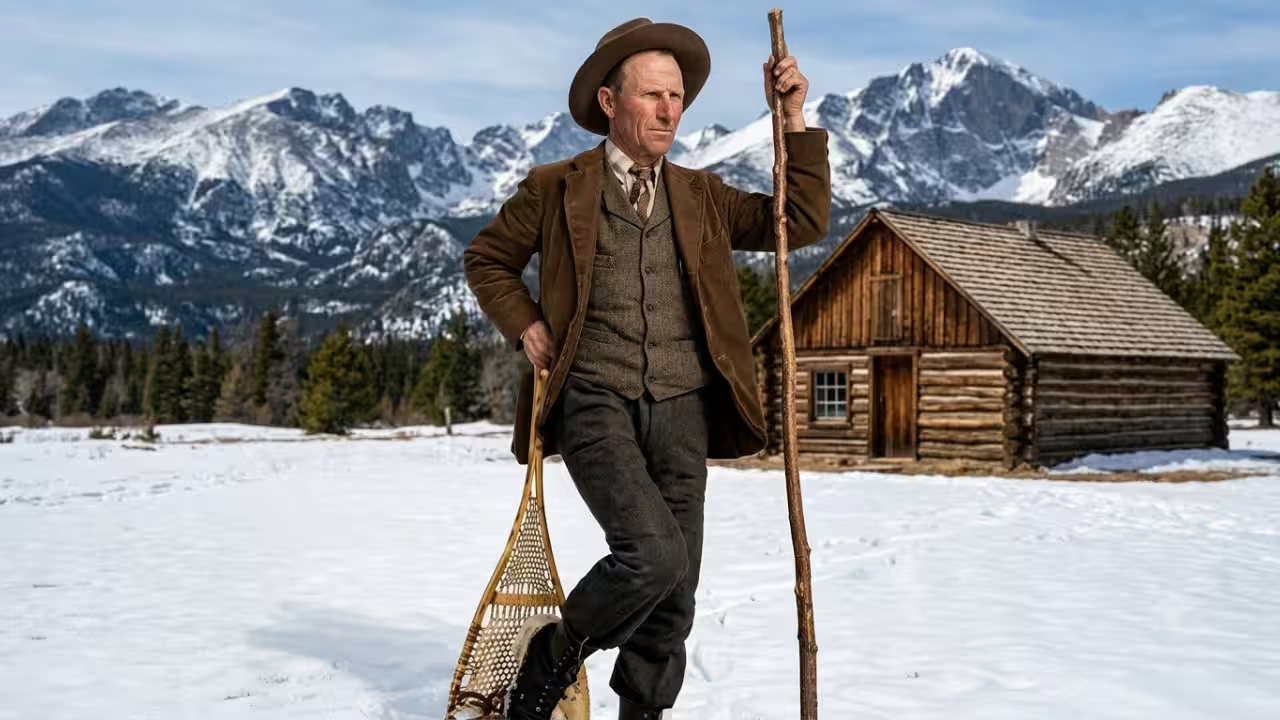
At 15, Enos Mills had already built himself a small cabin near Colorado’s Longs Peak. It was an unlikely beginning for someone who would later become closely associated with the creation of Rocky Mountain National Park. Mills had arrived in Colorado as a sick teenager from Kansas, after doctors warned his parents that he might not live long. Life in the mountains brought a change. He became a guide, writer and keen observer of the wilderness, spending years travelling its trails. But as visitors, miners and loggers put increasing pressure on the landscape, Mills began working towards a different goal: protecting the mountains for the future.The Colorado journey that changed a sick teenager’s lifeEnos Abijah Mills was born on April 22, 1870, on a farm in Kansas. His parents had previously tried their luck as miners in Colorado, although the venture had not provided enough money to keep them there. They returned to Kansas, carrying memories of the mountains with them.Those stories stayed with Mills. He was drawn to the outdoors from an early age, although his childhood was complicated by poor health. Doctors could not determine what was wrong with him, and by the time he was 13, his parents had been warned that he might not live much longer.The family eventually decided that Colorado offered him a better chance. During the 1880s, the state attracted people hoping that its mountain climate would help them recover from illness. For Mills, the move became the beginning of a life almost entirely connected with the outdoors.The teenager who built his own cabin near Longs PeakMoney was tight, so Mills travelled from Kansas to Estes Park by hitchhiking. He found work with relatives who ran a lodge, doing cleaning and other jobs. Away from the building, he began spending long periods on the trails.His health improved, and his familiarity with the surrounding country grew. Before long, he was working as a nature guide. Mills also had a practical goal. He wanted land of his own. During summer he guided visitors in Colorado, while winters were spent in Montana, where he worked as a runner at a mine. The job involved carrying tools and supplies to miners.The money he saved allowed him to purchase a small parcel near Longs Peak. He built a cabin there when he was just 15. Longs Peak became central to his life. Mills climbed it 297 times, according to records held by the Denver Public Library.Mills turns an unconventional education into a life of travelMills never attended school in the usual sense, but that did not stop him from educating himself. Libraries became an important part of his learning, and his interests extended well beyond the mountains.His work in mining provides one example of his ability to teach himself. He eventually became an engineer at the mine, despite working alongside people who had received formal college training.That career ended when a fire destroyed the mine when Mills was 20. He had saved enough money from his jobs to travel, and he set out across the United States, Canada and Europe. He also reached Alaska, at a time when it had not yet become a US state.Mills preferred wilderness to conventional sightseeing. He travelled with a camping mindset, often alone, and began turning his experiences into stories.A meeting with John MuirDuring a period of camping in California, Mills met the naturalist and conservationist John Muir. The two became friends, and Muir encouraged Mills to use his writing as a way of communicating the value of wild places to people who might never see them for themselves.The encounter helped shape the direction of Mills' life. He returned to the Rocky Mountains and continued writing about the landscape. He was also employed by the US government to measure snowfall in the Rockies, a task that required him to spend extended periods alone in remote mountain country. For Mills, isolation provided time to write. His articles began appearing in magazines and attracted readers far beyond Colorado. People living in cities could encounter the mountains through his descriptions even if they had never travelled there.Turning a lodge into a base for visitorsMills eventually purchased the lodge where he had once worked. He renamed it Longs Peak Inn, linking it to the mountain that had become so important to him. The inn gave him another way to introduce people to the Rockies. He guided visitors during the day and spoke about nature in the evenings. His lectures became popular enough that he travelled around the United States to speak about the mountains.There was a tension in this work, though. Mills wanted people to experience the wilderness, but increased visitation also brought problems.When visitors began damaging the landscapeAs tourism increased around the Rockies, Mills saw signs of careless behaviour. Wildflowers were being pulled from the ground, while mining and logging were altering the landscape on a much larger scale. He responded in a fairly direct way. Signs were placed around Estes Park asking visitors to protect wildflowers, including a reminder that flowers should be cut rather than pulled up by their roots.The small notices reflected a much bigger concern. Mills believed that simply encouraging people to appreciate nature would not be enough if the landscape remained vulnerable to development and extraction. He began advocating for a protected area in the Rocky Mountains.The campaign for a national parkMills had already seen what national-park protection could achieve through the work of John Muir in California. Yosemite had become a national park, providing a model for protecting important mountain landscapes. Mills spent years making the case for similar protection in Colorado. He spoke publicly, wrote about the Rockies and tried to persuade government officials and business interests that a national park would benefit the region while safeguarding its natural features.Muir died in 1914, before the campaign reached its conclusion. Mills continued. In January 1915, Congress and President Woodrow Wilson established Rocky Mountain National Park. Mills' long campaign had reached the outcome for which he had been working, and he subsequently became closely associated with the title "Father of Rocky Mountain National Park".Conservation became part of his public workThe creation of the park did not mark the end of Mills' work. He continued travelling and lecturing about forests, wildlife and the value of spending time in natural landscapes. One surviving handbill advertises a 1909 lecture by Mills at Carnegie Hall in New York City. The subject was "Our Friends, The Trees", an indication of how far his public speaking had taken him from the Colorado mountains where his career had begun.His approach to conservation was closely tied to personal experience. Mills had spent years walking trails, camping in remote areas and guiding visitors. He was not simply writing about a distant landscape. Much of his work came from years spent living within it.A family continued the workMills married Esther Burnell in 1918. She also had a place in the history of nature guiding, later becoming the first person to be formally named a professional nature guide by the National Park Service. The couple had one daughter, Enda.Mills' final years were cut short after an accident in New York City in 1922. He had travelled there to give a lecture about Rocky Mountain National Park when he was badly injured in a subway accident. He continued working afterwards but did not fully recover.He died on September 22, 1922, aged 52. Esther and Enda continued making his writings available and carrying on his message about the natural world. Later generations of the family remained connected with his legacy through the Enos Mills Museum in Estes Park.The landscape that first drew Mills to Colorado is now part of a national park visited by thousands of people. Its existence is tied to legislation, government action and wider conservation movements, but Mills' role was unusual. He spent years trying to persuade people that protecting the mountains was worth doing before such protection became official policy.Catch the latest World News and Live updates. Download the TOI app.
Topics in this story
Gathered from external sources. Rights to this text belong to whoever originally published it.