In 2009, researchers mixed grape-marc compost into slate-processing fines; the treatment helped the barren material retain more water and develop more soil-like properties
Rest of World News: Researchers in Spain demonstrate how mixing grape waste with slate mining byproducts can enhance soil qualities for successful land restoration.
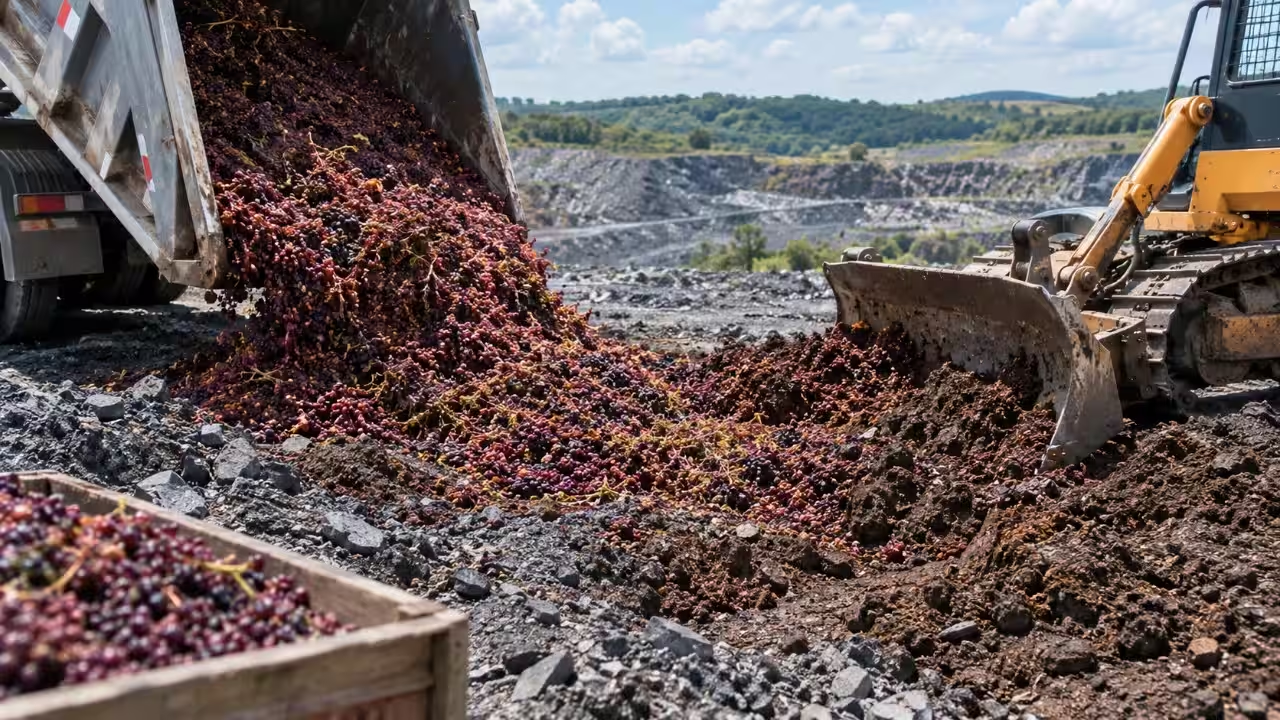
What looks like a pile of mining waste can be the opposite of living soil. Slate processing leaves behind huge quantities of fine, powdery material with little organic matter and limited ability to support vegetation. Researchers in north-west Spain tested whether a waste product from another industry, grape marc, could help change that. According to the Soil Science Society of America Journal, researchers tested grape-marc compost and vermicompost to improve slate-processing waste. In the field experiment, the highest application rate was about 120 tonnes of grape-marc vermicompost per hectare. The researchers found that adding organic amendments could improve several physical properties of slate waste, making it more suitable for use in land restoration.Turning mining waste into something closer to soilThe research was carried out in the Valdeorras area of Galicia, one of Spain's major slate-producing regions. Slate extraction and processing generate large quantities of waste, including very fine particles produced when blocks are sawn. Unlike ordinary agricultural soil, this material contains little organic matter and has physical characteristics that can make plant establishment difficult. Its structure also matters. Fine slate particles can compact, limiting the movement of water and air and making it harder for roots to develop. Without a functioning soil layer, establishing vegetation on a mine dump can therefore be difficult even when seeds are available.Grape marc was selected as the source of organic waste because it was available locally as well as being another form of industrial waste. Grape marc refers to the residue obtained from the processing of grapes and includes components such as skin, seeds, and pulp. When the grape marc undergoes composting or vermicomposting, it may offer organic matter, which the mineral waste does not have. The idea behind this was the formation of an artificial substrate rather than spreading the waste on the land.What happened when the two wastes were mixedAccording to a study published in Waste Management, researchers examined how grape-marc compost and vermicompost could improve the biological properties of slate-processing waste. The amendments were mixed with the mining waste and incubated under controlled conditions for 90 days. The researchers found that adding the organic materials increased nutrient availability, microbial biomass and enzyme activity in the slate waste, with vermicompost generally producing greater improvements than conventional compost. The researchers concluded that grape-processing waste could improve the biological condition of slate mining residues, making them more useful for land reclamation. Application of compost amendments led to an increase in water-holding capacity, consistency, and aggregate formation. This was significant as it meant that the fine mineral fraction acquired soil-like properties.In the field experiment, grape-marc vermicompost was tested at two rates, approximately 60 and 120 tonnes per hectare. The amended material was placed in a 15-centimetre-deep layer over the surface of a slate-waste dump. Both rates increased the amount of moisture retained by the material, while the highest application rate also increased hydraulic conductivity. Instead, the treatment changed several of the physical properties that determine whether a barren substrate can begin supporting vegetation.From waste pile to restoration surfaceThe work built on earlier experiments by the same research group. A 2007 study published in Geoderma tested mixtures of slate-processing fines and grape-marc vermicompost as an artificial soil for supporting vegetation. When Italian ryegrass was grown in the mixtures, even relatively small additions of vermicompost increased nutrient availability and plant productivity, while also improving water-holding capacity and biological activity. The researchers suggested that such mixtures could provide a first step towards establishing permanent vegetation on slate dumps. That distinction is important because restoration begins long before a landscape resembles a functioning ecosystem. A mine dump first needs a surface capable of holding water, supporting roots and allowing microorganisms to become active. Only after those basic conditions improve can vegetation become established and begin contributing organic matter of its own.Moreover, the method gives a new use to two waste streams. Instead of simply disposing of the waste created by the production process of grapes and slate, the researchers considered the possibility of using one to overcome the weaknesses of the other. In this case, the outcome is neither a completed forest nor a fully-fledged soil. However, what is offered here is an artificially created growing medium, partially composed of material that would otherwise remain waste. At sites where mining has stripped away the conditions plants need to grow, adding organic matter can help restore them. The broader lesson is that restoration does not always begin with planting trees. Sometimes, it starts by giving barren mineral waste the properties plants need to grow.Catch the latest World News and Live updates. Download the TOI app.
Topics in this story
Gathered from external sources. Rights to this text belong to whoever originally published it.