In 1930, John D. Rockefeller Jr. paid $115,000 for 267 acres at George Washington’s birthplace; nearly half of today’s 551-acre national monument was donated
US News: Discover how John D. Rockefeller Jr.'s philanthropy shaped the preservation of George Washington's birthplace and the establishment of a national monument in Virginia's Northern Neck.
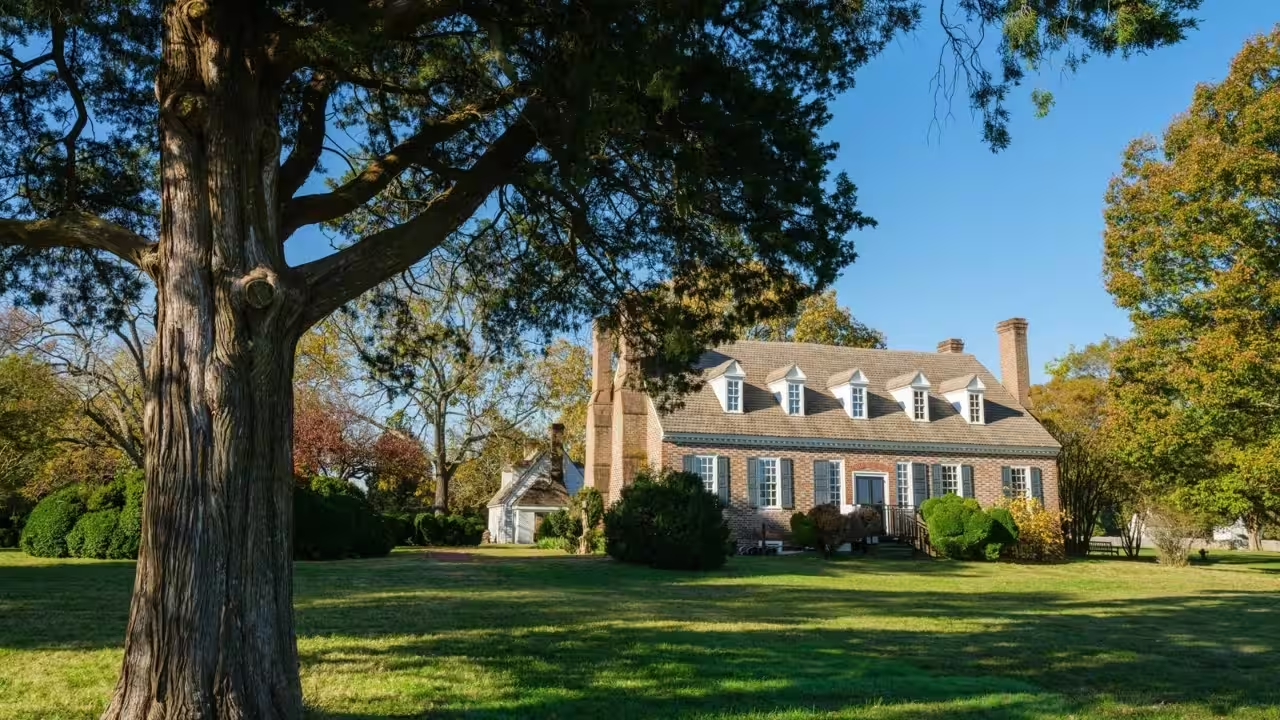
In 1930, philanthropist John D. Rockefeller Jr. made a major contribution to the effort to preserve the landscape where George Washington was born. The Wakefield National Memorial Association approached Rockefeller for financial support to develop a memorial at Washington’s birthplace. Rockefeller responded by initiating the acquisition of 267 acres for $115,000 in the late 1920s and holding the property in trust while the association raised money for its project. He completed the final deed transfer and financial release in early 1930, just days before the site was formally established as a national monument on 23 January 1930; Rockefeller handed over the land to the association. This final step allowed Rockefeller to formally handover the land to the association for immediate conveyance to the federal government. The National Park Service says almost half of today’s park acreage was donated by Rockefeller.From George Washington’s birthplace to national memorialGeorge Washington was born in 1732 at the family’s plantation on Popes Creek in Virginia’s Northern Neck, and the property remained central to the ancestral estate. The NPS now describes George Washington Birthplace National Monument as a 551-acre site where seven generations of the Washington family lived.By the 19th century, efforts were underway to identify and commemorate the location. Virginia acquired the property in 1858, and the federal government later became responsible for the site. In 1896, a granite obelisk was erected at what was then believed to be Washington’s birthplace, thus creating an early public memorial at the location.The memorial efforts gathered momentum in the early 20th century when the Wakefield National Memorial Association sought to create a larger commemorative landscape around the first president’s birthplace. However, acquiring enough land and financing the proposed improvements required substantial private investment. That was when the association turned toward John D. Rockefeller Jr., who was already known as one of the country’s most prominent philanthropists and a major supporter of historic preservation. The federal agency reported that the association approached Rockefeller specifically for funding to develop the Memorial Area, and he responded by purchasing the 267 acres.Rockefeller’s $115,000 land investment for the Memorial AreaThe transaction involved more than just buying land and giving it immediately to the federal government. Once the acreage was secured for the George Washington Birthplace National Monument in the late 1920s, Rockefeller held the property in trust for the Wakefield National Memorial Association. This move safeguarded the land while the organisation raised funding for its structural expansion, allowing the association to systematically develop the Memorial Area, before donating the private holding directly to the National Parks Service.The scale of Rockefeller’s contribution becomes clearer when compared with the monument’s present size. The federal organisation currently lists the park at 551 acres, and if the historical 267 acres is compared with today’s total, it represents approximately 48.5% of the monument. However, it is worth noting that this calculation does not mean that the current park consists of an unchanged 267-acre Rockefeller parcel, as decades of subsequent federal land acquisitions, boundary optimization swaps, and tract adjustments altered the original property lines while maintaining the core acreage footprint.Building a memorial for George Washington’s birthplaceThe national monument was established as the country was preparing to commemorate the 200th anniversary of Washington’s birth in 1932. As a result, the memorial effort moved quickly, and a Memorial House was built in the early 1930s as part of the commemorative landscape.The Memorial House, however, should not be confused with Washington’s actual birthplace. The original house in which Washington was born had disappeared long before the modern monument was created. Therefore, the Memorial House was a commemorative building rather than a surviving or exact replica of the 18th-century birthplace.To recognise the main historical grounds, planners integrated agricultural infrastructure into the site during its early 1930s construction phase. The large white barn constructed in the Memorial Area is known as the Rockefeller Barn, reflecting his extended charitable contributions to the association. Notably, the philanthropist continued to assist the site after the original land transaction.Today, George Washington Birthplace National Monument encompasses 551 acres in Virginia’s Northern Neck. The NPS says the property includes the Memorial Area, the Washington Family Burial Ground, a visitor centre, picnic facilities and a public beach, alongside areas used for hiking and fishing. Additionally, the site preserves the broader landscape in which Washington’s family lived.Catch the latest World News and Live updates. Download the TOI app.
Topics in this story
Gathered from external sources. Rights to this text belong to whoever originally published it.