France to ban ‘Black Friday’ in Franglais clampdown
France has restarted its long-running war on the English language with plans to ban the use of “Black Friday” and anglicised government slogans.
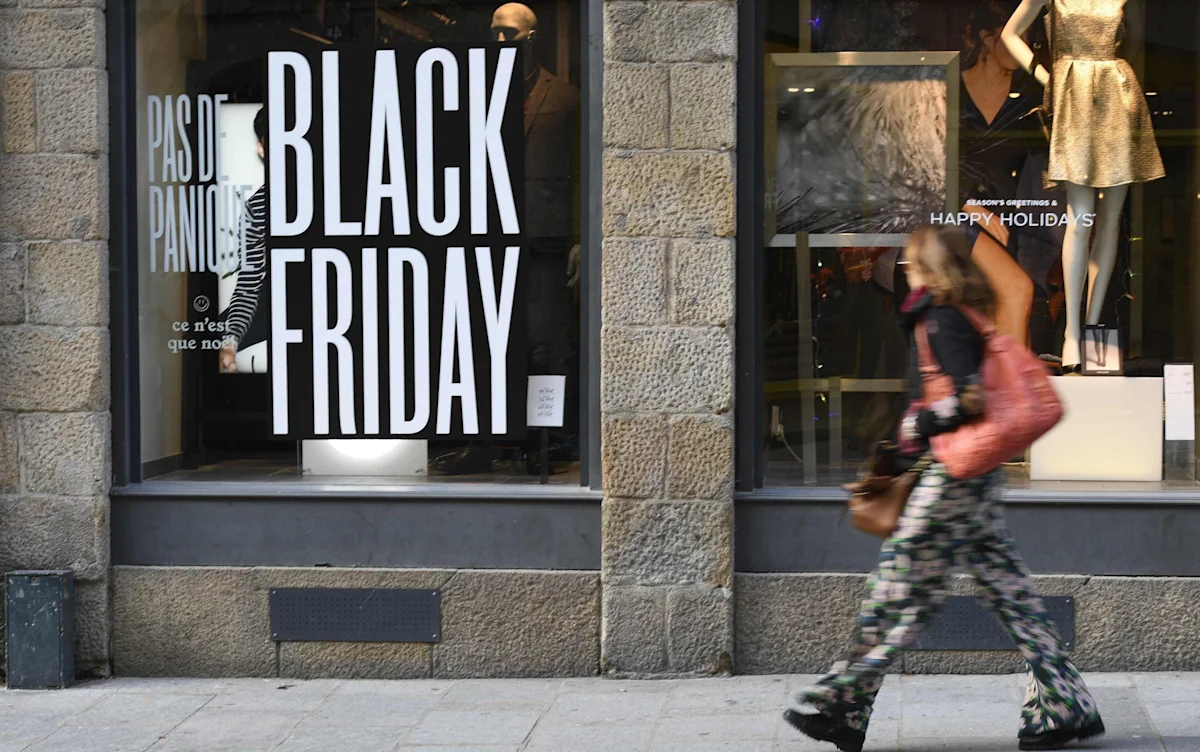
France has restarted its long-running war on the English language with plans to ban the use of "Black Friday" and anglicised government slogans.
The country's own culture ministry has cited the spread of "Black Friday" promotions in English as evidence that the 1994 Toubon law protecting the French language is ill-adapted to the internet age.
A new bill would require such foreign expressions in online advertising to carry French translations in equally large and prominent lettering.
The proposals have been lodged by Yan Chantrel, a Socialist senator. While their passage is not assured, they draw on a cross-party senate report backed by conservative and centrist colleagues.
Under the plans, multi-national companies could no longer address employees in France solely in English, while the proliferation of university courses taught entirely in English would be curbed.
Even state-backed slogans such as "Choose France" and "French Tech", which are dear to Emmanuel Macron , the French president, could be targets of the proposed clampdown, Mr Chantrel's office told The Telegraph.
Named after Jacques Toubon, Jacques Chirac's culture minister, the 1994 law was designed to guarantee a "right to French" in advertising, employment, education and public services. Yet the internet, globalisation and the spread of English have sorely tested its reach.
Few cases illustrate that better than "Let's Grau", the Franglais tourism slogan adopted by Le Grau-du-Roi, a Mediterranean resort, in 2015.
French-language campaigners fought a lengthy legal battle to have it banned, only for the Conseil d'État, France's highest administrative court, to rule in 2020 that the town could keep it because no officially approved French equivalent existed.
Nicolas Polge, the court's public rapporteur, called the slogan "unfortunate" and even mocked another southern tourism brand, "So Toulouse", wondering whether English speakers might hear "so to lose".
His legal conclusion was nevertheless categorical: the campaigners stood no chance without an overhaul of the Toubon law.
Mr Chantrel now wants to do precisely that. His office said the wording would be tightened so that a public authority should no longer be able to escape the law in the same way as Le Grau-du-Roi.
The bill would also address digital communications that fall outside legislation conceived in the internet's infancy.
Mr Chantrel wants the French translation of foreign wording in online advertising to have "equal legibility".
His office confirmed that would mean the same-size lettering, preventing advertisers from displaying an English slogan prominently while reducing its French equivalent to tiny print.
Public services and local authorities would face stricter obligations, while the government's official guardian of the French language, DGLFLF, would gain stronger powers to investigate and sanction breaches, inspired by Quebec's powerful language watchdog. The precise sanctions have yet to be set out.
The bill, lodged on Aug 12, follows a 2024 Senate inquiry co-written by Mr Chantrel with Catherine Belrhiti of the conservative Republicans and centrist Pierre-Antoine Levi, which called for the Toubon law to be "updated, strengthened and better applied".
It comes amid recurrent French alarm over the advance of "globish".
In 2022, the Académie Française, official guardians of the French language, threatened legal action over English words such as "surname" appearing on France's new identity cards.
Marine Le Pen, a nationalist French presidential candidate, also pledged to ban the use of foreign words in advertising and public communication as part of an "emergency plan" to "save" the French language.
A year later, Jean-Marie Rouart, one of the academy's "immortals", accused Mr Macron of being the "Tartuffe of the French language" for inaugurating a €2100m temple to French at Villers-Cotterêts while embracing slogans such as "One Planet Summit" and "Choose France".
He accused the president of participating in French's "slow destruction".
Language purists complained that the name Lorraine Airport infringed language laws with its use of English and was an insulting example of "Anglo-mania". It was told to change its name to Lorraine Aéroport.
Timed to coincide with Paris Fashion Week, purists also hoped to oust terms such as "must-have", "lifestyle" and "try before you buy".
Try full access to The Telegraph free today. Unlock their award-winning website and essential news app, plus useful tools and expert guides for your money, health and holidays.
Topics in this story
Gathered from external sources. Rights to this text belong to whoever originally published it.