Locked out, shut in, left hungry: Afghanistan after Taliban takeover
Five years of Taliban rule have left Afghanistan with so much loss and so little hope. Women have been pushed out of sight and eventually mind.
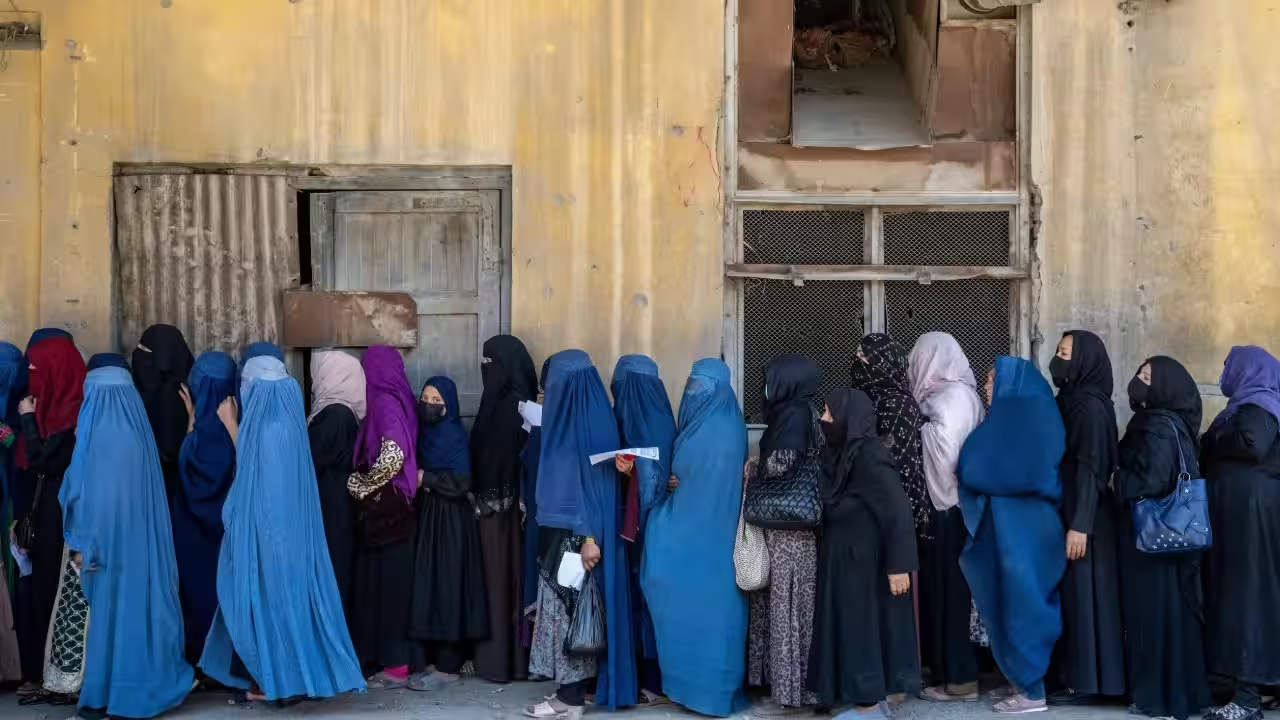
Five years of Taliban rule have left Afghanistan with so much loss and so little hope.Women have been pushed out of sight and eventually mind. Millions more face the threat of hunger as winter sets in.For a country that has already endured so much, hope is beginning to diminish.Since returning to power in August 2021, the Taliban has tightened its grip on everyday life, with women and girls bearing the brunt of its restrictions. Education, employment and freedom of movement have become increasingly difficult to access, while food insecurity, economic hardship, displacement and declining humanitarian assistance have deepened the crisis.“Today, the plight of many in Afghanistan is going from bad to worse,” UN Human Rights chief Volker Türk said, warning that the country's worsening situation was receiving inadequate international attention.“Yet, it seems the world has forgotten and abandoned the people of Afghanistan to a plight deepening by the day. The silence is deafening.”So, five years after the Taliban takeover, how has life changed for Afghans? Here are the numbers that tell the story.Living with over 100 decrees: How Afghan women are walking on eggshellsFor women living under the Taliban’s rule, everyday chores such as going to work, visiting a market, studying or seeking medical care have become a Herculean task.According to UN Women, more than 100 decrees targeting women and girls have been issued since the Taliban returned to power.It began with education. Girls were barred from secondary education beyond Grade 6, followed by the exclusion of women from universities.Then by July 2023, beauty salons, among the remaining sources of income and female-only social spaces, were ordered to shut. Women were also barred from parks, gyms and public bathhouses.Almost a year later, Taliban formalised its Law on the Propagation of Virtue and Prevention of Vice, imposing further controls on women's appearance and behaviour.Women were required to cover their bodies and faces in public and prohibited from raising their voices in public, including to sing or recite. Restrictions on employment, travel and dress, along with requirements to travel with a male guardian, further curtailed their freedom.And it's not just public life that the Taliban controls.In January 2026, the Taliban adopted a new Criminal Procedure Code for Courts that further highlighted the restrictions women face. Under Article 32, a husband who abuses his wife can face just 15 days in prison, and only if the abuse results in a broken bone, an open wound or a visible bruise.The code also allows husbands to impose discretionary punishments for “disobedience”, ranging from scolding to corporal punishment.Contrastingly, those who organise animal fights can face up to five months in prison.The restrictions have effectively shrunk women's everyday lives.According to a UN assessment, more than half of the women surveyed left home only once or twice a month. Nearly three-quarters felt unsafe leaving without a male guardian, while more than half avoided public spaces, including markets and healthcare facilities.Class dismissed: Afghanistan’s girls locked out of learningAfghanistan remains the only country in the world where girls and women are prohibited from accessing secondary and higher education under the current restrictions.According to UNICEF, more than 2.6 million girls had been denied secondary education since the Taliban takeover. Women had already been excluded from universities since December 2022, putting an end to an educational journey for millions.The consequences extend far beyond classrooms.Girls prevented from completing their education lose opportunities to pursue higher qualifications and skilled employment. Afghanistan, meanwhile, risks losing future teachers, doctors, nurses and other professionals needed to rebuild its institutions.The wider education system is also struggling. In January 2026, UNESCO and UNICEF reported that 93% of children completing primary school were still working towards basic reading proficiency.Between 2018 and 2024, the gross enrolment rate for boys fell from 120 to 104, while the rate for girls rose from 82 to 87. The overall rate declined from 101 to 95. Gross enrolment rates can exceed 100 because they include pupils outside the official age group and do not directly measure attendance or completion. The increase in girls' primary enrolment therefore does not mean restrictions on older girls have eased.The number of female teachers has also fallen, from 98,196 in 2019 to 66,208 in 2024, a decline of approximately 32.5%. UNICEF warned in April 2026 that Afghanistan could lose more than 25,000 female teachers and healthcare workers by 2030 if restrictions on girls' education and women's employment persist.The result could be a cycle of lost opportunity: girls are denied education today, fewer women qualify for professional jobs tomorrow, and future generations face a shrinking pool of trained educators and healthcare workers.No freedom and a huge mental tollThe loss of education, employment and freedom of movement has taken a psychological toll on Afghan women.UN Women reported in August 2026 that 70% of women surveyed described their mental health as bad or very bad. An earlier UNDP assessment, based on consultations conducted in 2024, found that 81% of women consulted rated their mental health as bad or very bad. The figures come from different assessments and should not be interpreted as a direct trend.The UNDP review identified excessive worry, hopelessness or hypervigilance among the most frequently reported behavioural changes, affecting 37% of respondents. Excessive sadness was reported by 22%, decreased appetite or sleep by 21%, fatigue by 20% and social withdrawal by 12%.These pressures are closely linked to restrictions on women's everyday lives. A student unable to return to school may see her future narrowing before she can choose a career. A woman who loses her job may lose both income and independence, while someone who rarely leaves home may have fewer opportunities to maintain friendships or seek support.Accessing mental-health services can itself be difficult because of movement restrictions, limited services and financial pressures on community organisations.UNICEF's 2025 humanitarian reporting said it provided mental-health and psychosocial support to more than 2.2 million children and caregivers through community-based and media initiatives.Women out of work: A deepening crisisInflation and job losses deepen economic hardshipAfghanistan's economic hardship has intensified as rising prices, job losses and cuts to international aid put further pressure on households.Inflation rose from an average of 3.6% in 2025 to 7.6% by March 2026, driven by higher food prices, supply disruptions and rising demand. Unemployment has almost doubled since 2021, according to the UN, while more than 500,000 jobs have disappeared.Women's exclusion comes at a steep economic costWomen face additional barriers to earning a living. UN Women estimated that only 7% of Afghan women were employed, compared with 84% of men. Their continued exclusion could cost the country $920 million cumulatively between 2024 and 2026, equivalent to 5.8% of GDP.Financial insecurity is particularly severe in female-headed households. UNDP's 2025 socio-economic review found that unstable sources accounted for 65% of income in these households in 2024, compared with 43% in male-headed households.Some women have turned to small businesses, but restrictions on mobility, access to markets and finance make running them difficult. Lost jobs, rising prices and limits on women's earnings leave families with fewer ways to absorb economic shocks.The damage could persist for years. UNICEF estimated in April 2026 that restrictions on girls' education and women's employment were costing Afghanistan at least $84 million annually in lost economic output. This estimate and UN Women's cumulative projection cover different periods and use different methodologies, so they should not be combined.Healthcare system left on ventilatorRestrictions on women's movement and a shortage of female medical professionals have made accessing treatment increasingly difficult.A February 2026 report by UN Special Rapporteur Richard Bennett found that movement restrictions, gender segregation and requirements to travel with a male guardian had severely limited women's access to healthcare. The absence of a male guardian could delay treatment even in emergencies.The shortage of female healthcare workers compounds the problem. Women were barred from medical and health education in December 2024, narrowing the pipeline of future doctors, nurses and midwives. In some regions, restrictions on women consulting male doctors make access to female medical professionals particularly important.Funding shortages have forced more than 440 health clinics to close or reduce services. The proportion of Afghans without access to healthcare rose from 16% in 2024 to 23% in 2025.Timely treatment is essential to prevent deaths from complications such as severe bleeding, high blood pressure, infections and obstructed labour. When women struggle to reach clinics or facilities that lack trained staff, the risks increase.Hunger games: Millions of Afghans have empty plateYears of economic hardship, drought and declining international aid have left millions of Afghans struggling to afford basic necessities.An October 2026 assessment by the Food and Agriculture Organization and the World Food Programme projected that 19.2 million people, or 38% of Afghanistan's population, would face acute food insecurity during November 2026-April 2027. This is up 10.3% from 17.4 million projected for the corresponding period a year earlier. Around five million people are expected to face emergency levels of hunger.Meanwhile, 21.9 million people, or about 45% of the population, are expected to need humanitarian assistance in 2026, including around 11.6 million children.Despite a relatively strong agricultural season, high food and transport costs, limited jobs, weak purchasing power, population movements and declining aid continue to undermine food access. Families may be forced to cut meals, buy less nutritious food or sacrifice other necessities, putting children and pregnant or breastfeeding women at particular risk.Child malnutrition deepens the crisisUNICEF reported in August 2026 that 3.7 million children were suffering from wasting, including around one million with severe acute malnutrition. Separately, supplied figures estimate that 3.5 million children under five are already experiencing acute malnutrition. These figures use different descriptions and require source checks before publication.Food-security assessments also projected that around four million women and children would need treatment for acute malnutrition in 2027, including approximately one million severe cases. These figures represent different measures and should not be added together.Funding shortages are already restricting access to help. The World Food Programme said in 2026 that it was turning away three out of four acutely malnourished children seeking assistance because it lacked funds to buy food.When the lifeline runs dry: Aid cuts leave Afghans in the lurcThe United States, previously Afghanistan's largest donor, provided more than $3 billion in humanitarian and development assistance between October 2021 and December 2024. In January 2025, US President Donald Trump suspended US humanitarian funding for Afghanistan, removing a source that had accounted for about 45% of humanitarian support.The 2026 Humanitarian Needs and Response Plan requires $1.71 billion to provide life-saving assistance and aims to reach 17.5 million people.As of August 2026, the UN Office for the Coordination of Humanitarian Affairs had recorded US$509.3 million, or 29.7% of the appeal, leaving a shortfall of approximately US$1.20 billion.Funding gaps have forced aid organisations to reduce coverage, interrupt supplies and close service points. Women and girls are particularly vulnerable when specialist services become unavailable.UN Women reported in August 2026 that nearly three-quarters of women-led organisations surveyed had experienced funding cuts in 2025, while more than half expected to suspend operations or close within the following year.The consequences extend across food assistance, nutrition and healthcare. With millions needing support, agencies face increasingly difficult choices about distributing scarce resources.Five years, countless restrictions: Afghanistan’s shrinking worldFive years after the Taliban returned to power, Afghanistan is a country where everyday life has become a struggle for survival, dignity and hope. For women and girls, restrictions have turned once ordinary freedoms into distant possibilities.For millions of families, putting food on the table and accessing basic healthcare have become increasingly difficult. As economic hardship deepens and humanitarian support dwindles, the crisis is reaching into every corner of Afghan life.But what has changed since the Taliban takeover, and what does it mean for the country's future?The numbers paint a grim picture.You use AI every day. Now get your AI Quotient. Take the AIQ test.
Topics in this story
Gathered from external sources. Rights to this text belong to whoever originally published it.