Lincolnshire farmer says turning to solar is only way to survive
Cranwell farmer Joe Ward is defending plans to build a 640-acre solar farm on his land.
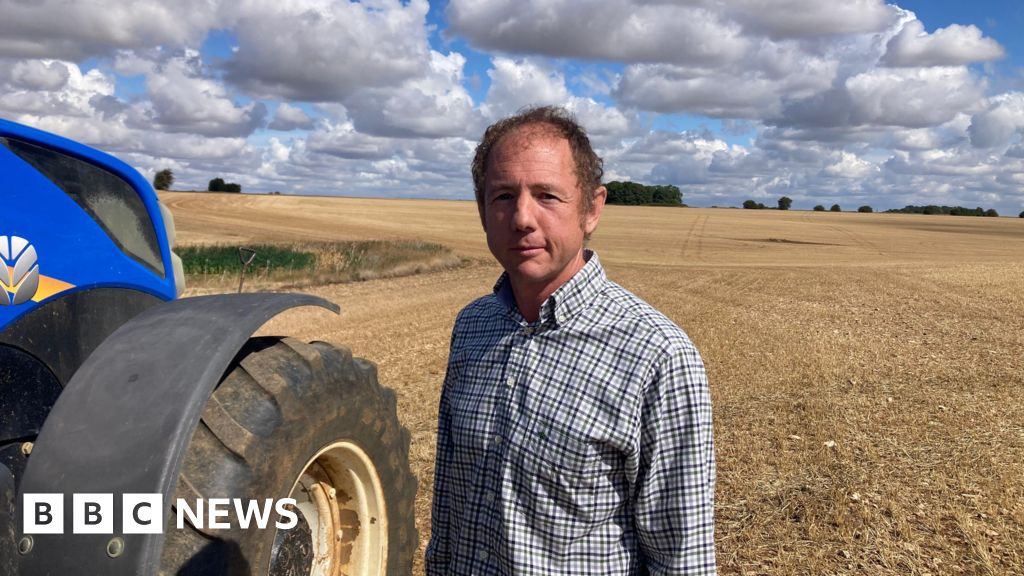
Despite promising clean energy, solar has become a dirty word in Lincolnshire, with at least 10 large projects currently in the pipeline. Critics point to a loss of productive farmland but one farmer says he has no choice but to turn to solar in order to survive.
Joe Ward slams a spade into the land he hopes will become Windsock Solar Farm. The sound of shovel on stone is like the crack of a whip.
This is not soft compost for roses in the back garden, it is sandy soil littered with rocks bigger than tennis balls.
"The topsoil is very shallow and stony, and the soil texture is coarse," he tells me.
"The last two years have been absolutely terrible. Experts tell us we can expect more drier summers. So if that's the case, the future doesn't look very good for this soil type."
Joe is the third generation of the Ward family who has farmed this land.
At a glance it could be a field of freshly harvested wheat, perhaps destined to become loaves of bread, but Ward tells me it has never really grown food.
"This land here really doesn't sustain wheat in a profitable way. So barley, especially for the malting industry, has been the mainstay of this farm."
But the malting industry, which processes barley to make whisky and beer, is a "reducing market due to consumer changes", Ward says.
"And with climate change making the last two summers so dry, it's been really difficult."
But surely a Lincolnshire farmer can find a crop that will grow in the county's famously food rich soil?
"On soil like this, you just couldn't grow potatoes without a water source," he says, and after changes to an agreement with a water company, which previously meant cheap access to water, Joe says he is left with no other option but to join with a developer who wants to build a solar farm spanning 640 acres (220 hectares), which is the equivalent of 360 football pitches.
"I think it's a good use of the land," Joe insists. "Solar will be far more productive financially for the business.
"It will produce more energy in solar panels than it ever will trying to grow very small crops."
It is just one of many patches of agricultural land in the county destined to use the power of the sun to generate electricity, rather than grow crops.
In a county famed for its produce, the idea is controversial.
Campaigners have been protesting about "energy invasion" fears, due to the number of large solar farms already approved for Lincolnshire by the government.
The Beacon Fen Energy Park in nearby Heckington was the latest to be approved, which the Reform-led county council says was an "appalling" decision.
Council leader Sean Matthews has said it was "another attack on our beautiful countryside".
Local Conservative MP Caroline Johnson says the proposals for Windsock Solar Farm "goes beyond the reasonable amount local people should be expected to bear".
Developers BLC Energy, which is behind the plans, says the impact on local residents is overinflated.
"I'm not going to deny it will be a change to views," managing director Neil Lindsay says.
"Locally, there is a change, but the advantage with solar compared to some of the other technologies is it's relatively low to the ground, which means you can put in hedgerows and new trees."
Neil thinks there is "misinformation about what these things look like".
He says if you were to drive past a solar farm "you wouldn't even know they're there".
"We've seen that from a lot of projects where we've taken concerned members of the community to visit an operating solar farm. Once they get there, they walk around, they understand it. A lot of those fears seem to dissipate."
Back on the farm, Joe climbs into his tractor to survey the land his grandfather bought in the 1950s.
Is he sad to turn over the land to solar after 70 years growing barley?
"Land use always changes," he says. "This is just evolving for the needs of the next 40 years.
"The solar panels can be removed if the needs change, and I'm sure in 40 years' time there will be different technologies and this land will be returned back to arable farming."
Listen to highlights from Lincolnshire on BBC Sounds , watch the latest episode of Look North .
App Store Google Play for Android devices
Solar farm approval may face legal challenge
'I'll lie down in front of solar farm bulldozers'
Court challenge to UK's largest solar farm plan
Solar farm planned for land near Sleaford
Topics in this story
Gathered from external sources. Rights to this text belong to whoever originally published it.