In 2020, Mississippi researchers applied blue pond dye 4 times to control algae in catfish ponds; musty fish still appeared in 2 treated ponds before harvest
In a bid to address the age-old issue of muddy-tasting catfish, Mississippi researchers explored the efficacy of blue pond dye to combat algae in aquaculture. Despite multiple treatments, the results reveal that the approach fell short, with musty fish still present at harvest.
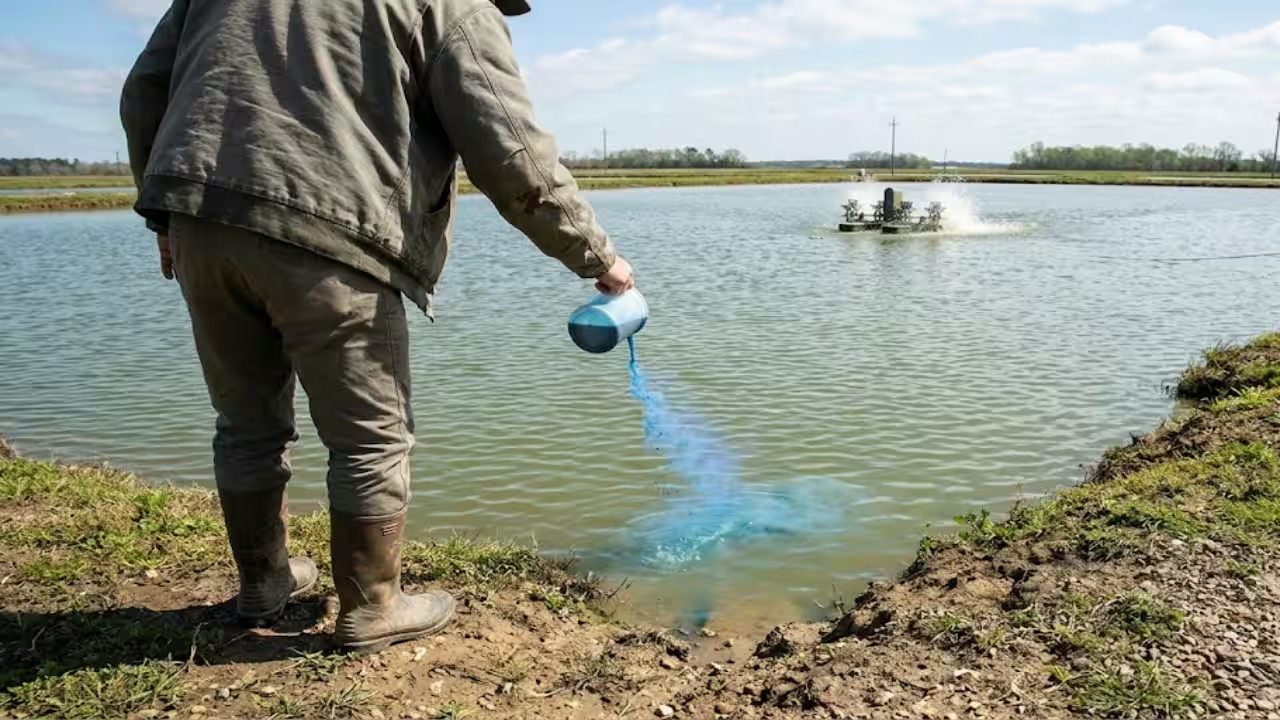
Catfish aquaculture has a peculiar problem that most consumers never hear about. Processors taste a sample of the fish before harvesting; if the meat tastes musty or earthy, the pond is left unharvested until the taste goes away. A farmer with fish ready to sell has little to do but wait, and that can take days or weeks. The stakes are higher than they appear, because a customer who dislikes the flavour may not buy catfish again.One idea was to use pond dye. Some farmers wondered if the same approach might starve the algae responsible for the unpleasant flavour. A commercial blue dye called Aquashade is sold to control underwater weeds by reducing the amount of light that reaches them. Researchers from Mississippi tested the theory, and their results, published in January 2020 in the North American Journal of Aquaculture, were dismal. The colour did not stop the off flavour. In the study, fish that processors would have rejected as musty were found in two of three dyed ponds and two of three untreated ponds on the sample date just before harvest, so the dye made no difference.Where the musty taste comes fromThe taste comes from substances generated by blue-green algae. These are plant-like microorganisms that grow in warm, nutrient-rich ponds. The musty flavour is associated with a chemical called MIB, and the earthy flavour is associated with geosmin. The musty kind is almost invariably associated with one species, a filamentous-shaped alga known as Planktothrix perornata, which older literature refers to as Oscillatoria perornata, in the main catfish-growing area, the Mississippi Delta.Fish absorb these substances via their gills, skin and intestines, and the flavour develops in the flesh. Extension specialists say the taste can develop in minutes or hours, but it takes days or weeks to dissipate and longer for large, fatty fish in cold water. That slow purge is why farmers wanted a way to stop algal blooms before they started.What the researchers triedThe work was directed by Craig Tucker of the US Department of Agriculture’s research service and Charles Mischke of Mississippi State University, both at Stoneville. During the summer growth season, they applied Aquashade four times, at a concentration of roughly one part per million, once a month. The dye was applied to three channel catfish ponds, with three ponds as controls.Then the crew compared the ponds. The dye had no measurable effect on nitrite or ammonia levels, the number of extra hours of aeration required for the ponds, the amount of phytoplankton, which are the microscopic drifting plants and algae in the water, or fish production in the ponds. Algae known to produce smelly compounds turned up at some point in every pond, dyed or not. The more interesting question is why a dye that works on weeds had so little effect on this algae.Why the dye didn’t make itThe dye absorbs light in the orange and red part of the spectrum, at wavelengths of about 600 to 650 nanometres, reducing the light available to plants growing on the bottom. The blue-green algae that produce the smell are adapted to those low-light conditions. The researchers point to pigments other than chlorophyll and an ability to change position in the water, both of which help these species thrive in low light. They are therefore not much troubled by a dye that dims the pond. The study was limited, with three ponds in each group, so it did not answer all questions about pond dyes. But the result is clear enough for farmers to weigh their options. Shading the water neither prevented the off-flavour nor had any influence on fish productivity.What farmers still rely onA 1999 extension guide from the Southern Regional Aquaculture Center spells out the basic choices, and they are mostly practical ones. When the odour-producing species leave, the flavour disappears, so a farmer may simply wait, because algal blooms come and go. The most reliable method, it says, is to move the fish into clean water to purge the taste. The algae can also be eliminated with an approved algicide, although it warns that copper-based products are problematic because they can stress fish and deplete the pond of oxygen. Some of the products and rules it mentions may have changed since. More recent guidance from the Global Seafood Alliance likewise starts with taste-testing to identify the type of off-flavour.Farms also plan around the problem. Many keep fish of different sizes in each pond so that if one pond cannot be harvested because of off-flavour, then another is likely to hold fish which might be ready to sell. It is not an ideal strategy, the guide admits, but it keeps cash coming in. The Mississippi test shows that pond dye did not solve the off-flavour problem.You use AI every day. Now get your AI Quotient. Take the AIQ test.
Topics in this story
Gathered from external sources. Rights to this text belong to whoever originally published it.