30 aircraft, 8 countries, multiple flight diversions: What happened in Europe's latest bomb scare
Nearly 30 passenger flights across Europe were targeted by bomb threats on Thursday, disrupting air travel for the second time in a week, forcing aircraft
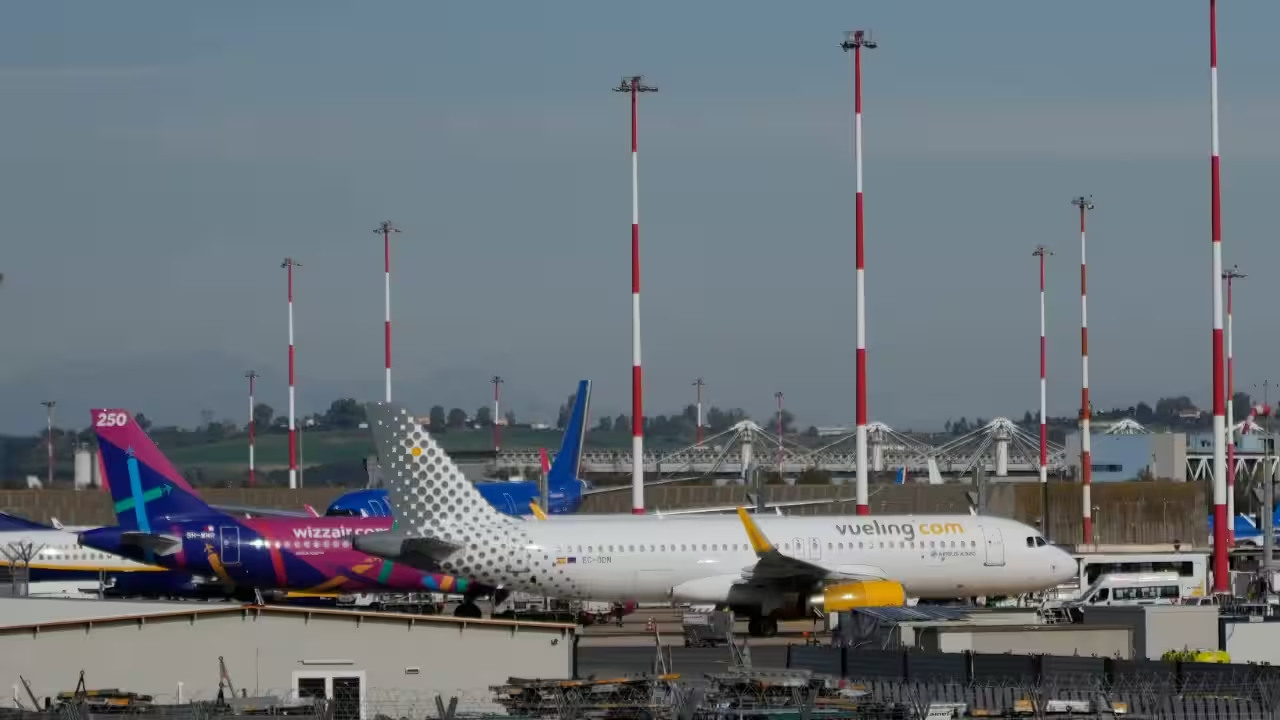
Nearly 30 passenger flights across Europe were targeted by bomb threats on Thursday, disrupting air travel for the second time in a week, forcing aircraft diversions and prompting fighter jets to escort several planes. Flights involving Austria, Belgium, Bulgaria, the Czech Republic, France, Italy, Poland and Romania were affected, while airports in the UK also received threats.No explosives have been found so far. The UK government described the latest incidents as "malicious hoax threats".The latest wave marks a significant escalation from Tuesday, when at least seven flights and a cruise ship received similar threats across Europe. A separate Wizz Air flight travelling from London Luton to Sofia was also escorted to Budapest by a Hungarian fighter jet on Monday after a mid-air bomb threat.The threats have affected several major airlines, including Aer Lingus, Finnair, Wizz Air, LOT, Ryanair, EasyJet, Aegean Airlines, Iberia and Air Serbia. Some aircraft were diverted to alternative airports, while others were escorted by military jets or subjected to security inspections after landing.What happened to flights across Europe?The incidents triggered security operations at airports across the continent, with several aircraft diverted or inspected.France: An Aer Lingus flight, EI402, travelling from Dublin to Rome was diverted to the Évreux-Fauville air base in Normandy. French fighter jets intercepted and escorted the aircraft. French Prime Minister Sébastien Lecornu's office said the pilot had not cooperated with authorities as expected, although it did not explain the reason. The airline said it was working to "re-accommodate customers to their final destination as soon as possible".Italy and Austria: A Finnair flight from Helsinki to Rome was escorted by Italian Air Force fighter jets into Fiumicino airport. Another Finnair flight from Helsinki landed in Vienna. Italian authorities carried out security checks on the aircraft.Poland and Belgium: LOT's Warsaw-Brussels flight landed as scheduled, with the airline reporting that "no suspicious items were found". Another LOT flight from Warsaw to Paris was stopped while taxiing towards take-off. Passengers were transferred to another aircraft after security screening.Bulgaria: Three flights operated by Ryanair were affected, according to Bulgarian media. Flights from Copenhagen and Madrid landed in Sofia, while another travelling from London to Sofia was diverted to Plovdiv. Bulgaria's Air Force confirmed that fighter jets escorted three airliners to the ground.Romania: Two Wizz Air flights departing from Milan were affected. One, bound for Warsaw, was diverted to Vienna, while the other landed safely in Bucharest. Nearly 200 passengers were evacuated from the Bucharest-bound aircraft, where authorities deployed an explosives disposal team to carry out inspections.Czech Republic: Police received threats involving four aircraft heading to Prague, including EasyJet flights from Newcastle and Glasgow. Authorities assessed the warnings as low risk and activated security measures. EasyJet said, "Passengers on both flights disembarked normally."Greece and Italy: Aegean Airlines said it had received bomb threats concerning two flights, one travelling from Thessaloniki to Milan and another from Athens to Vienna. The airline described the threats as "unfounded".Portugal and Italy: A Ryanair flight from Porto landed safely in Milan as scheduled. Bomb disposal experts inspected the aircraft on arrival, Italian news agency Ansa reported.Spain: The country's airport authority received threats involving three flights at Madrid airport. Iberia subsequently confirmed that two of its flights, from Milan and Rome to Madrid, were affected. Spanish police said several aircraft were halted or returned to their stands as inspections were carried out. According to Reuters, three emailed threats arrived within 20 minutes, involving two Air Europa departures from Madrid to Paris and four inbound Iberia flights from Rome and Milan.Serbia and Romania: Air Serbia said its flight from Belgrade to Bucharest landed safely. Following security checks, the reported threat was "assessed as unfounded".Reuters also reported that Romania's intelligence agency had received information about a bomb threat concerning a KLM flight to Tel Aviv, which had a layover in Bucharest.UK airports receive bomb threatsThe disruption was not limited to aircraft. London Heathrow and Birmingham airports also received threats on Thursday, although both were assessed as not credible.Heathrow said it had received a threat earlier in the day but stressed that there was "no risk to passengers, colleagues or the aircraft"."There are robust UK aviation security standards in place to assess and safely manage these types of situations," the airport said.Birmingham Airport spokesperson said that the airport had received a threat, following which "processes were immediately initiated in conjunction with emergency services and partners", according to a report by BBC.UK transport secretary Heidi Alexander described the incidents as "malicious hoax threats". She said the government was taking "these threats seriously", adding that there were "established processes for dealing with hoax and malicious threats".A UK government spokesperson later said the threats reported "in the early hours" had been "resolved", without providing further details.Who could be behind the bomb threats?The source of the threats remains unclear. However, emails sent to airport authorities in Italy have raised questions about a possible connection to an ultra-right Russian group.An email with the subject line "Threat report" had been sent to several addresses belonging to airlines, airport operators and airport service providers at Rome's Fiumicino and Milan's Malpensa airports, Reuters reported citing an airport source.The email claimed to be from "fighters of the Male State" and alleged that explosive devices had been placed on incoming flights from Helsinki and Dublin. It warned that the devices would explode within 60 minutes."Today your sky will be red," the email said.Aeroporti di Roma, which manages Rome's two airports, separately confirmed to the BBC that bomb threats against two inbound flights on Thursday had been received by email.The warnings were signed in the name of "Fighters of the Male State". The messages claimed to be targeting a "feminist regime" and said they wanted to "make our mark on history". They also threatened to "turn the skies red" with explosions.The name is believed to refer to the Russian group Muzhskoi Legion, or Male Legion, an ultra-right organisation banned by a Moscow court in 2021. Despite the ban, it retained tens of thousands of online followers and voiced support for Russia's full-scale invasion of Ukraine the following year.However, Vladislav Pozdnyakov, the Russian blogger who founded the anti-feminist Male State movement in 2016, denied any involvement. He said the group no longer existed."Anyone currently orchestrating provocations within European Union countries under the banner of this 'brand' is acting in their own self-interest - essentially flying someone else's flag," he wrote on his Telegram channel.Reuters said it could not independently establish who sent the email. There was also no immediate indication of who was behind the other threats across Europe.Threats part of wider hybrid attack?The repeated incidents have raised concerns about possible attempts to disrupt essential services across Europe. However, no government has publicly identified those responsible, and no claim of responsibility has been verified.Security experts have suggested that the threats could have been issued by individuals acting on personal grievances or by copycats. Others have pointed to the possibility of a more coordinated campaign of disruption.Eric Schouten, head of aviation security group Dyami, told Reuters that establishing the involvement of a particular country in such incidents was difficult."When it comes to a situation like this or even other sabotage attacks, it's really hard to prove there's a certain country behind it. But it does fit in the modus operandi," he said.European officials have repeatedly accused Russia of organising sabotage and hybrid attacks since its 2022 invasion of Ukraine. Such operations are often relatively inexpensive, difficult to trace and designed to disrupt essential services without provoking an armed response.Denmark, Poland and Romania, all affected by Thursday's incidents, have previously accused Moscow of involvement in hybrid attacks. Germany blamed Russia for an August attack on Leipzig airport, while Britain has previously accused Moscow of sabotage and linked Iran to a suspected plot against a US air base.Both Russia and Iran have denied the accusations.Aviation expert Marco Chan of Kingston University told the BBC that the threats were "most likely a hoax, but the system is right to treat it as real".He said some experts viewed them as "possibly part of a pattern of cheap, deniable disruption" to air travel. However, he cautioned that "three days of incidents is too small a sample to separate coordination from contagion".Philip Baum, professor of aviation security at the University of Coventry, said the industry "faces multiple bomb threats every single day", but he had been "surprised" by the incidents this week.A flight is diverted "only when the threat is credible and the authorities believe there is a potential of explosive device on board", he said.He warned that repeated hoaxes could lead to complacency, raising the possibility that a genuine threat could be overlooked or that the warnings could be used as a diversion.Passenger accounts: 'The plane was surrounded by fire trucks, ambulances'The disruptions also left passengers stranded and uncertain about their journeys.Emily Noble, a 26-year-old passenger on the diverted Aer Lingus flight from Dublin to Rome, told BBC Verify that she was about an hour into her journey when passengers were initially informed about a "technical" problem.As the aircraft began circling before its unplanned landing in France, the pilot announced that there was a "security" issue."It was an odd experience," Noble said. "It was worrying because we didn't know what was going on, but we were all trying to be as calm as we could."She said she could hear fighter jets during the landing and saw one touch down behind their aircraft.After landing at the Évreux-Fauville air base, passengers remained on board for two-and-a-half hours while police and military personnel conducted checks, including searches with sniffer dogs.They were later informed that they would be taken to an airport in Paris, from where another aircraft would fly them to Rome.Elena Pala, a passenger on a Wizz Air flight from Milan to Bucharest, also described the security operation after landing."First, they took us a long way from the terminal ... far away on the runway. The plane was surrounded by fire trucks, ambulances and anti-terrorist units," she told Digi TV."I asked what was happening. They said it was an emergency issue. That is all they said," Pala added.Cyberattacks on supermarkets and blood banks add to concernsThe aviation threats have also coincided with cyberattacks targeting other essential services in Europe.This week, unidentified hackers disrupted refrigeration systems at supermarkets in several European countries for the second time. French blood banks were also affected, with temperatures in refrigerators and freezers rising.Eliran Almog, CEO of aviation cybersecurity firm Cyviation, told Reuters that the aviation threats could be intended not only to disrupt operations but also to observe how airlines, airports and authorities respond."These aviation threats are also occurring in the same period as cyberattacks on supermarket refrigeration systems across Europe," he said."Different essential services are experiencing disruption that carries economic costs and can undermine public confidence."The incidents have intensified concerns about the vulnerability of essential infrastructure to low-cost and difficult-to-trace disruption operations. However, there is no established evidence linking the aviation threats to the cyberattacks.You use AI every day. Now get your AI Quotient. Take the AIQ test.
Topics in this story
Gathered from external sources. Rights to this text belong to whoever originally published it.