In 2012, Anguilla cleared invasive rats from Dog Island and its satellites, with sooty tern nests rising from 113,000 to more than 300,000 pairs and potentially aiding endangered turtles
In a groundbreaking conservation effort, Anguilla successfully eradicated invasive rats from Dog Island, leading to a remarkable increase in seabird colonies and enhanced nesting for endangered turtle species. Discover how this initiative transformed an ecologically important region in the Caribbean and set a precedent for future conservation projects.
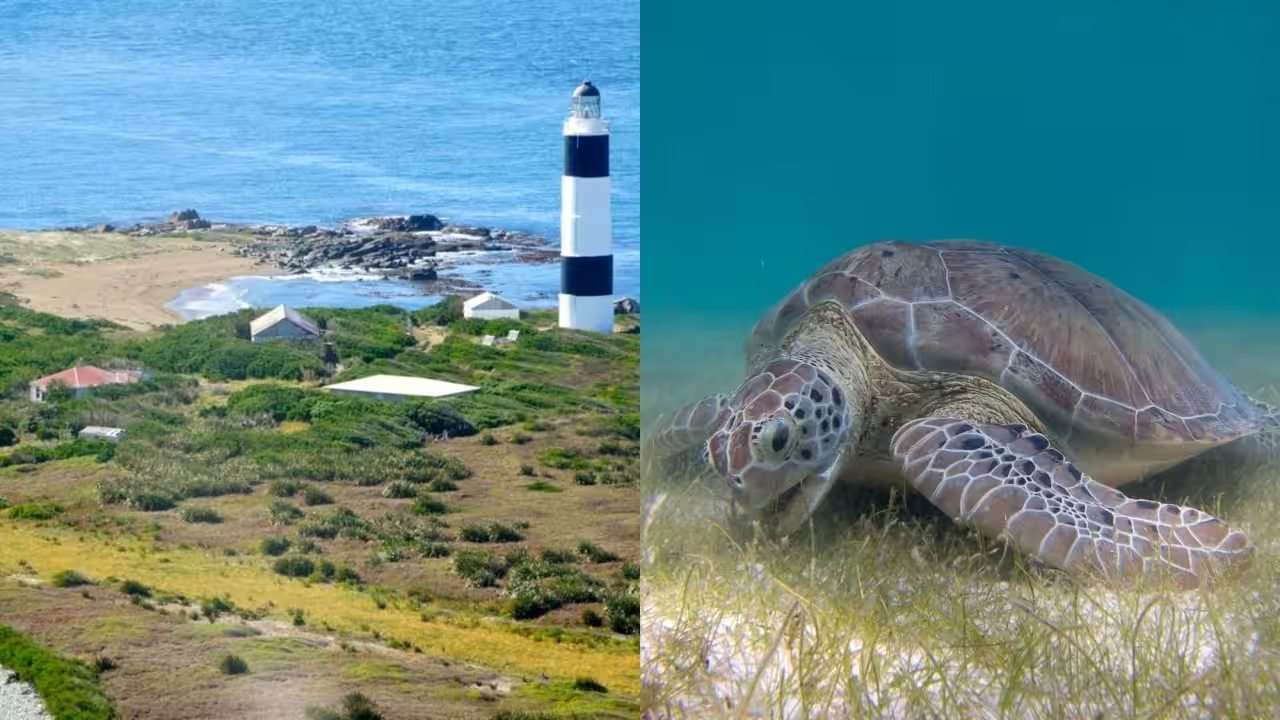
Dog Island is a small, uninhabited stretch of scrub-covered limestone in the eastern Caribbean, about eight miles northwest of the main island of Anguilla, though it saw light farming and habitation generations ago before being abandoned. There is little indication that the island has any special significance for tourists accustomed to the area's beaches and resorts. However, for many years, conservationists throughout the Caribbean had silently observed Dog Island's seabird colonies decline due to a threat that had nothing to do with development or tourism but rather with a species that had arrived on ships centuries earlier.A gradual fall, rodents and goatsDuring the age of human occupation, black rats appeared on Dog Island. They were probably accidentally introduced by vessels that used the island for farming and light habitation. Without management, rodents were regularly eating the eggs and chicks of ground-nesting seabirds, and introduced goats were eating the native foliage those birds relied on for shelter, according to the Anguilla National Trust's own account of the Dog Island Restoration Project. By the time conservationists began serious study of the island, the Anguilla National Trust's Dog Island Restoration Project page stated, the seabird colonies had probably been reduced to less than a quarter of their historic size, and the island itself was showing signs of desertification brought on by decades of unchecked grazing and predation.A labour intensive operation in challenging terrainThe operation was carried out by the Anguilla National Trust with international conservation partners, who laid ground-based bait stations along a network of paths carved through the the dense scrub of the island. Fauna and Flora International, the Royal Society for the Protection of Birds and Anguilla's own Department of Environment, which has sponsored conservation work on Anguilla's outlying islands since the late 1990s, supported the operation. The rats were effectively eradicated from Dog Island in 2012, and the island has since become a shelter for an estimated 200,000 pairs of breeding seabirds spanning nine unique species, according to Fauna & Flora International's own summary of its Anguilla conservation work. The population of sooty terns, the island's most numerous seabird, is believed to have grown substantially from the roughly 113,000 nesting pairs recorded before the clearance, according to survey work carried out by researchers tracking the island's recovery, though later islandwide counts have not broken the total down precisely enough by species to confirm an updated figure.In the months immediately following the clearance, a baseline survey published in the Journal of Caribbean Ornithology recorded more than 1,200 apparently occupied brown booby nests alone, along with globally significant numbers of red-billed tropic birds, highlighting how quickly seabird populations responded once the threat was removed. Two follow-up surveys in 2014, two years post-rat removal, then reported the first confirmed nesting record on the island for Audubon's shearwater, a species that may have been unable to nest successfully in the presence of rats.Turtles and a bigger island networkThe benefits were not just for birds. Reduced rat activity has also benefited the endangered hawksbill, green and leatherback turtles that nest on beaches around Anguilla. Rats are known to raid turtle nests in much the same way as they raided the eggs of seabirds. Dog Island is part of a bigger system of over twenty uninhabited islands dispersed around the waters of Anguilla, many of which are home to similarly rare or unique animals that exist nowhere else on earth, including the severely endangered Anguilla Bank racer snake.Dog Island has been utilised by conservation groups involved in the project as something of a proof of concept for similar work elsewhere in the region, including current attempts to eradicate invasive species from Anguilla's Sombrero Island and Prickly Pear Cays. What makes the Dog Island outcome significant is less the methodology itself, given that rat clearing methods pioneered in New Zealand have been used on islands around the world over the last few decades, and more the scale at which it succeeded. Few tropical rat eradication programs of equal scale have recorded recovery figures of this magnitude, and more than a decade later, the seabird colonies that returned to Dog Island show little sign of slowing off.You use AI every day. Now get your AI Quotient. Take the AIQ test.
Topics in this story
Gathered from external sources. Rights to this text belong to whoever originally published it.