In 2007, Scottish cyclist Mark Beaumont left Paris to race around Earth; 194 days and 17 hours later, crashes, theft and exhaustion had not stopped him
UK News: In 2007, Mark Beaumont set off from Paris on a remarkable solo journey, cycling around the globe in just 194 days. Overcoming crashes, theft, and exhaustion, his adventure redefined endurance cycling and raised £18,000 for charity. Read on to explore how he inspired a generation of cyclists!
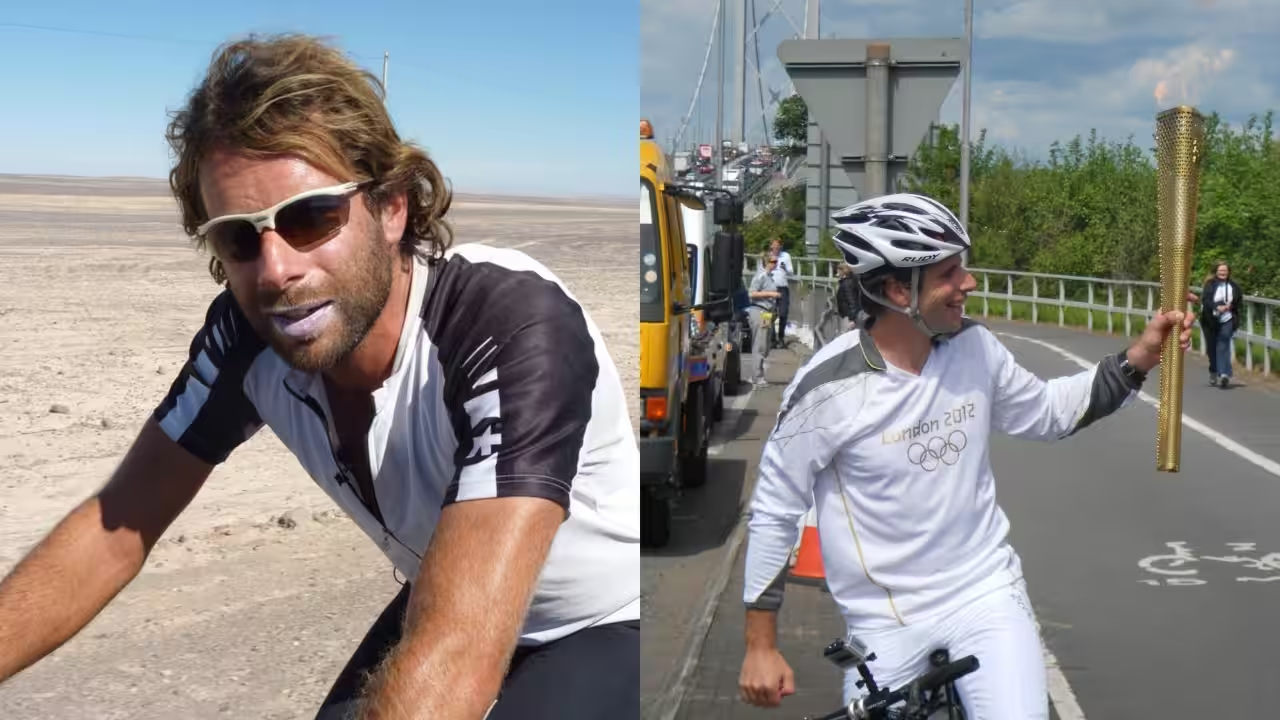
Long before ultra-endurance sport became a global spectacle, crossing the world on two wheels was the domain of the odd and the dreamer. Record keepers had been tracking efforts at this achievement for decades, and the bar kept moving as riders pushed further into the unknown with little more than paper maps, panniers and persistence. A young man from rural Fife, a man who had spent his childhood cycling throughout Scotland for enjoyment, stepped into that bloodline in the summer of 2007. What came next would see him become one of the defining figures in endurance riding and rewrite what people thought was physically feasible on a bicycle.On 5 August 2007, Mark Beaumont left the Arc de Triomphe in Paris on a laden touring bike with an objective that appeared almost reckless for someone who had never attempted anything on this scale before. He planned to ride about 100 miles a day, alone and unsupported, until he had travelled round the globe and got back to where he started. His bicycle, a Koga Miyata with a Rohloff internal gear hub, was loaded with around 30 kilogrammes of tools, spare parts and video equipment, since he was chronicling the voyage himself for what would become a BAFTA nominated BBC film. Cycling UK, the membership club that has long backed British riders on just this sort of personal endeavour, later published his own report of how three years of planning went into that single departure from Paris.A path through hardshipBeaumont’s journey carried him east via Europe and Russia, through Central Asia and the Indian subcontinent, across Southeast Asia and Australia, and then across North America before one more trans-Atlantic trip back to France. It was a tough trail, and preparation wouldn’t make it easier. In Lafayette, Louisiana, he was hit by a car and robbed later that same day, an experience that would have killed most people’s endeavours on the spot. Elsewhere he fought illness and the sort of physical disintegration that comes from sixteen or more hours a day in the saddle for months on end without rest. He’d also meant to be a vegetarian but had little choice but to give that up during the ride simply to keep enough calories going in to survive the daily mileage.It’s not only the distance but also the isolation that makes the achievement exceptional. Throughout the ride, Beaumont had no support car, no mechanic and no chef. If his gear broke or his body let him down, he had to tackle the problem himself, often in isolated parts of Pakistan, Iran or the Australian outback where help was hours or days away. He used paper maps in an age when smartphone navigation didn’t even exist for bikes and had his mother back home assist him in plotting alternative routes if roads were blocked.Rewriting the recordOn 15 February 2008, Beaumont cycled back past the Arc de Triomphe, having completed almost 18,000 miles in 194 days and 17 hours. That broke the previous world record by 81 days, a margin so vast that even veteran endurance athletes who had thought the mark would stand for years were startled. His accomplishment was officially validated, and the lineage of riders who chased and ultimately beat his time is still recorded on the official Guinness World Records page for the quickest circumnavigation by bicycle. Other cyclists would eventually beat Beaumont's own record, such as Vin Cox in 2010, before Beaumont himself recaptured the supported version of the championship in 2017 with a specially organised support squad, further lowering his own original time.But it is the 2007 solo ride that attracted public attention, because he did it without a safety net. Beaumont then returned to his old university, the University of St Andrews, to speak to students about the trip. He didn't frame it as some prank, but as proof that ordinary preparedness, stubbornness and a tolerance for discomfort might take a person further than nearly anyone expected. The ride raised £18,000 for charity and he utilised the platform it established to launch a series of additional expeditions including the length of the Americas trip from Alaska to Argentina and a solo unsupported crossing from Cairo to Cape Town.Nearly two decades later, Beaumont's original circumnavigation is still cited as a moment when unsupported round-the-world cycling moved from an oddity to a recognised branch of endurance sport, inspiring later solo riders like Jenny Graham and a wave of amateur cyclists who attempt similar routes every year. It’s not just the miles that keep the story alive, but what it said about the extremes individuals will reach when curiosity and discipline collide.Catch the latest World News and Live updates. Download the TOI app.
Topics in this story
Gathered from external sources. Rights to this text belong to whoever originally published it.