In 1851, ranchers placed sheep on California’s Santa Cruz Island; about 150 years later, survivors were smaller, hardier and had lost wool from their bellies
US News: Discover how a flock of sheep on California's Santa Cruz Island evolved over 150 years, developing unique traits in response to their harsh environment, and the efforts to preserve their genetically distinct lineage.
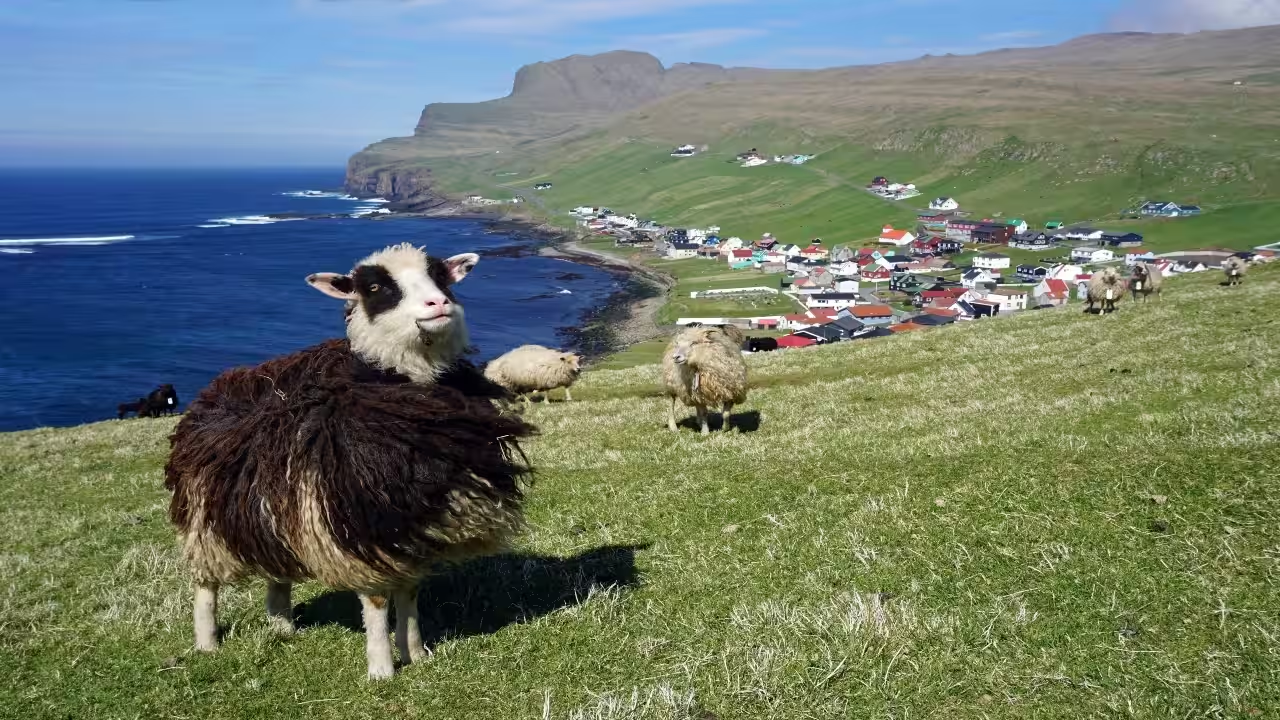
The largest of the eight Channel Islands strewn along the coast of Southern California is Santa Cruz Island, which is located off the coast of Santa Barbara. It's a rocky, windy, and mostly predator-free habitat that has subtly influenced the biology of everything that has survived there, including exotic flora and native foxes. A single flock of sheep left to fend for themselves over several generations with virtually little human supervision is one of the best-documented examples of that shaping process.Sheep were established on Santa Cruz Island by the 1800s, with local accounts placing their arrival in the early part of that century. During the 1850s, French Merino sheep were added to the island's herds, alongside earlier Spanish-derived stock. According to a history compiled by the Livestock Conservancy, the animals were probably descended from Merino, Rambouillet, and possibly Churro stock, breeds much esteemed at the period for their thick, high-grade wool. A series of owners continued ranching throughout the nineteenth century, and at its height, some estimates placed the number of sheep grazing mostly unfettered across the island's landscape at tens of thousands.Left to fend for themselvesThe change came with the waning of commercial ranching on the island in the twentieth century. Eventually large portions of Santa Cruz Island were retired from active cattle and sheep operations and shearing all but ceased in areas of the island as owners focused their attention elsewhere. Without regular supervision a lot of the sheep just went feral, breeding without veterinary care, without selective mating, and without protection from the elements beyond what the landscape itself gave them.The sheep lived through hot, dry summers and variable winters on marginal forage, while generations of unmanaged breeding exposed the population to strong environmental pressures. The resulting changes included smaller body size and altered wool traits. Researchers have suggested that these traits may have been favored because they improved survival under the island's conditions.A measurable shift in the flockThat research eventually produced strong scientific evidence for exactly how much the sheep had changed. Wildlife biologist Dirk Van Vuren examined the feral population and published his findings in the Journal of Zoology, describing what they termed rapid morphological change in an island population of wild sheep. Their investigation, together with decades of field observations on the island, indicated that the animals were far smaller than mainland domestic sheep but also significantly more hardy, with fewer birthing difficulties and a greater tolerance of poor grazing circumstances.Perhaps the most visible change involved wool itself. Breed records kept by Oklahoma State University's animal science programme note that Santa Cruz Island sheep tend to carry little or no wool on their bellies, faces and legs, a stark contrast to the heavily fleeced Merino and Rambouillet ancestors from which they descended. Without regular shearing, a full wool coat can be a burden during hot, dry summers on the island, trapping heat and moisture in ways that disadvantage unmanaged animals. It appears that sheep with less cover naturally in certain places have done better generation after generation and eventually become the most common pattern throughout the flock.Preserving a breed shaped by neglectBy the late twentieth century, conservation groups had begun to acknowledge the feral flock as the rarity of a genetically unique population that had developed its own breed through a century and a half of natural selection rather than artificial cultivation. That realisation occurred as the sheep’s very presence on the island was becoming an ecological hazard in its own right, with decades of unrestrained grazing having harmed native vegetation that environmentalists were trying to restore.In 1978, the Nature Conservancy purchased most of the island and began an effort to completely remove the sheep so that the ecology could recover. The Livestock Conservancy worked with the Nature Conservancy to capture and transfer breeding animals instead of merely wiping out the herd. To preserve the lineage, in 1988 twelve lambs were flown off the island and placed with breeders on the mainland. Further removals continued through the 1990s, and the remaining feral sheep were finally removed from the island in 1999.Today, Santa Cruz sheep survive in conservation flocks maintained by a small network of breeders on the mainland. The population remains rare, and conserving the breed requires continued participation from dedicated breeders. With their small bodies and bare bellies, they show how a century and a half of isolation and unmanaged breeding can shape a domestic animal.Catch the latest World News and Live updates. Download the TOI app.
Topics in this story
Gathered from external sources. Rights to this text belong to whoever originally published it.