Wrexham dog owners fear contaminated land contributed death
Donna and Pete O'Brien say Misty's health declined after a walk.
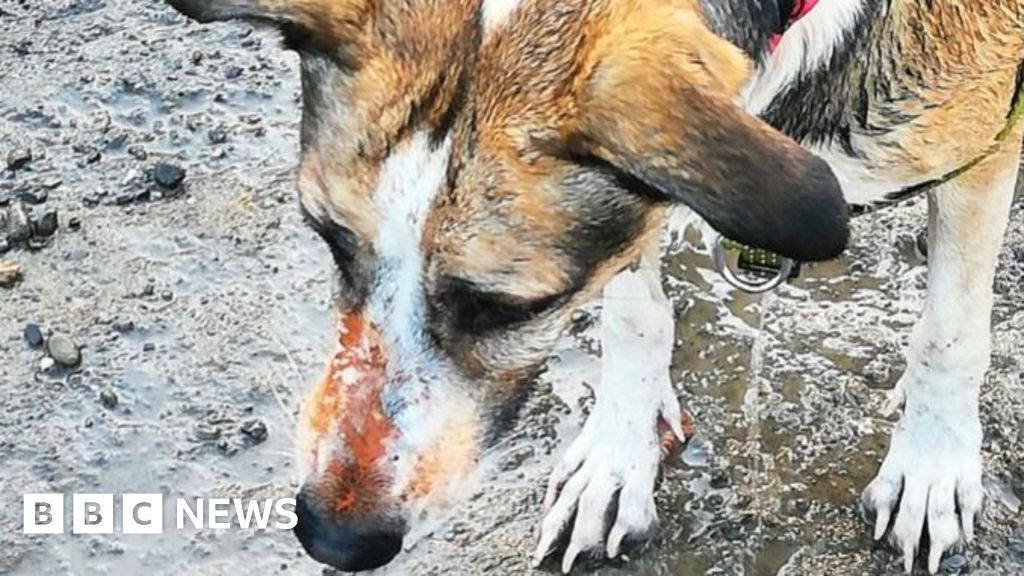
A couple say their dog may have died after being exposed to an orange substance on contaminated land during a walk.
Donna and Pete O'Brien noticed Misty's health deteriorating rapidly after wading through a swampy pool close to the Cefn Viaduct near Wrexham.
She started to cough up blood and then, around the time of her death, an ultrasound revealed that she had a heart tumour, which affects just 0.19% of dogs.
Donna and Pete said they believe it was linked to the historical chemical dumping that was recently explored in the BBC's Buried documentary, and they are calling for the examination of pet records to see if there are any clusters of rare illnesses.
Donna said they did not think much of it at the time after going for a walk near Ty Mawr in December 2019.
Misty loved to run in the mud and swamps, but on this occasion, she came back "covered in a sort of greasy orange film".
"At the time you think it might be copper or iron washing down through the landscape but it stank and it was sort of oily all over her coat," Donna added.
They vowed not to go back after the orange substance stained Misty for weeks, but the four-year-old dog, who had always been an "really healthy dog", soon became sick.
Vets records show that she started to have periodic diarrhoea and vomiting and by 2024, then aged nine, Misty was struggling.
"She would get to the end of a walk and just stop for a while," said Pete.
"It was unusual but I put it down to her wanting to stay out a bit longer."
Misty started to cough up blood and expel it from her nose, with an ultrasound scan showing a growth – believed to be a tumour – on her heart and potentially others on her stomach and lungs.
Pete said they were watching the Buried documentary, which premiered in August 2026, when they saw something that made them "sit up and take notice".
"People were describing substances similar to what we washed off Misty – greasy, oily orange deposits.
"Then we went to the meeting of the Monsanto Contamination Action Group and heard more stories that resonated."
He said it was worrying for the many visitors that go to Ty Mawr who might be unaware of the risk, and it has left them with "so many questions" about Misty's health.
"That's why we feel that as well as human medical records, pet medical records need to be examined for clusters of rare illnesses," Pete added.
Pete and Donna believe that due to many suspected or undocumented dump sites and water run-offs being in public rural areas, pet health data may provide more evidence of the impact of "forever chemicals" on communities.
"Illnesses that take decades to develop in humans often progress much quicker in animals," said Pete.
"There are so many sites. Who knows what we and they are being exposed to.
Their concerns were raised at a Wrexham council meeting by councillor Derek Wright.
He called for significant changes to monitoring and management of the contaminated sites that were "just a stone's throw" from the Ty Mawr Country Park.
During the meeting he questioned why the areas have a fence that is "only three foot" with no sign saying that chemicals are there, or why it was fenced off.
He said one of the ponds has since become a public footpath and that dog walkers and family frequently walk across them, despite no "publicised tests of what is in those lagoons, or what used to be lagoons".
A spokesperson for Wrexham council said investigations indicated deposits came from mining activity.
"We have inspected the area with Natural Resources Wales and they have undertaken liaison with the Coal Authority – we are satisfied there is no requirement for any further action to be taken," he said.
Uni Instagram 'banter' account under fire for 'perpetuation of rape culture'
'People use AI to avoid paying for school photos, but they don't realise the consequences'
Millions of bedbugs crawl out of mattresses and walls in huge outbreak
Topics in this story
Gathered from external sources. Rights to this text belong to whoever originally published it.