Award-winning video of child’s lungs sparks AI controversy: What gave it away, and how did it differ from the original?
Imagine looking through a microscope and discovering a world that seems almost impossible.
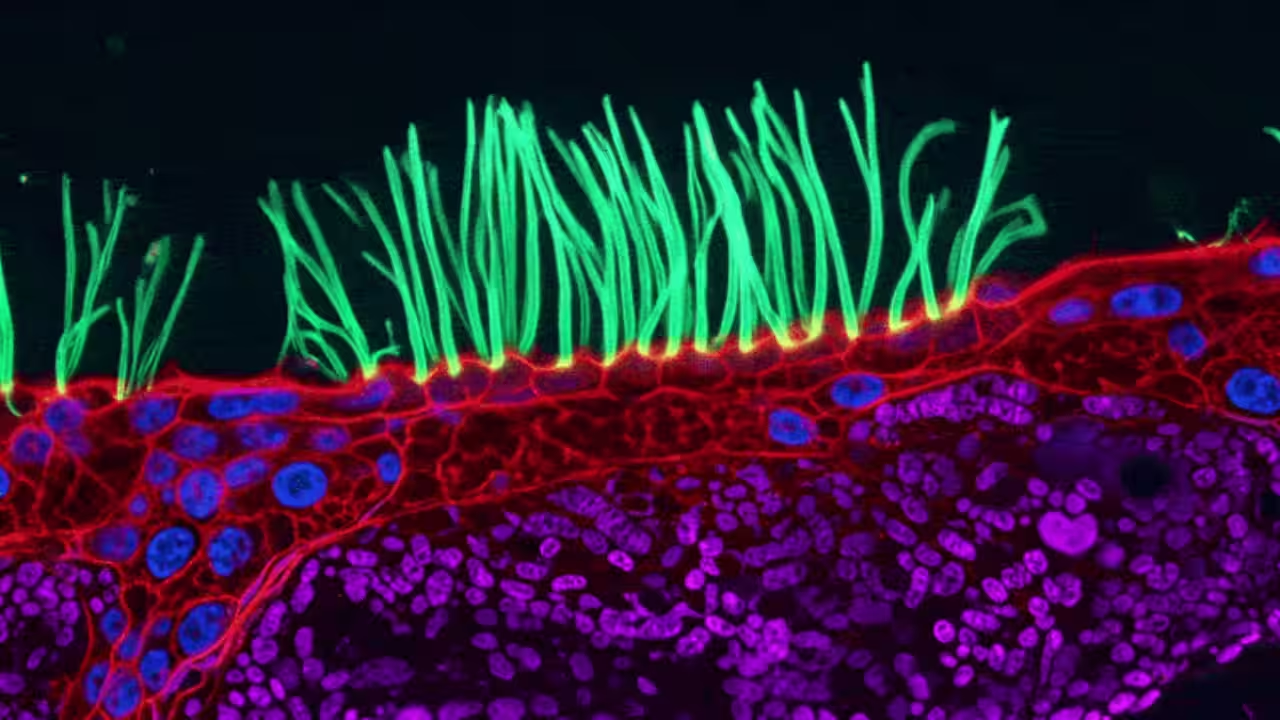
Imagine looking through a microscope and discovering a world that seems almost impossible. Tiny hairs sway above a colourful landscape of red, purple and blue structures.But then a scientist notices something odd. Some structures seem to appear and disappear. Others move in ways that do not make biological sense. What looks like a remarkable window into the human body may be showing viewers something that the underlying experiment never actually established.That question turned a prize-winning microscopy video into an international scientific controversy. The video, which showed tiny hair-like structures called cilia in the airway of a child with a rare respiratory condition, was initially declared the winner of Nikon’s Small World in Motion competition. On October 9, 2026, Nikon disqualified the entry after concluding that it violated the contest’s rules on generative artificial intelligence.What was the award-winning video supposed to show?The video was submitted by Dr Ning Xu, an optical engineering researcher whose work was associated with Tsinghua University in China. It was presented as footage of beating airway cilia taken from a child with primary ciliary dyskinesia (PCD), a rare inherited condition that affects the way cilia are formed or function.Cilia are tiny, hair-like projections found on cells lining parts of the respiratory tract. They move in coordinated waves, pushing mucus towards the throat so the body can clear dust, bacteria and other particles trapped in it. When cilia do not work properly, mucus can build up in the airways. People with PCD may experience repeated lung, sinus and ear infections, and some develop lasting lung damage. The US National Heart, Lung, and Blood Institute estimates that the condition affects around one in 10,000 to 30,000 people.Watching cilia under a microscope can help specialists investigate the condition. Their shape, length and movement can offer important diagnostic clues.That is what made the video so compelling. It appeared to turn an invisible biological process into something viewers could see with their own eyes.What gave the video away?According to Nature, microscopy specialists began questioning the video soon after it was announced as the winner in September 2026. Their concerns centred on structures beneath the cilia that appeared biologically implausible.Edward Phelps, a bioengineering researcher at the University of Florida, raised questions about the purple structures. They appeared to resemble mitochondria, the components of cells that help produce energy. Yet their apparent size, arrangement and location did not make sense as the structures they seemed to represent.Other researchers questioned the blue and red features. Some structures appeared to change or disappear abruptly, while others seemed to move in ways that scientists would not expect from the biological material being shown.Dr Robert Hirst, a University of Leicester scientist who works on diagnosing PCD, also questioned the footage. Speaking to the BBC, he said the cells and cilia did not resemble those he had seen in patients with the condition.How was the AI version different from the original?Xu acknowledged using an unsupervised neural network for AI-assisted post-processing. He said the model was applied to reconstructed greyscale data to distinguish and colour structures with similar appearances. He maintained that AI had not generated the experimental movie, the cilia or their movement.In other words, he disputed the suggestion that the entire recording had been invented. His explanation was that AI had been used after the initial imaging to improve the visual presentation of features beneath the cilia.Why Nikon withdrew the awardNikon’s Small World in Motion competition celebrates videos made using light microscopes. Its rules explicitly prohibit AI-generated videos and allow the organisers to request original footage for verification.After the questions about Xu’s entry emerged, Nikon reviewed the video, supporting material and feedback from members of its judging panel.On October 9, the company said it had determined that the winning entry did not comply with its rules on generative AI. It disqualified the video and updated the rankings.The new first-place winner was Nguyen Nam Nhat of Vietnam, whose video featured a tiny roundworm and a single-celled organism called Dileptus.Nikon said its decision concerned the entry’s eligibility under the competition rules. It stressed that the decision should not be interpreted as a judgement of Xu’s professional reputation, scientific contributions or intent. "After thoroughly re-evaluating the video and supporting materials and consulting with members of our judging panel, Nikon has determined that the winning video did not comply with the competition rules regarding generative AI. Nikon has adjusted the competition rankings to reflect this decision," it said.The company also acknowledged that advances in imaging and AI had created new challenges and said the incident highlighted the need to revisit its rules and evaluation procedures.The bigger question: Can we still trust what we see?The controversy has consequences beyond one competition. Scientific images help researchers communicate discoveries, teach students and explain illnesses to patients and families. Their power comes partly from the belief that they represent something observed in the real world.AI may become a valuable tool for scientific imaging. It can help analyse complex data and make difficult-to-see structures easier to examine.A microscope can reveal a world that the naked eye cannot see. AI can make that world easier to understand. But if the processing creates structures that viewers mistake for biological facts, the image risks becoming less informative precisely because it looks so convincing.Get the latest movie news, reviews, and celebrity updates. Download the TOI App.
Topics in this story
Gathered from external sources. Rights to this text belong to whoever originally published it.