After falling for his family's Ontario farm, William Shotyk spent 50 years restoring it, planting 25,000 trees; now, 145 bird species and bald eagles live there
Discover how William Shotyk transformed a barren 72-acre Ontario farm into a thriving wildlife sanctuary over 50 years, planting 25,000 trees and attracting 145 bird species, including majestic bald eagles.
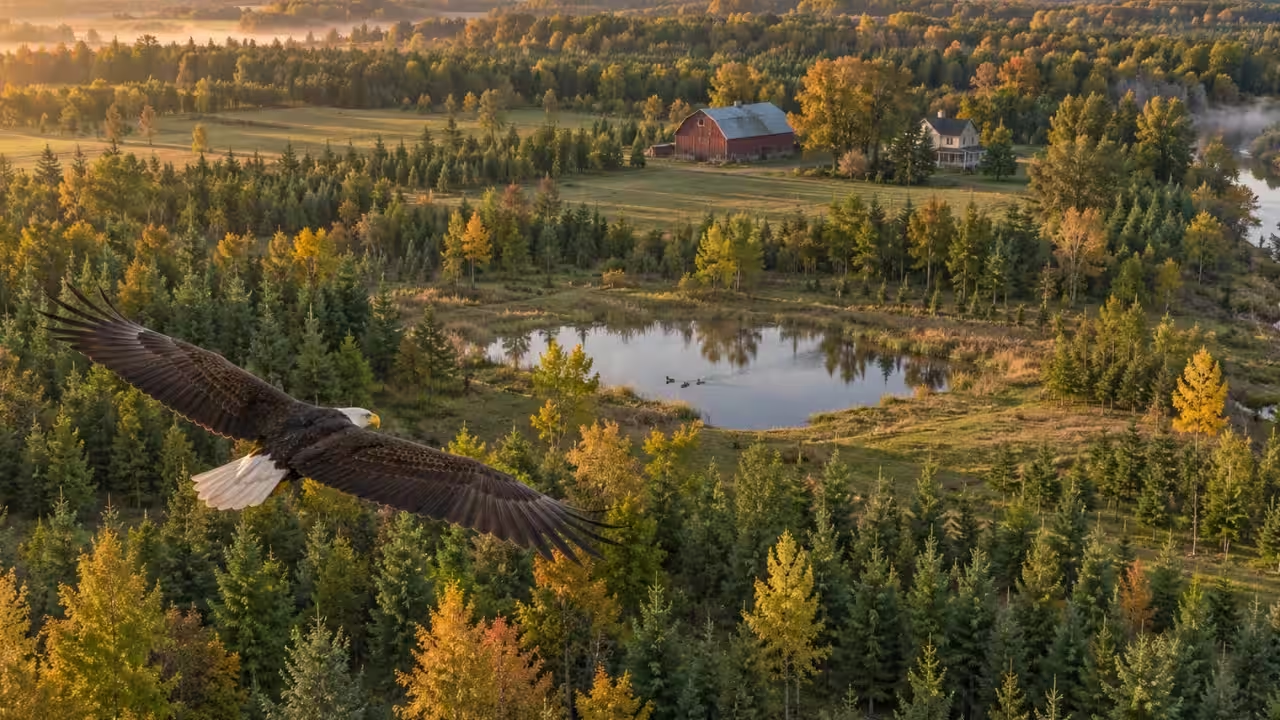
For most of us, there is probably a place from our childhood that we hope to return to someday. Few of us spend 50 years taking care of it. William Shotyk did exactly that. In October 2025, BarrieToday reported on his talk in Elmvale, Ontario, where the University of Alberta professor explained how he turned a bare 72-acre farm into a wildlife home. It all started when he was a Grade 8 student from Toronto who asked his father to purchase the land.A teenager’s request and a summer of plantingBarrieToday reports that Shotyk’s father purchased the farm as per his wishes. The University of Alberta’s Folio news site dates the purchase to 1972. Shotyk began planting in 1975, when he was still in high school. In that summer, he planted 2,000 trees of white spruce and red oak. “That's really when I fell in love with the farm,” he told the audience. After some time, he returned with 16 friends and planted 5,000 more seedlings at a penny each. The group slept in the old hay barn. His studies and research work kept him away from the farm, taking him to Europe and later Alberta, where he has been a professor since 2011. Before moving to Europe, he entered into an agreement with the natural resources ministry of Ontario under which the ministry would plant almost 14,000 spruce trees on the farm.More than 25,000 trees and a bold carbon claimThe farm now has more than 25,000 trees, from more than 50 species. By 2012, Folio reported, Shotyk had planted more than 25,000 trees with the help of family and friends. Shotyk says trees provide shelter for crops and livestock buildings, conserve moisture, and offer a home for birds that eat insect pests. They also suck carbon dioxide out of the air, he adds. The concentration of carbon dioxide rose from 315 parts per million when he was born in 1958 to 426 at the time of his talk. He believes that planting so many trees has cancelled out his personal carbon footprint for the next 300 years. That figure is his own estimate, so best read as his view rather than a verified fact.Frogs, turtles, and 145 kinds of birdsShotyk teamed up with Ducks Unlimited in 2016 to build a wetland on the farm. In the fall, it was nothing more than just a hole in the ground. However, by the following spring, it was full of water, and frogs showed up almost immediately. Then there were waterfowl, followed by a painted turtle, and eventually snapping turtles. Shotyk explains that he has no clue how the painted turtle discovered the wetland. The farm has hosted 145 different bird species, including bluebirds, meadowlarks, green herons, and trumpeter swans. The ultimate reward, he said, was a pair of bald eagles that showed up first in 2024.Why the bald eagles matter so muchShotyk says the eagles are important because DDT, a man-made insecticide that was once widely used for pest control, nearly wiped them out. In the early 1960s, he said, almost nobody would have seen a bald eagle in Elmvale. A 1982 study in the journal Science showed that the birds struggled, then bounced back. It followed eagles in northwestern Ontario, where the number of young per breeding area dropped from 1.26 in 1966 to 0.46 in 1974, then rose to 1.12 in 1981. The study was done in another part of Ontario and reflects the larger trend, not the Elmvale birds. Shotyk's farm is just one small patch of land, but it shows what decades of steady work can help bring back.You use AI every day. Now get your AI Quotient. Take the AIQ test.
Topics in this story
Gathered from external sources. Rights to this text belong to whoever originally published it.