In the early 1970s, schoolchildren released rabbits on an abandoned Japanese island; 50 years later, DNA suggested other people had repeatedly left unwanted pets there
Rest of World News: Discover the complex history of Okunoshima, Japan's Rabbit Island, where DNA testing unveils evidence of multiple introductions of domestic rabbits amidst a background of war and tourism.
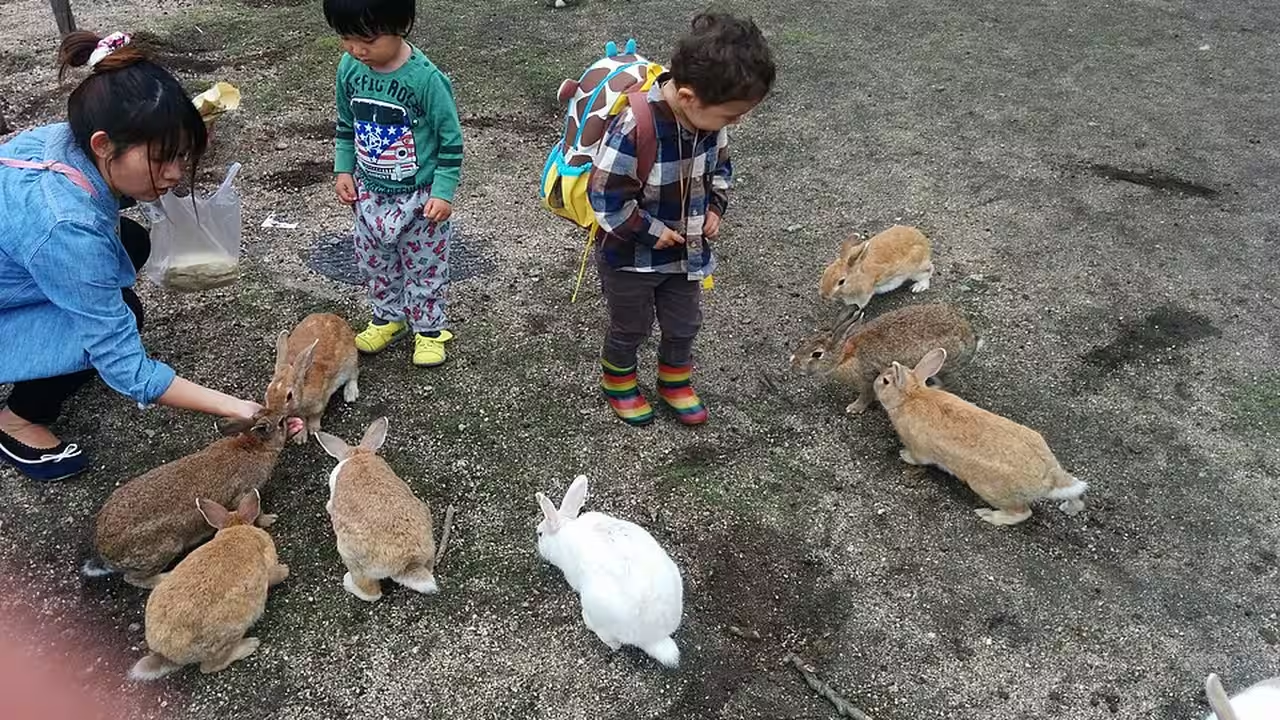
A small island in Japan’s Seto Inland Sea is now known as “Rabbit Island”, but its past is far darker. From 1929 until the end of the Second World War, the island was used by the Japanese Imperial Army for the secret production of poison gas. Today, hundreds of free-ranging European rabbits roam the island, drawing visitors who come to feed and photograph them.Eight rabbits and a mysteryThe most widely accepted account places the beginning of Okunoshima’s present rabbit population in 1971, when eight rabbits kept at a school were released on the island. Japan’s Environment Ministry says the release of eight rabbits that could no longer be kept at the school is considered the starting point of the island’s rabbit population. The animals were European domestic rabbits, rather than a species native to Japan. Nevertheless, another theory has followed the rabbits for decades. Because of the island’s history as a secret chemical weapons production site, a story has circulated that today’s rabbits are descendants of animals used in wartime experiments. This theory has never been proven. Rabbits were indeed used as test animals at the poison-gas facility, but accounts of their fate after the war differ. Some reports claimed that the test rabbits were released when the factory closed, while other accounts said they were killed or euthanised.Genetic research has made the rabbits’ origins even more intriguing. Rather than finding a clear genetic signature pointing to a single group of founders, researchers found evidence consistent with the population forming through multiple introductions over time. The scientists also noted considerable variation in the rabbits’ coat colours and types. According to the Journal of Ecotourism, the genetic evidence and the diversity of rabbits found on Okunoshima are consistent with the possibility that domestic rabbits were introduced to the island on multiple occasions. The findings do not establish the precise origin of every rabbit, but they suggest that the population may have been shaped by more than a single release.When tourism changed the islandAccording to Fukushima University, Okunoshima’s development as a tourist destination added another dimension to its relationship with the rabbits. The island is part of Setonaikai National Park, established in 1934, and developed as a leisure destination in the following decades. As its reputation as Rabbit Island grew, visitors began arriving specifically to see and feed the animals. Today, the rabbits rely at least partly on food supplied by people, and their population appears to be associated with tourism. Visitor numbers fell during the COVID-19 period, and rabbit numbers declined at the same time, which suggests the animals may have relied in part on food provided by tourists.The growing rabbit population has also created ecological pressures. Okunoshima has limited natural vegetation, while food provided for the rabbits can attract other animals. Researchers found that wild boars eat food intended for the rabbits and sometimes attack them. They also found that food provided to the rabbits could be encouraging this behaviour among wild boars, although they could not establish a direct causal link.A paradise with a complicated pastToday, visitors to Okunoshima encounter free-ranging rabbits alongside the remains of the island’s wartime poison-gas facilities. For years, the accepted account of the rabbits’ arrival was straightforward: eight domestic rabbits that had been kept at a school were released on the island in 1971 and multiplied over the following decades. But recent genetic evidence has complicated that story, suggesting that the present population may have been shaped by multiple introductions rather than a single release.The island’s history reflects several stages of human influence. Wartime poison-gas production altered Okunoshima’s landscape, while the introduction of domestic rabbits brought a non-native animal into its environment. Tourism later created another connection between people and the rabbits, with visitors supplying food that may have influenced the population. Visitor numbers fell during the COVID-19 period, and rabbit numbers declined at the same time, which suggests the animals may have relied in part on food provided by tourists. Okunoshima’s rabbits are therefore closely tied to both the island’s wartime past and the tourism that grew around them.Catch the latest World News and Live updates. Download the TOI app.
Topics in this story
Gathered from external sources. Rights to this text belong to whoever originally published it.