US tries new Sudan strategy as war fueled by ‘external actors’ drags on
The Trump administration is signaling a change in course on Sudan, facing months of failed diplomacy to achieve a ceasefire in the more than three-year conflict, a fight largely between two main warring factions but supported by a constellation of international backers. The U.S. is pushing at the United Nations Security Council a proposal to…
The Trump administration is signaling a change in course on Sudan, facing months of failed diplomacy to achieve a ceasefire in the more than three-year conflict, a fight largely between two main warring factions but supported by a constellation of international backers.
The U.S. is pushing at the United Nations Security Council a proposal to expand an arms embargo to the whole country, broadening it well beyond its current single region. The plan comes up for a vote Thursday.
The U.S. proposal proved polarizing, and divisions came to a head in September, when the Security Council only managed to extend the arms embargo on Sudan’s western Darfur region — a 21-year-old measure called Resolution 1591 — for one month, until Oct. 9. It was the shortest extension ever issued for 1591.
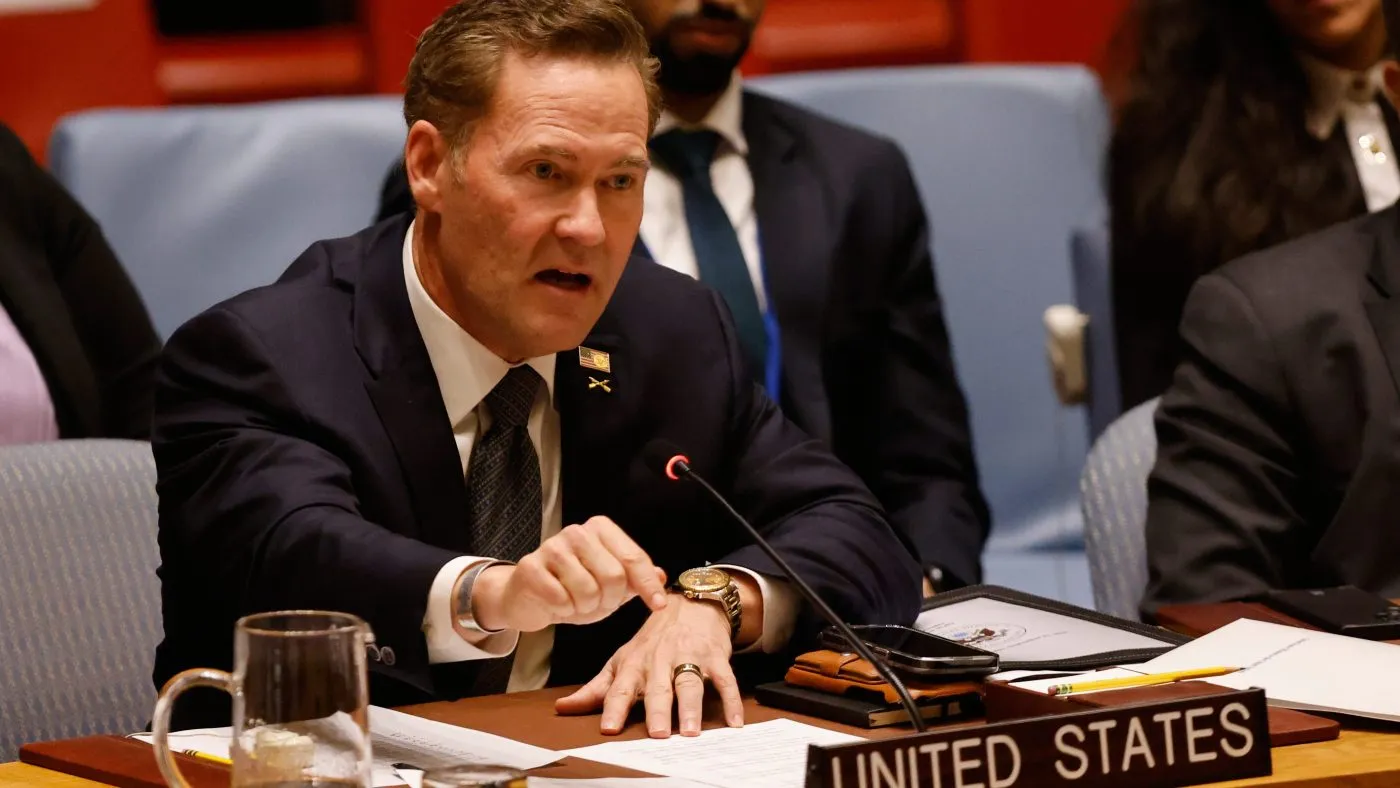
“The entire country is awash with weapons. Our position is that neither side needs additional weapons,” Ambassador to the U.N. Mike Waltz told Foreign Policy late last month.
The Trump administration argues that expanding the arms embargo to the whole country allows for the U.N. to take a fuller picture of violations and networks moving weapons and to document who flouts the embargo.
The proposal has put the U.S., United Kingdom and their backers on one side, and China, Russia and their backers on the other. It’s not clear if opposition among the veto-wielding permanent members could tank 1591 in its entirety.
While Resolution 1591 has failed to stem weapons flows into the country, it is useful for its Panel of Experts, which monitors and reports on violations while recommending people and entities for sanctions.
The U.S. proposal would add new pressure on Sudan’s Armed Forces (SAF), which is fighting the breakaway paramilitary group the Rapid Support Forces (RSF), by expanding the reporting requirements in 1591. The most recent report provided details on how the territory of the United Arab Emirates is a key link in arms transfers to the RSF — which Abu Dhabi rejects — but that investigations into the SAF’s procurement network, particularly drones, are “preliminary.”
Expanding 1591 gained the backing of a group of Senate Democrats, who wrote a letter to the administration to urge that reporting requirements include “explicit documentation of all violations of the arms embargo and the parties responsible.”
“Countries who blatantly circumvent the arms embargo and other UN restrictions to prolong the conflict cannot be permitted to continue hiding their role and must be publicly held to account for their actions,” they wrote.
Although it’s not a secret who is backing the main warring parties in Sudan’s war.
Saudi Arabia and Egypt lead a larger coalition supporting SAF Gen. Abdel-Fattah al-Burhan, while the United Arab Emirates is the main backer of Burhan’s former deputy, Gen. Mohamed Hamdan “Hemedti” Dagalo, as head of the paramilitary group the RSF.
Those three countries, along with the U.S., are part of a “Quad” group that proposed a ceasefire in September 2025 that has failed to take root. A renewed push in July for a 90-day truce stalled in the face of SAF demands that the RSF withdraw from cities it has occupied since May 2023.
“Every time it seems like we’re on the verge of making progress, one side or the other will back off because they think they’re winning or they think they could win,” Secretary of State Marco Rubio told reporters on the sidelines of the United Nations General Assembly in September.
Sudan’s war is the world’s worst humanitarian crisis. At least 150,000 people are believed to have been killed , with some killing campaigns amounting to genocide, according to U.N. monitors and a U.S. determination.
More than 33 million people require assistance and 9 million people are displaced inside the country, with more than 4 million refugees and “irregular arrivals” to Europe increasing . The United Nations’s appeal for nearly $3 billion in humanitarian aid for Sudan is only 43 percent funded .
The SAF has gained some battlefield momentum. The army-appointed prime minister declared victory in the war over a year into retaking the capital, Khartoum, during a visit by The Hill in April .
Sudanese Armed Forces made further significant territorial gains over the summer, according to the Armed Conflict Location and Event Data Project (ACLED). But an escalating air and drone warfare campaign is having an outsize impact on civilian casualties, with 1,000 people killed in drone attacks in the first half of 2026.
The SAF and countries backing it say the U.S. push for a country-wide arms embargo unfairly draws equivalency between the SAF and RSF. Both sides are accused of carrying out war crimes, but the RSF’s siege on the city of El Fasher was determined a genocide by the former Biden administration.
“The council must preserve the distinction between the national armed forces of a sovereign state and a militia accused of mass atrocities and genocidal violence,” Pakistan’s ambassador to the United Nations, Asim Iftikhar Ahmad, said during a Security Council meeting in August. Pakistan is one of the 10 nonpermanent members that will vote Thursday on whether to expand 1591.
The SAF and its backers further took exception when the U.S. reportedly conditioned a visa for Burhan to attend the U.N. General Assembly in September in exchange for accepting the ceasefire, according to Reuters.
The Saudis reportedly threatened to exit the Quad over the Burhan snub, according to The Africa Report.
In an apparent effort to smooth relations, Massad Boulos, Trump’s point person on Sudan and father-in-law to the president’s daughter, highlighted that he was in the same meeting space as Burhan during a luncheon in Egypt on Sunday.
A Sudanese government official told The Hill that no meeting took place and that Burhan did not exchange any words with Boulos.
Taken together, the U.S. is signaling increased pressure on the SAF, said Areig Elhag, Arabic content editor at The Washington Institute for Near East Policy, signaling a strategy focusing on who can legitimately govern Sudan in its next phase.
“The RSF already has very limited political legitimacy inside Sudan, but the SAF has continued to represent Sudan in many international and regional institutions,” she said.
“So the U.S. position is significant because it is also moving away from the idea that the SAF should automatically be treated as the legitimate political authority. So the pressure is mainly on SAF.”
Burhan seized his authority as president of the country’s Transitional Sovereignty Council in a 2021 coup, which initially included the RSF’s Hemeditti. At that time, the civilian head of the transitional government was Prime Minister Abdallah Hamdok.
Hamdok, in an interview last week with Al Monitor during a visit to Washington, D.C., said the Trump administration appears to be applying greater pressure on the SAF and RSF, shifting from what he described as a “soft” approach.
“I do not think these generals respond to niceties,” Hamdok told the outlet . “They need to be told bluntly that there are consequences to what they are doing.”
But the U.S. is still holding back public pressure on the war’s international backers. Rubio, during his appearance at the UN in September, said naming and shaming those countries would contribute to “friction.”
“There are external actors. I’m not going to single them out. You know who they are. I don’t want to create any more friction than there needs to be created,” he said.
“But that war and that conflict and that crisis would not be happening were it not for the active participation of external actors that are feeding one side of that conflict or another.”
The refusal to call out the countries enabling Sudan’s war is only one of the many confusions and contradictions of the Trump administration’s policy toward Sudan and overlapping crises in the Horn of Africa, said Michelle Gavin, senior fellow for Africa policy studies with the Council on Foreign Relations, said of the U.S. proposal.
“There’s something a bit through the looking glass about these repeated Quad statements about the need for external actors stopping their support for the war , signed by the external actors supporting the war,” she said.
“It really, to me, looks like a total unwillingness to take on very, very deep-pocketed potential partners in some of this, the deal making, that seems to be part and parcel of U.S. foreign policy these days.”
Topics in this story
Gathered from external sources. Rights to this text belong to whoever originally published it.