In 1997, Texas researchers poured fluorescein into Dry Fork Sink to map Austin’s hidden aquifer; it travelled at least 4.8 miles to Barton Springs in under 30 hours
US News: In a groundbreaking study, Texas researchers injected fluorescein into Dry Fork Sink, uncovering a rapid 4.5-mile water connection to Barton Springs in under 30 hours. This innovative technique sheds light on the Edwards Aquifer's surprising groundwater flow dynamics and has crucial implications for water quality management.
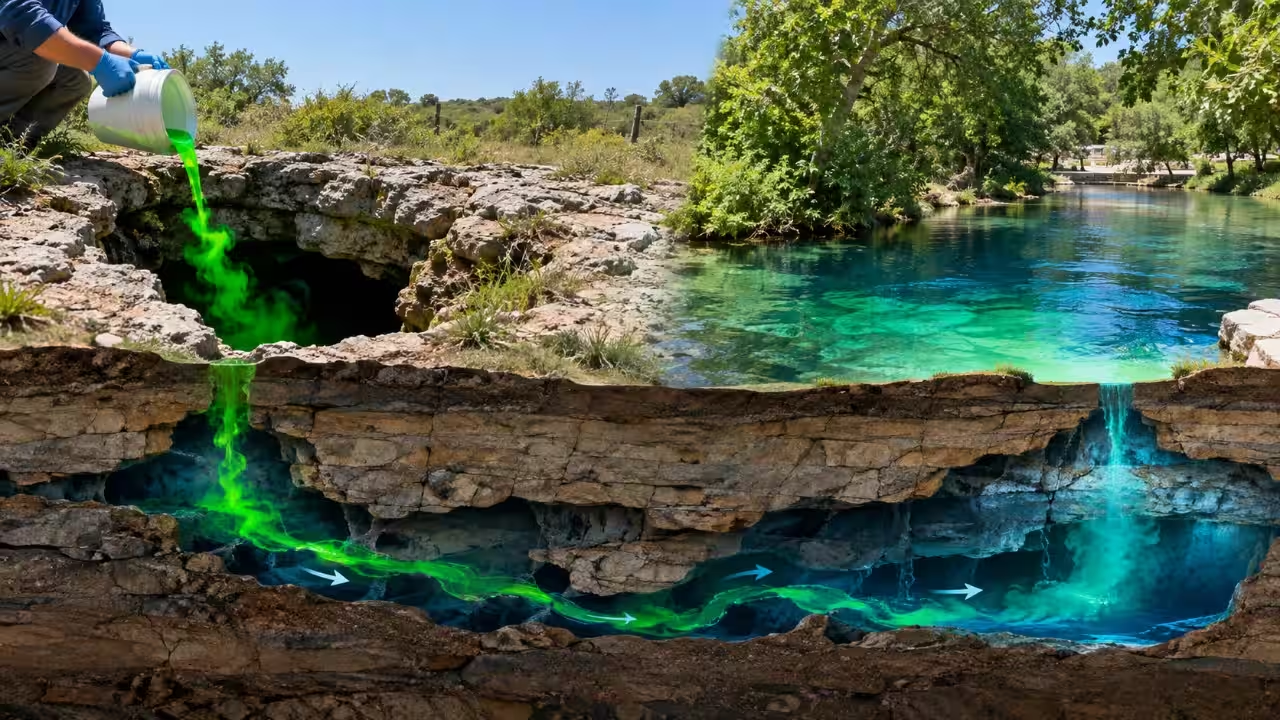
To understand where water was travelling beneath Austin, researchers used a technique that could make an invisible journey visible. According to the Barton Springs/Edwards Aquifer Conservation District, researchers injected three pounds of fluorescein dye into Dry Fork Sink on June 17, 1997, at 9 am. The sink is located on Kitcheon Branch, a tributary of Williamson Creek, in Sunset Valley, and was used as a natural recharge feature of the Edwards Aquifer. Researchers poured the dye into water entering the sinkhole and later detected it at Barton Springs, demonstrating a rapid underground connection. The report notes that fluorescein was one of several non-toxic organic dyes selected for groundwater tracing because of its suitability and safety for drinking-water supplies and aquatic habitats.A dye trail beneath the cityThe fluorescein travelled underground and was detected at Barton Springs in under 30 hours. The original tracing report gives the minimum distance to the detection point as about 4.8 miles, while an accompanying account puts it at 4.5 miles. Either way, the experiment demonstrated a rapid connection between Dry Fork Sink and the springs. This result mattered because the Edwards Aquifer does not behave like a conventional underground reservoir, where water seeps slowly through tiny spaces between sediment grains. It is a karst system carved into limestone that has fractured and dissolved over geological time. Water can therefore find preferential routes through openings and interconnected conduits, allowing it to travel much faster than might be expected from ordinary groundwater movement.According to research published in the Journal of Contemporary Water Research & Education, a long-distance groundwater-tracing programme began in 1996 and used injected tracers to map groundwater basins and underground flow paths in the Barton Springs segment of the Edwards Aquifer. Results from 40 groundwater traces, 88% of which were successfully recovered, showed that groundwater can move rapidly through the karst aquifer, with mean residence times of about one to eight days. The study found that tracer pulses travelled through conduit pathways far more rapidly than through the aquifer's diffuse-flow component, demonstrating how quickly water can move between recharge areas and springs under suitable conditions.An underground map made with colourThe Dry Fork test was one of many in a broader series that began in the mid-1990s to understand how water enters the aquifer and moves underground before reaching springs or other discharge points. Monitoring equipment was installed at the spring sites and other places where the dye could be found. The activated charcoal receptors proved especially helpful because they could capture traces of the dye, while water samples provided further readings on the tracer. The wider programme eventually identified several groundwater basins within the Barton Springs segment. Traces from parts of the Williamson and Barton Creek watersheds were shown to move toward different discharge points, including Barton Springs and Cold Springs. This replaced assumptions about underground water movement with evidence from water moving through the aquifer.The speed observed at Dry Fork Sink was impressive. Three pounds of fluorescein had to travel at least several miles within less than a day and a quarter. The estimated initial velocity exceeded 21,100 feet per day, but that figure should be treated as a minimum estimate rather than the true speed of water through all underground passages. The water does not follow a simple direct path between sink and spring. The experiment also shows why dye tracing is so useful in a karst aquifer. Underground pathways cannot be identified from surface geology alone. Dye introduced at one point allows groundwater to carry that information downstream.Why Austin's hidden water mattersBarton Springs is more than a picturesque landmark. It is a major discharge site in the Barton Springs portion of the Edwards Aquifer and has played an important role in Austin's hydrology for many years. The springs are habitat for endangered aquatic species, so groundwater quality is both a management and ecological issue. That is why the understanding of the groundwater flow paths is so vital. If water can travel from a sinkhole to a spring in hours rather than months or years, contaminants in the recharge area may reach groundwater much faster than expected.Research published in the Journal of Contemporary Water Research & Education also notes that the broader tracing programme demonstrated that rapid groundwater movement is a defining feature of parts of the Barton Springs system. A later synthesis of the tracing work reported that dozens of groundwater traces had been used to delineate flow paths and groundwater basins, with rapid travel times repeatedly observed under suitable conditions. Thus, the Dry Fork Sink experiment made underground flow visible and showed that water entering the sinkhole in the Williamson Creek basin could reach Barton Springs in just a few hours.Catch the latest World News and Live updates. Download the TOI app.
Topics in this story
Gathered from external sources. Rights to this text belong to whoever originally published it.